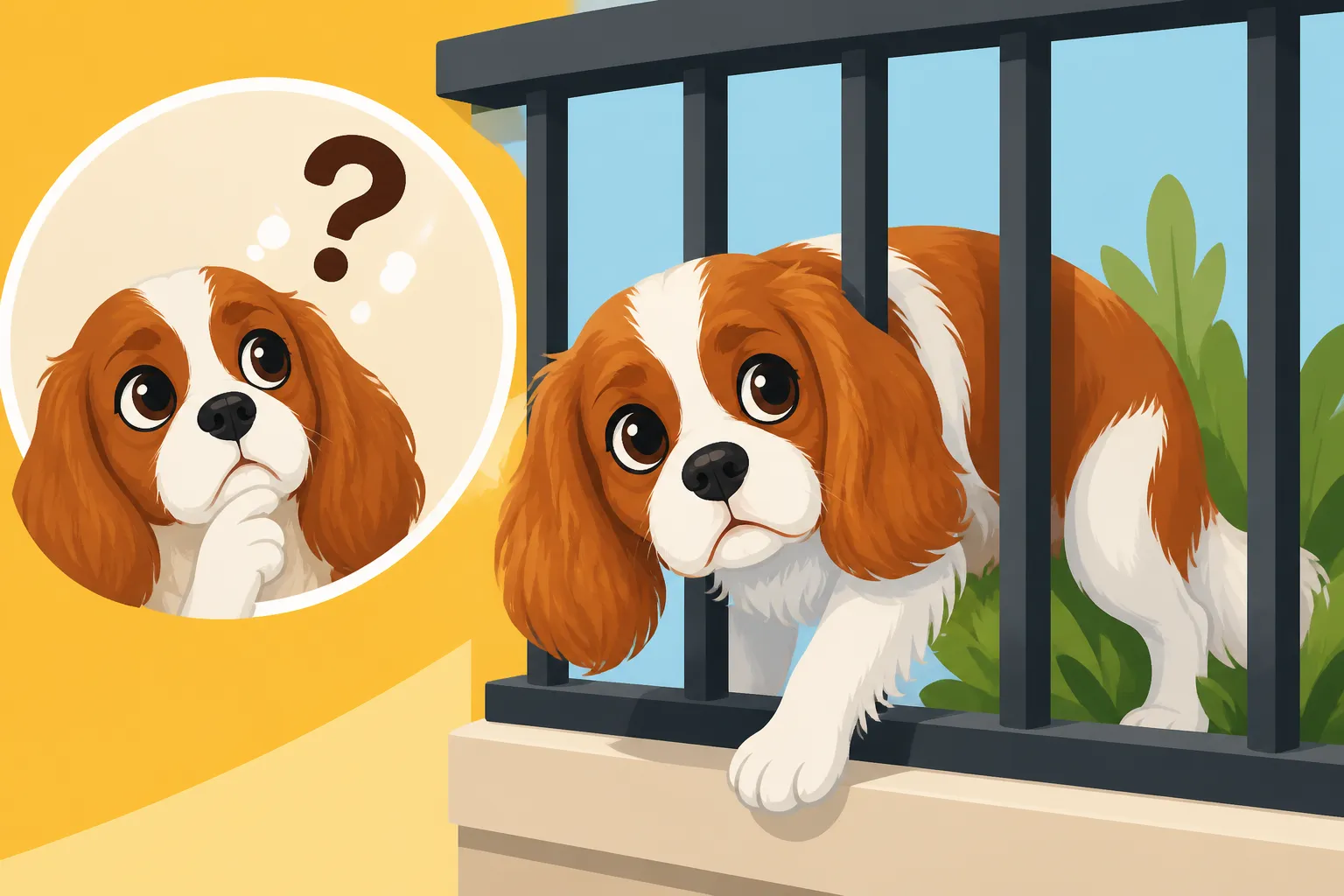
Whether a Cavalier Squeezes Through Railings
It’s a heart-stopping moment many Cavalier owners dread: you turn your back for a second, and your little shadow has suddenly vanished from the yard, potentially squeezing through a gap you thought was perfectly secure. These sweet, often-clingy dogs might seem too small to be escape artists, but their compact size and curious nature can make them surprisingly adept at finding their way out of seemingly small spaces. This guide is all about understanding why your Cavalier might try to squeeze through railings and fences, identifying those sneaky escape routes, and, most importantly, how to keep your beloved companion safely contained.
The Cavalier's Compact Size and Their Houdini Tendencies
Cavalier King Charles Spaniels are undeniably charming, known for their affectionate personalities and desire to be close to their humans. However, don't let their cuddly demeanor fool you; they possess a surprising athleticism and a curious spirit that can lead them on adventures right out of your yard if you're not careful.
Understanding the Cavalier's Build
While not as diminutive as, say, a Chihuahua, Cavaliers are still a small breed, typically weighing between 13 to 18 pounds and standing 12 to 13 inches tall at the shoulder. What's crucial to understand about their physique, especially concerning fences and railings, is their flexibility and compact bone structure. They are small but not fragile. Their bodies are quite agile, capable of twisting, turning, and, yes, flattening themselves remarkably well when motivated.
Imagine a scene: you're out in the garden with your Cavalier, perhaps watering plants or tending to flowers. Suddenly, a squirrel darts across the neighbor's yard, disappearing under a gap in the fence. Your Cavalier, with that inherent spaniel instinct still very much alive, sees this as an irresistible invitation to chase. Before you can react, they've wiggled their head through what looked like a barely-there gap, and because their head went, their shoulders often follow, and then the rest of their body. It's truly astonishing how small a space they can navigate if something exciting is on the other side. This blend of small stature and innate curiosity makes them little escape artists in waiting.
Why Cavaliers Might Try to Escape
It's natural to assume your "Velcro dog" would never want to leave your side, but even the most devoted Cavalier can be spurred to escape. Their motivations are varied and often rooted in their natural instincts or emotional needs.
One primary driver is pure, unadulterated curiosity. Cavaliers are intelligent and inquisitive; a new smell, a rustling leaf, or the sight of a bird can trigger an exploratory impulse. They want to know what's on the other side, and if there's a perceived weakness in your barrier, they'll investigate. Another significant factor is their prey drive. While they are companion dogs, they are still spaniels. That instinct to chase small animals like squirrels, rabbits, or even just interesting insects is very strong. A brief, exciting chase is often all it takes for them to attempt a squeeze-through. You might find it helpful to read about The Bird Chase a Cavalier Cannot Resist to understand this instinct better.
Beyond instinct, emotional factors play a huge role. Many Cavaliers are prone to separation anxiety, often described as "Velcro dogs" for a reason. If they perceive you leaving or if they feel anxious when left alone in the yard, they might desperately try to follow you. This desire to reunite can give them the determination to push through incredibly tight spots. If your Cavalier tends to follow you from room to room inside the house, you can bet that same drive extends to the great outdoors. Why a Cavalier Follows You Room to Room delves into this common Cavalier trait. They aren't trying to run away from you; often, they're trying to run to you.
Assessing Your Fencing and Railings for Cavalier Safety
You might think your yard is perfectly secure, but a Cavalier has a unique way of seeing the world – specifically, they're looking for avenues of adventure or escape that might be invisible to the human eye. Performing a thorough "Cavalier-level" inspection is key to preventing any unwelcome excursions.
Identifying Potential Escape Routes
When assessing your outdoor space, you need to think like a small, curious dog. The most obvious culprits are gaps between fence pickets or posts. Standard wooden fences often have spaces that, while fine for a larger dog, are an open invitation for a Cavalier. Measure these gaps, especially at the bottom where the ground might be uneven, creating a larger opening. Horizontal railings, common on decks or balconies, also pose a risk. A Cavalier can easily wriggle between the slats, especially if the distance is more than a few inches.
Don't forget the bottom edge of your fence line. Over time, fences can shift, or the ground can erode, creating small tunnels or larger gaps directly beneath the fence itself. Even a seemingly minor gap, where you can see light coming through, is a red flag. Gates are another critical point. Look at the gap between the gate and the fence post, as well as the space underneath the gate. If it's elevated even slightly, a determined Cavalier can flatten themselves and slide under. Older gates can also sag, widening existing gaps. Remember, their soft coats and flexible bodies can compress more than you'd expect, allowing them to squeeze through surprisingly narrow openings.
The "Head First" Rule and Other Indicators
A good rule of thumb that many experienced dog owners and trainers use is the "head first" principle: if your dog's head can fit through a gap, the rest of their body can likely follow. Cavaliers have relatively small, well-proportioned heads for their body size, making this rule particularly pertinent. If you can fit your fist comfortably through a gap, your Cavalier probably can too.
Beyond just the head, consider the overall "flex" of your fencing. A weak section of chain-link, a loose picket, or a wobbly gate might not look like an escape route at first glance. However, a Cavalier can push against these weak points, gradually widening the opening over time. If they dig, even a solid fence can be compromised. Observe your Cavalier's behavior in the yard. Do they patrol the fence line? Do they sniff intensely at certain spots? These behaviors might indicate they've already identified potential weaknesses. It’s also important to remember that puppies are particularly adept at finding small gaps that adult dogs might not even bother with. Their small size combined with boundless energy and lack of experience means they explore everything.
Practical Solutions for Securing Your Yard and Home
Once you've identified potential escape routes, it's time to take action. Thankfully, there are many effective and often simple solutions to fortify your perimeter and ensure your Cavalier stays safely within bounds.
Reinforcing Existing Fences and Gates
The most common and effective way to secure a yard for a small dog like a Cavalier is to add a secondary layer of protection to your existing fence. Hardware cloth or welded wire mesh are excellent choices. They come in rolls and can be attached to the inside of your fence, covering gaps between pickets or along the bottom. Look for mesh with openings of no more than 1×2 inches or even 1×1 inch. This is typically too small for even a determined Cavalier to squeeze through. You can often find these materials at your local hardware store or easily order them from online retailers like Amazon.
For gaps at the very bottom of the fence, where the ground might be uneven, you can bury a section of wire mesh several inches deep to prevent digging, or lay landscape timbers or heavy stones along the base. This also helps close off any crawl-under spots. Don't forget your gates! Ensure they fit snugly within the frame, with minimal gaps around the edges and underneath. Replace any loose latches with more secure, spring-loaded ones or add a barrel bolt for extra security. Double-check hinges to make sure they aren't sagging, which can create new gaps. Sometimes, simply adding a piece of plexiglass cut to size can close a tricky gap in a gate without compromising its appearance.
Indoor Railings and Balconies
While we often focus on the yard, indoor railings, especially on multi-story homes or open balconies, can pose a significant risk, not just for escape but also for accidental falls. A curious Cavalier can easily slip through vertical balusters or climb over low railings.
For interior stairs or landings, baby gates are your best friend. Choose gates that are tall enough and have vertical bars close enough together that your Cavalier can't push through or jump over. These can also be invaluable if you need to temporarily restrict your Cavalier to a safe area. For balconies or open stairways with wider gaps, you might consider attaching clear plexiglass panels or sturdy mesh to the inside of the railing. This provides a physical barrier without significantly altering the aesthetic. Think of it as creating an invisible wall. For a puppy, or a particularly adventurous adult, using an exercise pen or a puppy playpen can provide a secure, temporary solution within the house, especially when you need to step away for a moment. This offers a secure space without needing to fully baby-proof every single room. You can learn more about suitable indoor confinement options in Pens Instead of Crates for a Cavalier.
Training and Supervision as a Last Line of Defense
Even with the most secure fencing, human vigilance and good training remain crucial components of your Cavalier's safety. No physical barrier is entirely foolproof if not regularly checked or if a dog is left unsupervised for extended periods.
Always supervise your Cavalier when they are in the yard, especially if your fencing isn't absolutely impenetrable. This means actively watching them, not just letting them out and forgetting about them. Regular checks of your fence line are also important; wood can rot, wires can loosen, and storms can create new vulnerabilities. Basic obedience commands, particularly a strong recall, are invaluable. If your Cavalier does manage to find a way out, having a reliable "come" command could be the difference between a quick retrieval and a frantic search. Practicing recall in various environments, including your yard, is essential. You might want to brush up on Cavalier Recall and Its Limits to understand how to best work on this with your dog.
Positive reinforcement training, like the methods taught by programs such as BAXTER & Bella, can significantly improve your Cavalier's responsiveness and build a strong bond that encourages them to stay close. Teach them boundaries, not just physically but also verbally. For instance, if you have a spot in the fence that you're working on, actively distract them from it with a toy or treat whenever they show interest. For those moments when you simply can't supervise or your yard isn't fully secure, consider using a long line. This allows your Cavalier some freedom to explore while remaining physically attached to you, ensuring they can't make a dash for it. Long Line Practice for a Cavalier offers great tips on how to use this safely and effectively.
Comparison of Fence Reinforcement Methods
To help you decide which method might be best for your specific situation, here's a quick comparison of popular fence reinforcement options for Cavaliers:
| Method | Pros | Cons | Best Use for Cavaliers |
|---|---|---|---|
| Hardware Cloth/Mesh | Very effective for small gaps; durable | Can be time-consuming to install; may alter aesthetics | Closing gaps between pickets, under gates, or along fence bottoms |
| Burying Wire/Timbers | Prevents digging escapes; creates a solid base | Requires digging; can be labor-intensive | Stopping diggers, uneven ground at fence base |
| Plexiglass Panels | Aesthetically pleasing; clear visibility | More expensive; requires precise cutting; can scratch | Balcony railings, interior stair gaps, ornamental fences |
| Child Safety Gates | Easy to install (pressure mounted); portable | Not suitable for all openings (e.g., very wide); can be jumped | Interior doorways, temporary blockage of stairways |
| Landscape Rock/Brick | Natural look; deters digging | Can create uneven surfaces; may not stop determined diggers | Along fence lines with minor gaps, decorative barrier |
Remember, the goal is to create a secure environment where your Cavalier can enjoy the outdoors without you constantly worrying about a great escape. It takes a little effort, but the peace of mind is absolutely worth it.
Ultimately, while Cavaliers are small and generally well-behaved, their innate curiosity and the deep bond they form with their owners can make them surprisingly determined when it comes to exploring beyond the garden gate or attempting to follow their favorite human. By carefully inspecting your property, implementing practical reinforcements like mesh wiring or secure gate latches, and continuing with consistent training and supervision, you can create a safe haven for your Cavalier. Don't underestimate their ability to squeeze through railings or navigate gaps; instead, be proactive and make sure every potential escape route is firmly closed.
Disclaimer
This article is for general informational purposes only and does not constitute professional advice. Laws, prices and regulations vary by location and change over time. Consult a qualified professional for guidance on your specific situation.