Why a Cavalier Announces Everyone Who Walks Past
If you share your home with a Cavalier King Charles Spaniel, you've likely experienced the enthusiastic, sometimes incessant, "announcements" they make every time someone dares to walk past your window or door. It's truly a common frustration, leaving many owners feeling helpless or embarrassed by the constant commotion. This comprehensive guide is here to shed light on why your sweet-faced Cavalier feels the need to alert you to every squirrel, pedestrian, or delivery driver, and more importantly, how you can gently and effectively manage this behavior to restore some peace to your household.
Understanding the Cavalier's Instinctual Bark
It's easy to dismiss your Cavalier's barking as mere naughtiness or a desire for attention, but often, there's a deeper, more instinctual reason at play. While they might be the ultimate lapdog, Cavaliers still carry echoes of their spaniel heritage, which includes an innate awareness of their surroundings. They're not just cute faces; they're sensitive, intelligent little dogs who take their perceived roles very seriously.
The "Velcro Dog" Paradox: Loyal but Alert
Cavaliers are famously known as "Velcro dogs" because of their intense desire to be close to their human companions. This deep attachment is one of their most endearing qualities, making them wonderful, loving pets. However, this profound bond can also manifest in ways that are less convenient, such as their tendency to announce every passerby. Because they are so devoted and so keenly aware of your presence and safety, they often see themselves as your tiny, vigilant guardians. They believe they are helping by alerting you to potential "threats" or changes in their environment, even if that threat is just Mrs. Henderson walking her poodle down the street. It’s a paradox: their loyalty makes them clingy, and that same loyalty drives them to be incredibly alert on your behalf. Why Cavaliers Are Called Velcro Dogs goes into more detail about this intense bond.
Imagine your Cavalier, nestled comfortably on the sofa, seemingly relaxed. Suddenly, a shadow flickers past the window, or they catch a whiff of a new scent. In their mind, this isn't just a shadow or a smell; it's a change in the perimeter, something new that you might not have noticed. Their quick bark is their way of saying, "Hey! Did you see that? Something's out there! I'm on duty!" This behavior, while annoying to us, is a testament to their inherent nature and their bond with you. They genuinely feel they are performing an important service.
Not Just "Being Naughty": Interpreting the Alert Bark
When your Cavalier launches into a barking fit, it's rarely because they're deliberately trying to be disruptive. Instead, it's a form of communication. For a dog, barking can convey a whole spectrum of messages: excitement, fear, loneliness, boredom, or, in this case, an alert. It’s vital for us as their human companions to try and understand the message behind the bark rather than simply labeling it as "bad behavior."
An alert bark, specifically, usually has a distinct tone compared to, say, a playful bark or a demand bark for food. It's often sharper, more insistent, and may be accompanied by a stiff body posture, ears perked forward, and intense focus on the source of the stimulus. If you can learn to differentiate these barks, you might start to see it not as a nuisance, but as your Cavalier's earnest, if overzealous, attempt to communicate with you about their surroundings. It truly takes patience to respond thoughtfully rather than just reacting with frustration, but it's a key step in helping them learn other ways to cope.
How Their Small Size Affects Their Perceived Role
It might seem counterintuitive that a small dog like a Cavalier would take on the role of a guard dog, but their size can actually play a significant psychological role in their barking habits. For many small breeds, a louder, more frequent bark can be a compensatory mechanism. They might perceive themselves as needing to make a bigger impact, or be heard more clearly, to effectively "protect" their territory or their beloved family members.
A Cavalier, despite its sweet demeanor, can have a surprisingly formidable bark when it deems it necessary. Their small stature doesn't diminish their sense of duty; in fact, it might amplify it. They are acutely aware of their vulnerability, and often, this leads to an intensified need to warn off anything they perceive as an intrusion, however minor. This isn't bravery in the face of danger so much as it is a deep-seated instinct to safeguard their home and their people, even if their "weapon" is just a loud noise. They aren't trying to be intimidating, but they are absolutely trying to be heard.
Triggers for Cavalier Announcing Behavior
To effectively manage your Cavalier's barking, you first need to become a detective and identify what exactly triggers their "announcement" system. It's rarely just one thing; often, it's a combination of visual, auditory, and even olfactory cues that kick off their alert behavior. Understanding these specific triggers is the cornerstone of any successful management strategy.
Visual Stimuli: The Window Watcher
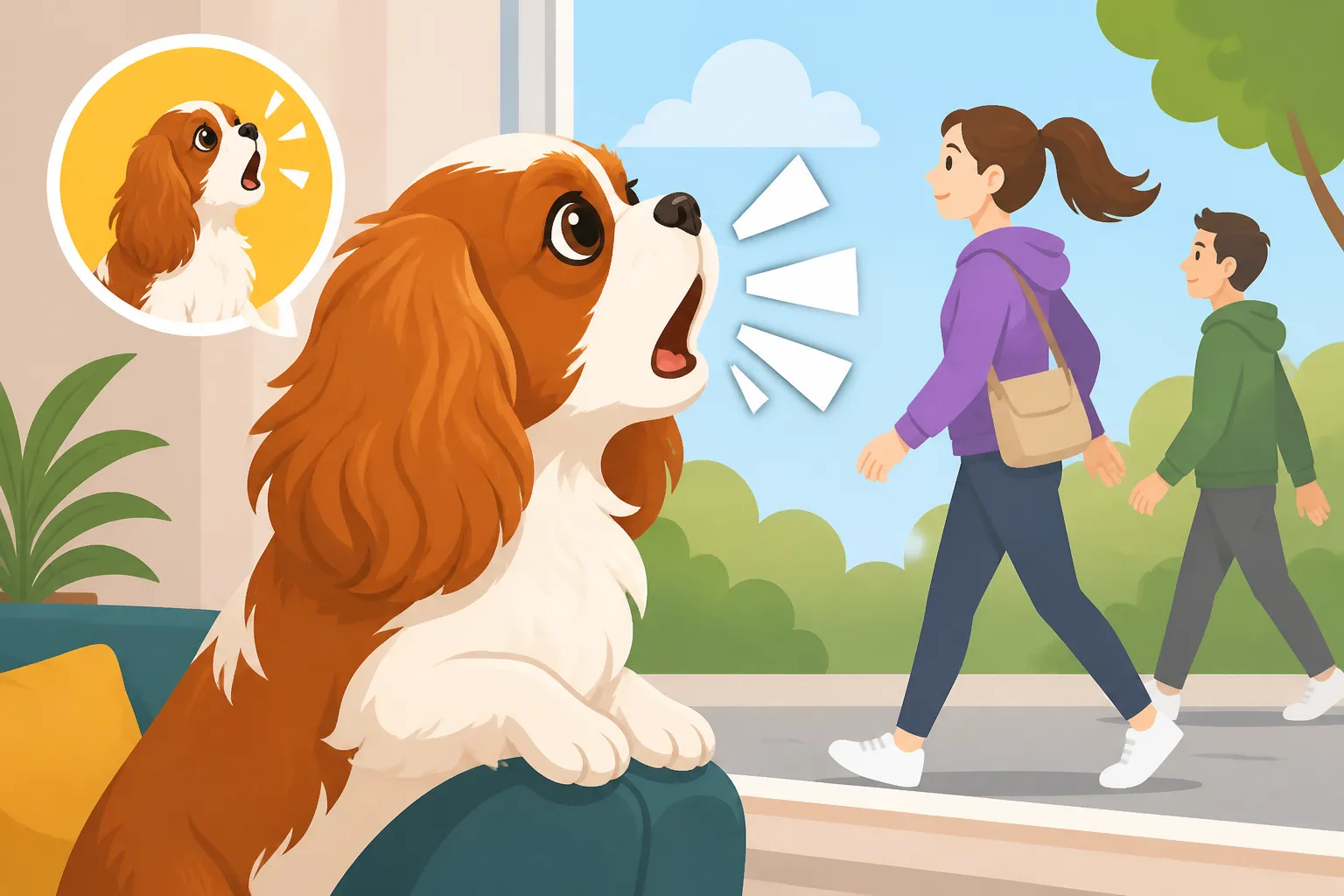
For many Cavaliers, the window is their personal television screen, offering an endless stream of fascinating, and sometimes alarming, visual stimuli. A person walking their dog, a child riding a scooter, a car driving by – each of these can be perceived as an event worthy of a vocal notification. The visual aspect is particularly strong because they can see the "intruder" approaching, giving them time to escalate their alert.
If your Cavalier spends a lot of time gazing out windows, especially front windows facing a busy street, they are constantly bombarded with these visual triggers. The more they practice barking at these sights, the more ingrained the habit becomes. They learn that "person walks by = I bark" and, because the person eventually leaves (unaware they've been "warned off"), the Cavalier feels their barking was successful. This self-reinforcing cycle can be tough to break without proactively managing their view of the outside world.
Auditory Cues: Every Sound is a Signal
Beyond what they can see, Cavaliers have incredibly sensitive hearing, and every little sound can become a trigger. The distant jingle of keys, the creak of a neighbor's gate, the muffled sound of footsteps on the sidewalk, or the distinct crunch of a delivery truck's tires can all set them off. They're often tuned into frequencies and nuances of sound that we humans barely register.
This can be incredibly frustrating because it feels like there's no escape. You might cover the windows, but the sound still penetrates. Your Cavalier might wake from a deep sleep, suddenly alert, because they heard something imperceptible to you. This hypersensitivity to auditory cues means that managing the environment isn't just about what they see, but also about what they hear, and how those sounds are interpreted. A doorbell ringing on TV might even get a reaction, making it clear how generalized this sensitivity can become.
Scent Detection: Picking Up on the Invisible
While less obvious to us, scent plays a massive role in how dogs perceive their world. A Cavalier can pick up on the lingering scent of another dog that walked past hours ago, the distinct smell of a postal worker's uniform, or the faint odor of a cat from across the street. These invisible cues can be just as potent as visual or auditory triggers, prompting an alert bark even when nothing visible or audible seems to be present.
Imagine your Cavalier sniffing at the base of the door, then suddenly barking into the empty hallway. To you, nothing is there. To them, the scent tells a story: "Another dog was here! They passed our territory!" This level of detection makes it challenging to pinpoint the exact trigger, as the source might be long gone, leaving only its olfactory signature behind. This often requires a more holistic approach to managing their reactivity, as you can't block scents as easily as you can block sight or sound.
The Role of Anxiety and Insecurity in Barking
It's tempting to think of barking at passersby as a purely territorial or alert behavior, but for many Cavaliers, there's a significant undercurrent of anxiety or insecurity driving the vocalizations. These aren't necessarily "brave" barks; they can often be rooted in a feeling of vulnerability or a need for reassurance. Understanding this emotional component is crucial for gentle and effective intervention.
Separation Anxiety and General Nervousness
Cavaliers are predisposed to a strong desire for companionship, and for some, this can escalate into genuine separation anxiety. While barking at the window might seem unrelated to being alone, a dog with underlying anxiety may bark excessively at any perceived threat or change, regardless of whether you're home or not, because they're simply more on edge. When you are home, the barking can be an extension of their general nervousness, an attempt to control their environment or seek reassurance from you.
A Cavalier who is generally anxious may be more prone to alert barking because their threshold for what constitutes a "threat" is much lower. A rustling leaf might be enough to trigger a full alert. This isn't just about the external trigger; it's about their internal state. If your Cavalier also shows signs of distress when you leave – like destructive chewing, howling, or house soiling – their window barking might be part of a broader anxiety picture. Addressing the core anxiety can often significantly reduce the alert barking. Resources like Building a Cavalier's Tolerance for Being Left can offer valuable insights.
Fear-Based Reactions to Novelty
Sometimes, the incessant barking isn't about being territorial, but actually about fear. Novel sights, sounds, or smells can be genuinely frightening for a sensitive Cavalier, especially if they weren't properly socialized as a puppy. A large hat, a person on a bicycle, or a new type of vehicle might appear menacing to them, and barking becomes their way of trying to make the scary thing go away.
This fear-based barking can be tricky because it looks similar to alert barking, but the underlying motivation is different. Instead of warning you, they might be trying to warn off the perceived threat, or even expressing their own distress. You might notice their tail tucked, a stiff body, or even backing away while barking. Understanding this distinction is important because the training approach for fear is different from that for simple alert behavior. It requires building confidence and creating positive associations, rather than just teaching them to be quiet.
Lack of Early Socialization
The foundation of a well-adjusted dog lies in early and appropriate socialization. If a Cavalier puppy isn't exposed to a wide variety of sights, sounds, people, and other dogs in a positive way during their critical developmental window (roughly 3-16 weeks), they can grow up to be insecure or fearful of the unfamiliar. This lack of exposure can directly contribute to excessive alert barking later in life.
A Cavalier who didn't learn that strangers, strange noises, and general outdoor activity are usually benign might view every new stimulus as a potential danger. They haven't built up a robust "data bank" of positive experiences, so their default reaction is caution and vocalization. It’s not their fault; it's a consequence of missed opportunities during a crucial learning period. If you have an adult Cavalier with a history of limited socialization, it's never too late to begin, but it requires even more patience and careful, gradual introductions to new experiences. Socializing a Cavalier Puppy Gently offers excellent guidance on setting your puppy up for success.
Managing the Environment to Reduce Triggers
Before you even start thinking about training, the most immediate and often most effective step is to manage your Cavalier's environment. If you can reduce their exposure to the triggers that cause them to bark, you automatically decrease the opportunities for the barking behavior to occur and become ingrained. It's about setting them up for success, not expecting them to magically ignore everything.
Window and Door Management Strategies
Since visual triggers are so powerful, managing access to windows and doors is paramount. This can range from simple solutions to more robust setups. Consider using privacy window film, which allows light in but obscures the view out, or keeping blinds and curtains closed during peak "traffic" times outside. For especially persistent window watchers, strategically placed furniture can block their access point, or you might use baby gates to restrict them to areas of the house with fewer outward-facing windows.
Another effective strategy is to create a "safe zone" for your Cavalier in a quieter part of the house, away from the constant parade of people and dogs. This might be a cozy corner with their bed and toys, or even a crate in a den where they feel secure. The goal is not to punish them, but to remove the temptation and give them a chance to relax without feeling the constant need to be on alert. Many effective products for this, from durable pet gates to window films, are readily available on platforms like Amazon.
Sound Masking Techniques
Just as visual triggers can be managed, so can auditory ones. If your Cavalier is reactive to every distant sound, consider using sound masking techniques. Playing classical music, white noise, or even talk radio can help muffle outside noises, making them less distinct and less likely to grab your Cavalier's attention. The key is to introduce these sounds calmly and consistently, so they become part of the background, not something new to react to.
Think about a subtle fan running in the background, or a white noise machine placed near the door or window. The aim isn't to completely silence the world (which is often impossible), but to create a less jarring soundscape. By blurring the edges of distinct noises, you can reduce the number of times your Cavalier perks up and decides to issue an alert. This technique works best when combined with visual management, creating a more holistic barrier against external triggers.
Creating a Safe, Quiet Space
Every Cavalier, especially one prone to anxiety or over-stimulation, benefits immensely from having a designated safe and quiet space. This isn't a place for punishment, but a sanctuary where they can retreat and feel secure. This could be a comfortable crate with a soft bed and a blanket draped over it to create a den-like feel, or a specific room in the house that is generally peaceful and low-traffic.
This dedicated space should be introduced positively, with treats and praise, making it a desirable spot for your Cavalier to rest. It gives them an option to opt-out of the constant vigilance that might be stressing them out. When they are in their safe space, they are less likely to bark at passersby because they feel protected and their direct view or hearing of the outside world is minimized. Providing engaging chew toys or a puzzle feeder in this space can also help them settle and associate it with positive, calming activities.
Training Approaches to Modify Barking Behavior
Once you've managed the environment to reduce triggers, the next crucial step is to engage in consistent, positive reinforcement training. The goal isn't to silence your Cavalier completely, but to teach them more appropriate ways to react to external stimuli and to provide you with a tool to manage their vocalizations.
Positive Reinforcement for Quiet Behavior
The most effective way to change unwanted behavior in Cavaliers is through positive reinforcement. This means rewarding the behavior you want to see, rather than punishing the barking you don't. When your Cavalier barks, avoid shouting or scolding, as this can often be misinterpreted as you joining in the "barking party" or simply increase their anxiety. Instead, focus on rewarding moments of quiet.
Start by noticing when your Cavalier doesn't bark at a trigger. Perhaps they glance at the window, notice someone, and then turn away or simply don't make a sound. In that exact moment, quietly reward them with a high-value treat and calm praise. The timing is crucial: the reward must happen during or immediately after the quiet behavior. Over time, your Cavalier will start to associate quiet observation with positive outcomes, learning that being calm pays off much more than barking. Reward-Based Training With a Cavalier explores these principles in depth.
Teaching a "Quiet" Cue
Teaching a "quiet" cue is a game-changer for managing alert barking. This cue helps you interrupt the barking and direct your Cavalier to a more desirable behavior. Here’s a basic way to train it:
- Trigger the Bark: Have someone walk by the window, or make a slight noise that you know usually gets a reaction from your Cavalier.
- Let Them Bark Once or Twice: Allow them to bark a couple of times to get it out of their system.
- Introduce a High-Value Treat: Hold a really enticing treat (like cheese or cooked chicken) right in front of their nose. Most dogs will stop barking to sniff the treat.
- Mark and Reward Quiet: The instant they are quiet, even for a second, say "Quiet!" (or your chosen cue word) and immediately give them the treat.
- Repeat and Fade: Practice this many, many times in various scenarios. Gradually increase the duration of quiet time required before the reward. Eventually, you'll be able to say "Quiet!" and they'll cease barking in anticipation of the treat.
This method effectively teaches them to stop barking on command, giving you a powerful tool for intervention. It shifts their focus from the trigger to you, and to the expectation of a reward for their silence. Teaching a Cavalier to Stop Barking on Cue provides a step-by-step guide on mastering this command.
Desensitization and Counter-Conditioning
For Cavaliers whose barking is rooted in fear or over-excitement, desensitization and counter-conditioning are invaluable. Desensitization means gradually exposing your Cavalier to the trigger at a very low intensity, so they don't react. Counter-conditioning means changing their emotional response to the trigger from negative (fear, excitement) to positive.
For example, if your Cavalier barks at people walking past the window, start by having a "fake" person (like a standee) visible from a distance where your Cavalier doesn't bark. As you slowly move the fake person closer over days or weeks, reward your Cavalier with treats and praise for remaining calm. Eventually, you can graduate to a real person, starting far away and gradually decreasing the distance, always rewarding quiet, calm observation. Pairing the sight of a person with high-value treats changes their emotional association from "danger/alarm" to "treats are coming!"
This process takes significant time and patience, but it's incredibly effective at reshaping your Cavalier's underlying emotional response, rather than just suppressing the behavior. Remember to always work below their threshold of reactivity; if they start barking, you've gone too far, too fast, and need to dial it back.
Enlisting Professional Help
Sometimes, despite your best efforts, your Cavalier's barking might be too deeply ingrained or driven by complex anxieties that are difficult to manage on your own. This is where professional help becomes invaluable. A certified professional dog trainer or a veterinary behaviorist can assess your Cavalier's specific situation, identify underlying causes, and develop a customized training plan.
They can offer personalized guidance on desensitization protocols, help you fine-tune your timing with rewards, and introduce advanced techniques you might not be aware of. Online platforms such as BAXTER & Bella offer comprehensive dog training programs, including resources for common behavior challenges like excessive barking, and can be an excellent starting point for structured learning and expert support. They provide guidance from puppyhood right through to adult behavioral issues, often with accessible formats that fit into busy schedules.
Tools and Resources to Aid in Training
Training a Cavalier to reduce their alert barking isn't just about techniques; it also involves utilizing the right tools and resources to support your efforts. These aids can help manage the environment, provide mental stimulation, and offer additional learning opportunities.
Management Tools: Gates, Crates, and Blinds
Effective environmental management is your first line of defense. Physical barriers can be incredibly helpful in preventing your Cavalier from practicing the unwanted behavior.
- Baby Gates: These are fantastic for restricting access to high-traffic window areas or doorways, keeping your Cavalier in a quieter part of the house without isolating them completely. You can find a wide variety of sizes and styles on Amazon, from pressure-mounted gates to hardware-mounted options for more permanent solutions.
- Crates: A comfortable, positively-introduced crate can serve as that designated safe space mentioned earlier. When your Cavalier is crated in a quiet room, they can't see or hear every external stimulus, significantly reducing their barking opportunities.
- Window Coverings: As discussed, privacy film, blinds, or even simple opaque curtains can block visual triggers. Consider applying static cling window film to the lower panes of windows that face busy areas, giving your Cavalier privacy while still allowing natural light into the room.
The key is to use these tools not as punishment, but as aids to create a controlled environment where your Cavalier feels secure and has fewer reasons to bark.
Interactive Toys and Mental Stimulation
A bored Cavalier is often a noisy Cavalier. Mental stimulation is just as important as physical exercise for tiring out your dog and redirecting their energy. When your Cavalier is mentally engaged, they are less likely to be scanning the environment for things to bark at.
- Puzzle Feeders: Toys that dispense food as your Cavalier manipulates them can keep their brains active for extended periods. Instead of feeding meals in a bowl, try using a slow feeder or a puzzle toy that requires them to work for their food. This satisfies their natural foraging instincts and can significantly reduce boredom.
- Chew Toys: Providing appropriate, long-lasting chew toys can also help relieve stress and keep your Cavalier occupied. Look for toys specifically designed for strong chewers, if applicable, to ensure they last and are safe.
- Scent Games: Hide-and-seek with treats or toys uses your Cavalier's keen sense of smell, providing excellent mental enrichment without relying on external triggers. Start simply by hiding treats in plain sight and gradually increase the difficulty.
Incorporating these types of activities daily can make a big difference in reducing overall anxiety and the compulsive need to bark at every passerby.
Online Courses and Expert Guidance
Learning how to effectively train your Cavalier takes knowledge and skill, and you don't have to go it alone. Online resources and expert guidance can provide structured learning and support.
- Online Training Programs: Many reputable online dog training platforms offer courses specifically designed to address nuisance barking, reactivity, and general obedience. These programs often include video tutorials, written guides, and sometimes even access to trainers for personalized questions. BAXTER & Bella is a prime example of an online resource that offers comprehensive puppy and adult dog training, which can be invaluable for tackling behavioral issues like alert barking with expert support and guidance from the comfort of your home.
- Behavioral Consultations: For more severe or persistent barking, a virtual consultation with a certified professional dog trainer or veterinary behaviorist can provide tailored advice. They can review videos of your Cavalier's behavior and help you create a highly specific intervention plan.
- Books and Articles: Educate yourself on canine body language, learning theory, and breed-specific traits. The more you understand why your Cavalier behaves a certain way, the better equipped you'll be to address it effectively and empathetically.
Addressing Underlying Health Concerns
While barking at passersby is often a behavioral issue, it's always crucial to rule out any underlying health problems that might be contributing to, or exacerbating, your Cavalier's reactivity. Pain, discomfort, or sensory changes can significantly alter a dog's temperament and increase their vocalizations.
Pain as a Driver for Reactive Barking
Dogs, including Cavaliers, are masters at hiding pain. However, chronic discomfort can make them more irritable, anxious, and reactive to their environment. A Cavalier suffering from an undiagnosed condition might bark more because they are constantly on edge, or because a sudden movement or loud noise startles them more acutely due to their pain.
Conditions common in Cavaliers, such as Syringomyelia and Chiari Malformation in Cavaliers or Cavalier Knees, Hips and Joint Problems, can cause chronic pain, particularly in the neck and back. If your Cavalier yelps when picked up, shows reluctance to jump, or has any new behavioral changes alongside increased barking, a vet visit is essential. A Cavalier That Yelps When Picked Up highlights the importance of investigating pain as a cause of such reactions. Addressing the pain with appropriate veterinary care can often lead to a dramatic improvement in their general demeanor and a reduction in reactive barking.
Hearing or Vision Changes in Older Cavaliers
As Cavaliers age, they can experience changes in their sensory perception, particularly hearing and vision. A dog with declining eyesight might be more easily startled by sudden movements or shadows they can't quite make out, leading to reactive barking. Similarly, hearing loss can make a Cavalier more anxious because they can't fully process sounds, or they might bark more loudly because they can't hear their own volume.
If your older Cavalier suddenly starts barking more at things they used to ignore, or seems more jumpy, it's worth a trip to the vet to check their eyes and ears. Conditions like Cavalier Cataracts and Retinal Disease or age-related hearing loss are common. Even if the sensory loss can't be reversed, understanding it allows you to adapt your environment and communication style to help your Cavalier feel more secure, which in turn can reduce their need to bark constantly. For example, using hand signals alongside verbal cues can be very helpful for a dog with hearing loss.
Consistency and Patience: The Keys to Success
When it comes to modifying ingrained behaviors like alert barking in your Cavalier, there's no magic wand or quick fix. The journey requires immense consistency, unwavering patience, and a unified approach from everyone in the household. Without these foundational elements, progress will be slow, inconsistent, or non-existent.
Involving the Whole Household
For any training to be truly effective, every person who interacts with your Cavalier needs to be on the same page. If one family member is diligently implementing the "quiet" cue and rewarding calm behavior, but another is inadvertently reinforcing barking by shouting or giving attention every time the dog barks, you're sending mixed signals. This confusion will only prolong the behavior and make it harder for your Cavalier to understand what's expected of them.
Hold a family meeting to discuss the training plan. Ensure everyone understands the chosen cues, the reward system, and the importance of ignoring unwanted barking while proactively rewarding quiet moments. Consistency extends beyond direct training sessions; it includes how everyone manages environmental triggers, provides mental stimulation, and interacts with your Cavalier throughout the day. A unified front is critical for your Cavalier to learn and generalize new behaviors effectively.
Realistic Expectations and Long-Term Goals
It's natural to want immediate results, especially when dealing with something as annoying as constant barking. However, it's vital to set realistic expectations. Your Cavalier has likely been practicing this barking behavior for months or even years, and it's a deeply ingrained habit. Unlearning it will take time, dedication, and sometimes, several steps backward before moving forward.
Focus on small victories. Perhaps today, your Cavalier barked for only 30 seconds instead of two minutes, or they glanced at a passerby but didn't bark at all. Celebrate these incremental improvements. Your long-term goal should be to teach your Cavalier to observe the world calmly, perhaps with one initial alert bark, rather than a continuous barrage. It's about shifting their default response from automatic vocalization to thoughtful observation, which is a significant change that won't happen overnight. Remember, you're building a new habit, and habits take time to form and solidify.
| Trigger Type | Common Examples | Management Strategy | Training Approach |
|---|---|---|---|
| Visual | People, dogs, cars, delivery trucks | Close blinds, use window film, block access | Desensitization, "Look at That" game, reward quiet |
| Auditory | Doorbell, footsteps, distant voices, sirens | White noise machine, music, fan, doorbell desensitization | "Quiet" cue, reward focus on handler |
| Olfactory | Scent of other animals/people | Clean entryways, use air purifiers, increase mental stimulation | Scent games to redirect focus, reward calm behavior |
| Anxiety/Fear | Loud noises, unfamiliar objects, being alone | Create safe space, consistent routine, increase enrichment | Counter-conditioning, confidence building, professional help |
Disclaimer
This article is for general informational purposes only and does not constitute professional advice. Laws, prices and regulations vary by location and change over time. Consult a qualified professional for guidance on your specific situation.