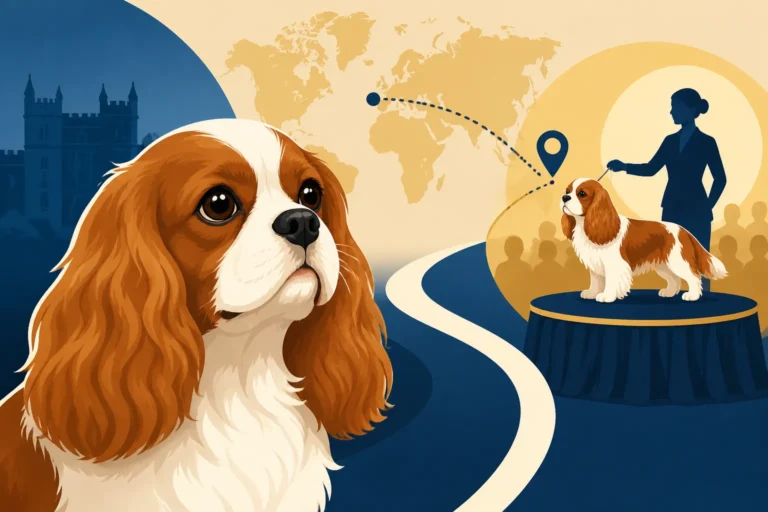
Whole Colors Against Particolors in Cavaliers
It’s perfectly natural to be captivated by a Cavalier King Charles Spaniel's stunning coat. You might find yourself scrolling through endless photos, wondering about the different patterns and colors, or perhaps even feeling a little lost trying to understand what "Blenheim" or "Tricolor" really means. This guide will walk you through the distinct classifications of Cavalier coat colors – particularly the difference between whole colors and particolors – so you can appreciate the unique beauty of each and understand what the breed standard truly values.
Understanding Cavalier Color Classifications: Whole vs. Particolor Basics
When you first dive into the world of Cavalier King Charles Spaniels, the sheer variety of their coats can be a little overwhelming. You'll hear terms like "Blenheim," "Ruby," "Tricolor," and "Black and Tan," and it's easy to wonder what defines each one. Fundamentally, all recognized Cavalier colors fall into one of two main categories: "whole colors" or "particolors." This distinction isn't just a fancy way of describing patterns; it's a core part of the breed standard that differentiates the solid-coated Cavaliers from those with patches of color.
What Defines a "Whole Color" Cavalier?
A whole color Cavalier, as the name suggests, has a coat that is predominantly one solid color. There might be a tiny splash of white, usually on the chest, but it should be minimal and ideally, not present at all according to the strictest interpretations of the breed standard. These dogs present a striking, uniform appearance that highlights the rich depth of their primary hue. Think of it like a beautifully painted canvas, where one dominant shade takes center stage, allowing its vibrancy to truly shine.
The whole color designation means that the dog's coat is genetically predisposed to a single, un-patterned color distribution. While slight variations in shade might occur from puppyhood to adulthood, the overall impression is one of solid, unbroken color. This uniform coat type truly showcases the silkiness and luxurious texture that Cavaliers are so well known for, making them appear incredibly elegant and refined.
What Defines a "Particolor" Cavalier?
Particolor Cavaliers, on the other hand, are characterized by distinct patches of color on a white background. These dogs are typically white with clear, well-defined markings in specific colors. The contrast between the crisp white and the rich colored patches is what makes particolors so visually appealing and unique. You won't find a particolor Cavalier that is mostly one color with just a little white; instead, the white is an integral part of their overall pattern.
The markings on a particolor Cavalier should be evenly distributed and clearly broken, rather than having a "ticked" or "roaned" appearance where the white areas have flecks of color. This clear delineation of color and white creates a charming, often playful, aesthetic. It's like having a living piece of art, where nature has painted beautiful, distinct designs across their soft fur.
A Quick Visual Guide to the Four Recognized Colors
To help you visualize the differences, here's a breakdown of the four colors recognized by the American Kennel Club (AKC) and other major kennel clubs, categorized by their classification. This table will quickly show you which color belongs to which group and give you a brief description of what to expect.
| Color Name | Classification | Description |
|---|---|---|
| Blenheim | Particolor | Rich chestnut (reddish-brown) markings on a pearly white ground. The markings should be evenly broken up on the head, with a unique "lozenge" or "Duchess thumb print" spot often appearing between the ears. |
| Tricolor | Particolor | Black markings on a pearly white ground, with tan (or "rich mahogany") markings over the eyes, on the cheeks, inside the ears, and on the underside of the tail. This combination creates a striking, multi-faceted appearance. |
| Ruby | Whole Color | Entirely rich red. No white markings are desired, though a very small white patch on the chest is sometimes seen and considered a minor fault. The color should be deep and uniform throughout. |
| Black and Tan | Whole Color | Raven black with rich, bright tan markings over the eyes, on the cheeks, inside the ears, on the chest, legs, and underside of the tail. Similar to the Tricolor, but without the white background. |
As you can see, understanding these basic classifications is your first step to truly appreciating the diverse coats of these beloved dogs. Each color, whether whole or parti, contributes to the Cavalier's undeniable charm. You can read more about The Four Cavalier Colors and What They Are Called.
The Beauty of Whole Color Cavaliers: Ruby and Black & Tan
There’s something undeniably elegant about a Cavalier with a solid, unbroken coat. The way the light catches their silky fur, highlighting a singular, rich hue, is truly stunning. These "whole color" Cavaliers – the Rubies and the Black & Tans – stand out with their distinct, unified appearances that truly embody the breed's regal heritage. They carry themselves with an air of classic beauty, and their coats often feel incredibly soft and luxurious to the touch.
For owners, a whole color Cavalier offers a specific kind of visual appeal, often drawing admiration for their deep, consistent pigmentation. While the focus in the show ring is on the uniformity and richness of these colors, in a family home, it’s simply another aspect of your cherished companion's unique charm.
The Rich Hue of the Ruby Cavalier
The Ruby Cavalier is a magnificent sight, boasting a coat that is a solid, rich, mahogany red. When you see a well-bred Ruby, the depth of color is breathtaking – it's not a faded orange or a light brown, but a vibrant, deep red that commands attention. The ideal Ruby Cavalier should have no white markings at all, although a small patch of white on the chest is sometimes present. While not ideal for the show ring, it doesn’t diminish the dog's beauty or value as a loving pet.
These dogs are like living embers, glowing with warmth and intensity. Their rich coloring often pairs beautifully with their expressive, dark eyes, creating a truly captivating look. Owners often find that the Ruby coat, while stunning, can sometimes show dirt a little more readily than a particolor, making regular grooming and quick wipe-downs a part of their routine. However, the effort is always worth it to maintain that beautiful, lustrous shine. What Makes a Ruby Cavalier a Whole Color provides even more detail on this striking color.
The Striking Contrast of the Black & Tan Cavalier
A Black & Tan Cavalier is a study in elegant contrast. Imagine a sleek, raven-black coat, perfectly accented with sharply defined, rich tan markings. These tan points typically appear above the eyes, on the cheeks, on the inside of the ears, on the chest, on the legs, and under the tail. The ideal is for these tan markings to be bright and distinct, providing a beautiful visual break from the deep black. The overall effect is one of sophistication and timeless beauty, reminiscent of a classic Doberman or Rottweiler, but in a much more compact, cuddly package.
The crispness of the black against the vivid tan is what makes this color so desirable. Any smudged or faded tan, or white markings, would detract from its ideal presentation in the show ring. Outside of competition, a Black & Tan Cavalier is simply a stunning companion. Their unique pattern makes them instantly recognizable, and their silky fur, whether black or tan, remains a joy to stroke. Just like other Cavaliers, their coats do benefit from regular brushing to keep them free of mats, especially in the feathering behind the ears and on the legs. You can learn more about What a Black and Tan Cavalier Looks Like.
The Charm of Particolor Cavaliers: Blenheim and Tricolor
Particolor Cavaliers offer a completely different, yet equally enchanting, visual experience. With their distinct patches of color against a pristine white background, they embody a playful charm and classic appeal that has endeared them to royalty and families for centuries. These dogs often have markings that feel almost hand-painted, each one a unique work of art.
For many, the particolor patterns are what first come to mind when they think of a Cavalier. These patterns are deeply ingrained in the breed's history, and there's a certain romanticism associated with their heritage. Whether it’s the iconic Blenheim spot or the bold statement of a Tricolor, these dogs carry their patterns with grace and undeniable cuteness.
The Classic Blenheim Cavalier and its Signature Markings
The Blenheim is perhaps the most famous and historically significant of all Cavalier colors, named after Blenheim Palace, where the Dukes of Marlborough kept the ancestors of these spaniels. A true Blenheim Cavalier features rich chestnut (a warm reddish-brown) markings on a pearly white ground. The markings should be well-distributed on the body, but it's the head that holds a particularly special feature: the "lozenge." This unique, thumb-sized chestnut spot, located ideally on the top of the head between the ears, is often referred to as the "Duchess thumb print" or "kissing spot." It's not a mandatory trait for the breed standard, but it's highly prized and adds to the romantic lore of the Blenheim.
The overall impression of a Blenheim is one of gentle beauty and sweetness. The contrast between the soft chestnut and pure white is simply captivating. While the lozenge is much sought after, it's important to remember that its absence doesn't make a Blenheim any less beautiful or any less a Cavalier. The key is the clear, distinct patching and the rich color of the chestnut. Regularly checking for mats, especially where the white and chestnut meet in the feathering, helps keep their coat looking pristine. You can delve deeper into the specifics of The Blenheim Cavalier and Its Lozenge.
The Bold Patterns of the Tricolor Cavalier
The Tricolor Cavalier is a striking blend of three distinct colors: black, white, and tan. These dogs have sharply defined black patches on a pearly white background, much like a Blenheim, but with the added elegance of tan markings. These rich tan points are strategically placed, usually appearing over the eyes, on the cheeks, inside the ears, and on the underside of the tail. The combination creates a dynamic and sophisticated look, making the Tricolor instantly recognizable and a favorite for many.
What really sets the Tricolor apart is the interplay of all three colors, with the tan adding warmth and definition to the black and white canvas. The ideal Tricolor will have clearly broken black patches, distinct white areas, and vibrant tan points that aren't muddy or faded. When you look at a Tricolor, it's like observing a miniature masterpiece, with each color complementing the others to create a harmonious and eye-catching design. Keeping their beautiful white coat free from stains, particularly around the muzzle if they tend to drool or get messy eaters, is a common task for owners. Investing in good grooming supplies, which you can easily find on sites like Chewy, can make a big difference in maintaining their stunning appearance. For a more in-depth look, see The Tricolor Cavalier.
Beyond the Standard: Unrecognized Colors and Markings
While the four recognized colors – Blenheim, Tricolor, Ruby, and Black & Tan – are the benchmark for the Cavalier King Charles Spaniel breed, it's not uncommon to encounter dogs with variations or entirely different coat colors. These can be the result of different genetic expressions, or sometimes, they indicate a mixed heritage. While these colors aren't accepted in the show ring, they don't diminish the love, health, or personality of the individual dog. Every Cavalier, regardless of its coat's compliance with the standard, is a cherished companion.
Understanding these variations can help prospective owners know what to expect and recognize that a dog's color isn't the sole determinant of its breed purity or suitability as a pet. It's about being informed and appreciating the dog for who they are, rather than focusing solely on their external appearance.
When a Cavalier's Color Isn't "Standard"
Sometimes, you might come across a Cavalier with colors or markings that fall outside the traditional four. Examples include Cavaliers that are predominantly black with minimal white, or dogs with heavy ticking (small flecks of color within the white patches) that blur the distinct lines characteristic of particolors. You might even hear of "chocolate" or "merle" Cavaliers, though these colors are not found in purebred Cavaliers and are strong indicators of cross-breeding. These non-standard colors typically result from a combination of recessive genes or, in some cases, are introduced through outcrossing with other breeds, either intentionally or accidentally.
For instance, a Blenheim with very dark, almost liver-colored patches, or a Ruby with a significant amount of white that covers more than just a small chest patch, would be considered non-standard. These variations often spark curiosity, but it’s crucial to remember that they are deviations from the recognized breed type. It’s important for breeders to be transparent about the genetic background of their dogs, especially if unusual colors appear in a litter, so prospective owners are fully aware.
The Impact on Show Ring Eligibility (but not on love!)
The primary impact of a non-standard color or marking is on a Cavalier's eligibility for conformation dog shows. According to The AKC Standard for the Cavalier King Charles Spaniel, only the four specific colors are permitted to compete. A dog with an unrecognized color would be disqualified from the show ring, regardless of its other fine qualities or conformation. This strict adherence to color is a way to maintain the breed's distinct aesthetic and historical type.
However, for families and individuals seeking a loving companion, a dog's show ring eligibility is often a non-issue. A Cavalier with a non-standard color is still every bit a Cavalier in terms of temperament, intelligence, and capacity for affection. Their coat color is simply an aesthetic detail that doesn't affect their ability to be a wonderful pet, cuddle on your lap, or play happily in the park. The true measure of a Cavalier's worth is in its loving heart and cheerful disposition, not in the precise shade or pattern of its fur.
Why Color Matters (And Why It Doesn't) to Your Cavalier's Health and Temperament
It's common for prospective owners to have a preferred color for their future Cavalier. Whether you dream of a vibrant Ruby or a classically marked Blenheim, the aesthetic appeal is undeniable. But beyond personal preference and show ring standards, does a Cavalier's coat color actually tell you anything about their health or temperament? This is a question many people ponder, and it's important to separate fact from fiction.
While certain health conditions can sometimes be linked to genes that also influence coat color in some breeds (think of merle patterns in Australian Shepherds and certain health risks), for the Cavalier King Charles Spaniel, the connection is far less direct and, in most cases, non-existent.
Color, Health, and Genetic Considerations
For Cavaliers, there is no established scientific link between any of the four recognized coat colors and specific breed health issues like Mitral Valve Disease in the Cavalier King Charles Spaniel or Syringomyelia and Chiari Malformation in Cavaliers. All Cavaliers, regardless of their color, are susceptible to the same breed-specific health concerns. For example, a Blenheim is no more or less likely to develop heart disease than a Black & Tan. The health of a Cavalier is primarily determined by its genetic lineage, the health testing performed on its parents, and good veterinary care throughout its life, not by the color of its fur.
Reputable breeders prioritize health over color. They focus on breeding healthy dogs from lines with good health clearances, regardless of which of the four colors those dogs carry. When selecting a puppy, it's far more crucial to inquire about the health testing of the parents – specifically heart, eye, and MRI clearances – than to agonize over whether a Ruby is healthier than a Tricolor. Focusing on Reading a Cavalier Puppy's Health Certificates will give you a much better indication of future health than coat color ever will.
Temperament: Is There a Link to Coat Color? (Spoiler: No!)
This is a really fun myth to debunk! Many owners wonder if certain colors have different temperaments. You might hear someone say that Ruby Cavaliers are "spicier" or Blenheims are "calmer." While it makes for interesting conversation, there is no scientific evidence or widespread anecdotal proof to suggest that a Cavalier's coat color dictates its personality or behavior. A Cavalier's temperament is a product of its genetics (from its parents), early socialization, and the environment it grows up in.
All Cavaliers, regardless of their color, are generally known for their affectionate, gentle, and eager-to-please nature. They are famous for being "Velcro dogs" who love to be with their people. Whether you have a playful Tricolor, a serene Blenheim, a spirited Ruby, or a dignified Black & Tan, you're getting a dog with the quintessential Cavalier disposition. Their individual personalities, quirks, and level of energy will vary from dog to dog, just as they do in people, and are not tied to their coat pigment. So, when choosing your furry friend, pick the color that speaks to your heart, knowing that their loving personality will shine through, no matter the hue. Whether Cavalier Color Affects Temperament delves deeper into this fascinating topic.
Disclaimer
This article is for general informational purposes only and does not constitute professional advice. Laws, prices and regulations vary by location and change over time. Consult a qualified professional for guidance on your specific situation.