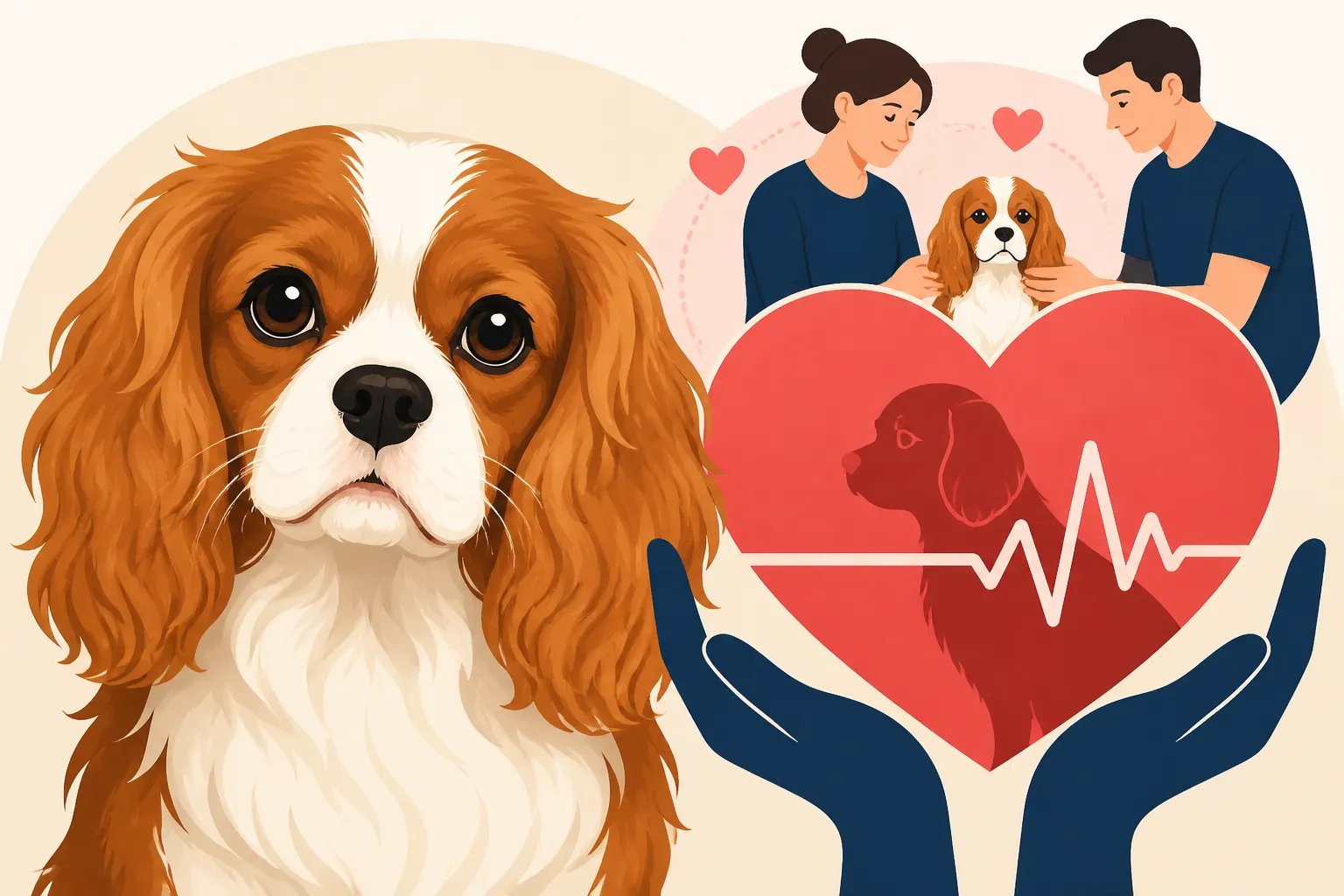
What Breeders Are Doing About Cavalier Hearts
A Cavalier puppy can look perfectly healthy while inheriting a risk that may not become obvious until years later. Mitral valve disease is common in the breed, so responsible breeders focus on reducing risk—not promising a heart-disease-free puppy. This guide explains the screening, breeding choices, and records that can help buyers judge whether a breeder takes Cavalier heart health seriously.
Why Cavalier breeders pay special attention to heart disease
What mitral valve disease means for the breed
Mitral valve disease, often shortened to MVD, is a progressive condition in which the valve between the heart’s left chambers gradually thickens and may begin to leak. A veterinarian may first detect a murmur with a stethoscope. Some dogs remain well for a long time, while others develop heart enlargement or, in advanced cases, congestive heart failure.
The disease is a particular concern in Cavaliers because it is seen frequently in the breed and may appear at a relatively young age. That does not mean every Cavalier will develop serious heart problems, or that a puppy with healthy parents is guaranteed to avoid them. It does mean a breeder’s heart-health decisions deserve careful attention alongside temperament, structure, and other health checks.
A murmur is a finding, not a complete diagnosis. A veterinarian may recommend further assessment to understand whether a murmur is related to valve changes and whether the heart is enlarged. For a closer look at what screening can reveal, see Stethoscope Screening Against a Cavalier Heart Scan and What a Cavalier Echocardiogram Shows.
Why one healthy checkup is not enough
Heart status can change with age. A young breeding dog that has no murmur at one examination may develop one later, so a single early check is not a lifetime clearance. Breeders who take the issue seriously plan repeat examinations and consider the dog’s age and family history, rather than treating one normal result as proof that the risk has disappeared.
It is also important to distinguish an examination from a guarantee. Screening can identify signs that affect a breeding decision, but it cannot predict with certainty how every puppy in a litter will fare. A responsible breeder should be willing to explain that uncertainty plainly. If someone says their puppies “cannot get heart disease,” that is a reason to ask more questions, not a reassuring health claim.
The age when a murmur appears can matter when evaluating a dog’s history, but it should be interpreted with veterinary guidance and in context. The Age a Cavalier Murmur Usually Appears explains why timing is useful information without turning it into a yes-or-no prediction for an individual dog.
What responsible breeders do to reduce risk
They use repeated, qualified heart examinations
A careful breeding program includes regular heart assessments, not just a casual listen during a routine puppy visit. The breeder should be able to say who examined the parent dogs, when the examinations took place, and what the results showed. In some breeding guidance, examinations by a veterinary cardiologist are emphasized; the exact protocol can vary by country, club, and program.
A stethoscope examination and an echocardiogram are not interchangeable. A stethoscope can identify a murmur, while an echocardiogram uses ultrasound to assess the heart’s structure and function. The appropriate assessment depends on the dog and the breeding protocol being followed. A breeder should explain which type of examination was done and why, rather than using the vague phrase “heart tested.”
| Breeder practice | What it can tell you | What it cannot guarantee |
|---|---|---|
| Repeat heart examinations | Whether a murmur or other concern has been detected at the time of each exam | That the dog will never develop MVD |
| Examination by a qualified veterinary professional | A more informed assessment of the dog’s heart status | That every puppy will have the same outcome |
| Echocardiography when appropriate | More detail about heart structure and function than listening alone | A permanent clearance for future breeding |
| Review of parents’ and relatives’ histories | Context about heart health across the family | A precise prediction for an individual puppy |
| Clear written records | What was checked, by whom, and when | That screening results are meaningful if they are outdated |
Ask for dated documentation rather than relying on a verbal assurance. A useful record identifies the dog, the examining professional, the date, and the findings. If a breeder says a clearance is current, ask what “current” means within their program and whether the examination meets the protocol they claim to follow. Whether a Cavalier Breeder's Heart Clearance Is Current covers the questions that help clarify this.
They consider age and family history before breeding
A key part of many MVD-focused breeding approaches is delaying breeding decisions until a dog is old enough for its heart history to be more informative. Young dogs can appear normal before signs develop, so breeding a dog very early may leave less information about its own later heart health and that of close relatives.
The parents’ records matter, but so do the records of older relatives. A breeder who keeps in touch with puppy families may learn whether a dog developed a murmur later in life. That information can help inform future breeding choices, particularly when considered alongside the ages at which signs appeared and the broader family pattern.
There is no single test that makes these decisions automatic. Breeders have to weigh multiple factors, and different organizations may set out different recommendations. The important thing for a buyer is to see a coherent process: the breeder can explain the criteria used, how age affects those criteria, and what would cause them to reconsider a planned pairing. For more background, read The Cavalier MVD Breeding Protocol and Why a Cavalier Should Not Be Bred Before Five.
What health testing can and cannot accomplish
Breeding choices can reduce risk but not erase it
MVD is not a condition that a breeder can screen out with one simple DNA test. Breeding decisions instead rely on heart examinations, age, and family information. Because risk is complex, even a thoughtful program cannot guarantee that puppies will remain free of heart disease throughout their lives.
This is why careful breeders talk in terms of risk reduction. They may choose not to breed a dog with concerning findings, wait until more health information is available, or reconsider a pairing when family histories raise concerns. Those choices can matter over generations, but they do not provide a promise about any one puppy.
Be wary of impressive-sounding claims that do not come with details. “Our lines are heart clear” could mean several different things: perhaps the parents had one examination when young, or perhaps the breeder tracks repeated assessments and relatives over time. Ask what the phrase means in practice and request the records that support it. The Heart Testing a Cavalier Breeder Must Do is a useful companion guide to understanding what questions belong in that conversation.
Heart checks are one part of broader health care
Heart health should not be the only subject in a breeder’s health conversation. Cavaliers can also face other inherited or breed-associated concerns, and buyers should ask how the breeder evaluates health more broadly. A thoughtful approach is not about collecting the longest possible list of certificates; it is about understanding which checks are relevant, how results are interpreted, and what they mean for breeding decisions.
Ask how the breeder handles findings that are not straightforward. Do they consult a veterinarian? Do they keep records over time? Do they share information with puppy families if a concern appears later? Responsible breeders should be able to discuss uncertainty without becoming defensive or making guarantees.
A breeder’s willingness to explain their process is often as important as the paperwork itself. Clear records, open communication, and a plan for staying informed about dogs after they leave the breeder’s home are all practical signs that health is being treated as an ongoing responsibility.
How to evaluate a breeder’s heart-health practices
Questions to ask before choosing a puppy
Rather than asking only, “Are the parents heart tested?”, ask for details. You want to understand the timing, type, and results of the examinations, as well as how those results affected the breeding decision. If the answer is vague, politely ask for clarification. A responsible breeder should understand why a buyer wants to know.
Useful questions include:
- Who examined each parent’s heart, and when?
- Was the assessment a stethoscope examination, an echocardiogram, or another evaluation?
- How often are breeding dogs rechecked?
- What heart history is known for the parents’ older relatives?
- What protocol or guidance does the breeder follow?
- How does the breeder decide whether a dog is suitable for breeding?
- Will the breeder share copies of relevant, dated records?
- Does the breeder ask puppy families to report health information as the dog grows older?
A breeder may not be able to answer every question about every relative, especially if some dogs live with other families. What matters is whether they make a good-faith effort to gather and share relevant information rather than presenting a thin record as complete certainty. You can also compare the breeder’s explanation with The Cavalier Heart and MRI Papers to Ask For and How to Judge Whether a Cavalier Breeder Is Serious.
Red flags and reassuring signs
A reassuring conversation is specific. The breeder can describe what was checked, when it was checked, and how the findings shaped the mating. They acknowledge that MVD remains a risk in the breed and do not claim that testing eliminates it. They are also willing to discuss what they know about older dogs from their lines, including less comfortable information.
Be cautious if a breeder says heart screening is unnecessary because the parents “look healthy,” refuses to provide any details about examinations, or treats a puppy’s normal checkup as proof of lifelong heart health. Another concern is a breeder who makes absolute promises, such as guaranteeing that a puppy will never develop a murmur or heart disease. No responsible screening program can support that kind of certainty.
After bringing a puppy home, keep the breeder’s records with your veterinary documents and tell your veterinarian about the family history. Routine examinations allow your veterinarian to listen for changes and decide whether further assessment is appropriate. If a heart concern is found later, ask your veterinary team what it means for your dog rather than assuming that a murmur alone tells the whole story.
Some families also need help organizing ongoing care once a dog has a diagnosis. Follow the veterinarian’s instructions for prescribed treatment and refills; if comparing pharmacies or retailers such as Chewy, confirm the medication and prescription details with the clinic first. Chewy or any other retailer should not replace veterinary advice, especially if symptoms change. For information about treatment decisions, see Medication for a Cavalier With Heart Disease.
The practical takeaway for puppy buyers
A good heart-health program is built from repeated assessment, thoughtful breeding decisions, honest record-keeping, and communication over time. It cannot remove every risk, and a healthy examination today is not a guarantee about tomorrow. What it can do is give breeders and puppy buyers better information than a one-time check or a reassuring slogan.
When comparing breeders, look for evidence of a process rather than a promise. Ask for dated records, understand the type of examination performed, and learn how age and family history influence the breeding plan. Then keep your puppy’s health records and maintain regular veterinary care throughout its life.
If you are preparing for the practical side of caring for a Cavalier, discuss any diet or medication recommendations with your veterinarian before shopping. Owners may compare local options with retailers such as Chewy for veterinarian-approved supplies, but the clinic should guide choices when a heart condition is involved. Chewy can be one point of comparison for routine pet-care items; the breeder’s records and your veterinarian’s advice remain the important tools for understanding heart risk.
Disclaimer
This article is for general informational purposes only and does not constitute professional advice. Laws, prices and regulations vary by location and change over time. Consult a qualified professional for guidance on your specific situation.