How to Judge Whether a Cavalier Breeder Is Serious
Choosing a Cavalier King Charles Spaniel breeder can feel harder than it should: polished websites and friendly messages do not prove that a litter was responsibly bred. This guide explains what to ask, which health records to check, how to assess the puppies’ upbringing, and what warning signs should make you pause before sending a deposit.
Start with the breeder’s health practices
Ask what was tested and who did the testing
A serious breeder should be able to explain the health checks performed on the puppy’s parents and show records that match those dogs. For Cavaliers, ask specifically about heart screening, eye examinations, and orthopedic evaluations. Also ask whether the breeder tests for relevant inherited conditions, including episodic falling syndrome and dry eye and curly coat syndrome.
The details matter. “The parents are healthy” is not a substitute for dated documentation. Ask who performed each exam, when it took place, and whether the paperwork identifies the dog by name, registration number, or microchip. A heart assessment from a veterinarian is not necessarily the same thing as an examination by a veterinary cardiologist, so clarify what the certificate actually represents. To understand the questions behind those records, read The Heart Testing a Cavalier Breeder Must Do and The DNA Tests Every Cavalier Should Have.
A good breeder should also explain the limits of testing without becoming defensive. Health screening can reduce some risks, but it cannot promise that a puppy will never develop a health problem. Some diseases have complex inheritance or can appear later in life. If someone presents a test as a guarantee of a completely healthy dog, ask for a clearer explanation.
Check that the paperwork belongs to the dogs in front of you
Read the documents rather than relying on a summary in a message or advertisement. Confirm that names and identifying details match the sire and dam, and check the dates. Some health clearances need to be repeated or are meaningful only in the context of a dog’s age, so an old certificate may not answer your question about the parents’ current status.
You can ask whether results are listed in a searchable health database, such as the Orthopedic Foundation for Animals database, and whether the breeder can show you how to find them. A breeder who shares records openly is easier to assess than one who offers vague assurances or changes the subject. For more help interpreting the documents, see Reading a Cavalier Puppy's Health Certificates and The Cavalier Heart and MRI Papers to Ask For.
Registration papers are useful for confirming ancestry, but registration alone does not show that the parents were health-screened or that the litter was responsibly raised. Likewise, a DNA panel is only useful if you know which conditions were tested and what the results mean for the particular mating. The guide Cavalier Puppy Scams and Fake Heart Certificates covers why it is worth verifying records instead of accepting screenshots at face value.
| What to ask about | What a responsible answer should include | What deserves a follow-up question |
|---|---|---|
| Heart screening | Who examined each parent, what the examination involved, and when it happened | “The vet listened and said everything was fine,” with no record or date |
| Eye exams | The examiner, date, and written result for each parent | A general claim that the dogs have “perfect eyes” |
| Orthopedic checks | Which joints were evaluated and where the results are recorded | A claim that small dogs do not need orthopedic screening |
| DNA testing | The specific conditions tested and the results for both parents | “They are DNA clear” without naming the tests |
| MRI information | Whether relevant scans exist and how the breeder uses the information | An implication that a scan guarantees a puppy will never develop neurological signs |
Judge how the breeder talks about health and breeding decisions
Look for thoughtful answers, not a perfect-sounding sales pitch
A knowledgeable breeder can describe why two particular dogs were paired and what strengths and concerns each brings. They should be able to talk about health as well as temperament, structure, and the needs of the breed. You do not need to agree with every decision, but you should be able to follow the reasoning and ask questions without being hurried.
Notice whether the breeder discusses difficult subjects plainly. Cavaliers can be affected by inherited conditions, including mitral valve disease and syringomyelia. A responsible breeder should not claim those concerns do not exist in their lines. They should be willing to explain what they screen for, what they know about relatives in the pedigree, and how health information influences future breeding choices. For broader context, see What Breeders Are Doing About Cavalier Hearts.
It is also reasonable to ask about the parents’ ages, previous litters, and the breeder’s plans for them after breeding. Their answers should be specific and consistent with the documents. Be cautious if a breeder breeds the same female repeatedly without a convincing explanation, has many litters available at once, or seems to know little about the health or temperament of close relatives.
Ask how the breeder chooses homes and handles the unexpected
A serious breeder usually wants to learn about your daily routine, experience with dogs, household members, and plans for exercise and care. That conversation should feel like a two-way fit check, not an interrogation or a sales script. You should also be able to ask about the puppies’ personalities and receive an honest answer rather than a promise that every puppy is “perfect for anyone.”
Ask what happens if the puppy develops a serious health issue or if your circumstances change and you can no longer keep the dog. Get the return or rehoming policy in writing. A breeder’s willingness to remain a point of contact after the puppy goes home is reassuring, but clarify what that support means rather than assuming it includes veterinary expenses or a particular outcome.
Contracts deserve a careful read before you pay. Check the terms for health concerns, spaying or neutering expectations, registration, and the breeder’s role if the dog needs to be rehomed. A contract should make responsibilities understandable. If a clause is unclear, ask for an explanation before signing, not after you have brought the puppy home. Buying a Cavalier From a Health-Testing Breeder offers more questions to bring into that conversation.
Assess the puppies’ environment and early care
Ask to see where the puppies are raised
When possible, arrange a visit or a live video call that lets you see the puppies with their mother and observe where they spend time. The area should appear reasonably clean, safe, and suited to puppies. You are not looking for a spotless showroom; you are looking for evidence that the dogs have room to rest, interact, and become familiar with ordinary household life.
Watch how the breeder handles the puppies and how the puppies respond. Do they seem curious, comfortable, and appropriately active for their age? Does the mother appear at ease, and can the breeder explain her temperament and care? A puppy may be shy or sleepy during a visit, so one moment is not a complete personality test. Ask what the breeder has observed over time and how they match individual puppies with homes.
Some practical limits are normal. A breeder may set rules for visits to protect young puppies, especially before vaccination or when there are biosecurity concerns. A reasonable alternative could be a video call, regular updates, or a later visit. A complete refusal to provide any meaningful view of the dogs, paired with pressure to pay immediately, is different. For more warning signs, read Warning Signs at a Cavalier Breeding Kennel.
Find out what the puppies have experienced
Early socialization is not about overwhelming puppies with constant activity. Ask what gentle, age-appropriate experiences they have had: household sounds, handling, different surfaces, short periods of independent rest, and calm interaction with people. The breeder should be able to describe a routine, not simply say the puppies are “well socialized.”
Ask what veterinary care the puppies have received, whether they have been examined, and what records will travel with them. Find out how old the puppy will be when it goes home and why the breeder considers that timing appropriate. Requirements and accepted practices can differ by location, so check local rules as well as the breeder’s stated policy. Do not let excitement about a particular puppy push you into overlooking missing records or unclear answers.
Talk through the first days at home, too. Ask what food the puppy currently eats, how often meals are offered, what the puppy is used to sleeping in, and whether there is a familiar blanket or toy. If you need everyday supplies once the breeder has answered those questions, retailers such as Chewy can be one place to look for basics like bowls or grooming tools; follow the breeder’s advice on keeping the puppy’s food routine steady at first. You can also use a simple list to avoid buying a pile of items the puppy may not need.
Spot pressure tactics and make a careful decision
Take your time with deposits and breeder claims
A deposit is not proof that a breeder is legitimate. Before sending money, make sure you know who you are dealing with, have seen the puppies or received a credible live view, reviewed the health documents, and read the contract. Ask what the deposit reserves and under what circumstances it can be returned. Keep written records of agreements and payments.
Be wary of urgency designed to stop you from asking questions: “Pay in the next hour,” “the paperwork comes after the deposit,” or “there are several other buyers waiting, so decide now.” Other red flags include requests for unusual payment methods, inconsistent names or locations, copied-looking photos, and claims that a puppy can be shipped immediately without a conversation about the home. A reputable breeder may have a waitlist, but should still make room for reasonable questions.
Compare the breeder’s answers across more than one conversation. If the explanation of testing, puppy age, or the contract changes each time, pause. You can also speak with breed clubs and ask experienced Cavalier owners how they evaluated their breeder. Club membership can be a useful lead, but it is not a substitute for checking the individual breeder’s practices. Where People Actually Get Their Cavaliers outlines alternatives and starting points if you decide not to proceed with a particular litter.
Use a written checklist before you commit
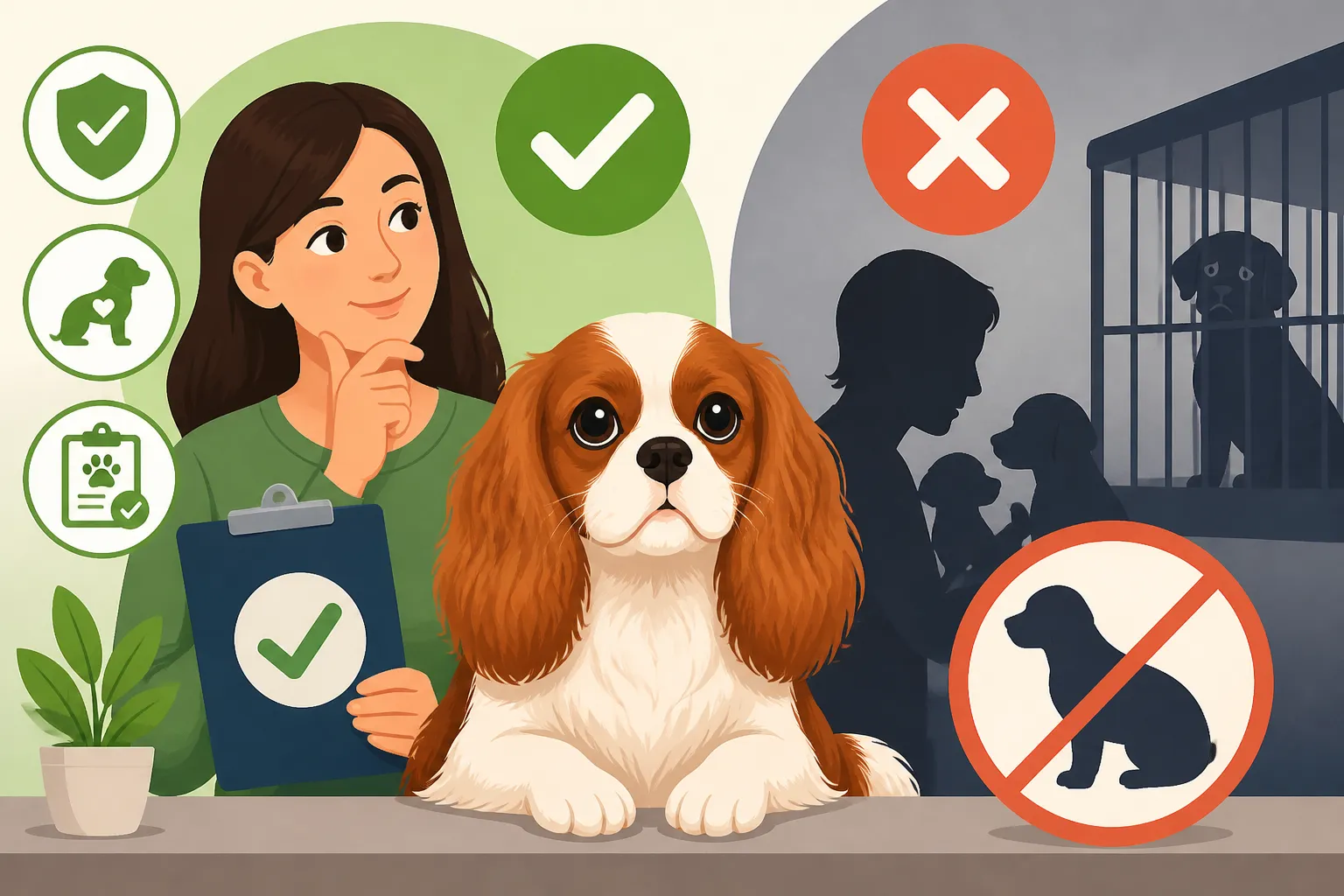
When you are emotionally invested, it is easy to remember the adorable face and forget the unanswered questions. Before paying a deposit, write down what you have verified and what remains unclear. If a breeder is responsible but busy, they should still be able to tell you when they can provide missing information. If you feel pressured to accept verbal promises instead, step back.
Here is a practical final check:
- Verify the parents’ identities. Make sure the health records match the sire and dam named by the breeder.
- Review health testing. Ask who performed each examination, when, and what the result means.
- Discuss family health history. Ask about relevant conditions in parents and close relatives, and how that information affects breeding decisions.
- Observe the puppies’ setting. Visit or arrange a credible live call, and ask about early care and socialization.
- Read the contract. Understand the health terms, return policy, and your responsibilities.
- Confirm the practical details. Ask about the puppy’s age at pickup, veterinary records, food, and transition plan.
- Give yourself permission to walk away. A puppy being available now is not a reason to overlook concerns.
Once you have chosen a breeder and agreed on a pickup plan, prepare calmly rather than buying everything at once. Chewy is one possible source for routine supplies such as a crate mat or a comb, but check the breeder’s recommendations first so you do not purchase unsuitable items. For grooming, ask what the coat-care routine will look like and which tools the puppy is already familiar with.
A serious Cavalier breeder does not need to be flawless, and no amount of paperwork can guarantee a dog’s future health. What you are looking for is openness, careful records, sensible breeding decisions, thoughtful puppy care, and a willingness to stay accountable. If those pieces are missing or you are made to feel foolish for asking, it is reasonable to keep looking. You can always revisit your checklist or compare another breeder’s answers before making a decision. Chewy and other pet retailers can help with ordinary supplies after you have settled on a puppy, but the most important preparation is choosing a breeder whose practices you understand and trust.
Disclaimer
This article is for general informational purposes only and does not constitute professional advice. Laws, prices and regulations vary by location and change over time. Consult a qualified professional for guidance on your specific situation.