Training a Cavalier Around Food Distraction
It's incredibly frustrating when your sweet, well-behaved Cavalier King Charles Spaniel transforms into a food-obsessed vacuum cleaner the moment a stray crumb hits the sidewalk or an enticing scent wafts through the air. You want to enjoy walks and training sessions, but it feels like you're constantly battling their nose and stomach. This guide will walk you through understanding why your Cavalier is so food-driven and provide actionable strategies to manage those powerful temptations, helping you build better focus and control in any environment.
Understanding Your Cavalier's Motivation for Food
Cavaliers, despite their regal, lapdog appearance, still carry the strong instincts of their spaniel ancestors. These aren't just fluffy companions; they're dogs with a keen sense of smell and a history rooted in finding things – and often, those things were edible. This natural inclination, combined with other factors, can make them incredibly focused on food.
The Strong Scent Drive of a Cavalier
Think about your Cavalier's origins as a "comforter spaniel." While they weren't primarily hunting large game, their smaller ancestors would have been adept at sniffing out fallen morsels or small prey. This deep-seated instinct means their nose is a powerful tool, constantly processing information about the world around them, and food scents are often at the top of the priority list.
Imagine walking past a busy park where someone just enjoyed a picnic. To us, it might be a faint, pleasant smell. To your Cavalier, however, that grass is a treasure trove of tantalizing scents – a dropped piece of hot dog, a forgotten potato chip, or even just the lingering aroma of crumbs. Their delicate, long ears, which are so charming, also act like little scent funnels, helping to direct those delicious smells right to their nose. This isn't naughtiness; it's just your Cavalier being a dog, using their senses exactly as nature intended. It's why a simple stroll can feel like an Olympic event in distraction management.
Why Some Cavaliers Are Extra Food-Motivated
While most Cavaliers have a healthy appetite, some seem to take it to an entirely new level. This isn't always about being "greedy"; several factors can amplify a Cavalier's food motivation. For one, if a dog's early experiences involved food scarcity or competition, they might develop a stronger drive to secure any available food source. This could stem from a less-than-ideal start in life, or even just being the smallest in a competitive litter.
Then there's the individual personality. Some Cavaliers are simply more oral than others, finding immense satisfaction and comfort in chewing and eating. Hunger levels certainly play a role; if your Cavalier is genuinely hungry, the lure of an dropped sandwich crust is going to be incredibly strong. It's also worth considering that as a smaller breed, every calorie feels important, and they can be incredibly opportunistic about finding treats. This means what might seem like a small, insignificant crumb to us is a potential feast to a fifteen-pound Cavalier.
You might also notice that dogs on certain diets, especially those managing a sensitive stomach or other health issues, might develop a heightened interest in "forbidden" foods simply because their regular diet is less exciting. It's not a fault in their character, but rather a combination of genetics, learned behavior, and physical needs all contributing to that intense focus on food.
Laying the Foundation Indoors: Building Focus with Food
Before you tackle the unpredictable world outside, it's absolutely crucial to build a strong foundation for focus and impulse control in a quiet, low-distraction environment indoors. This helps your Cavalier understand what you want from them and that ignoring tempting things can lead to even better rewards.
Making Yourself More Interesting Than the Treat
This is perhaps the golden rule of training a food-distracted Cavalier: you have to be the most exciting thing in the room, even more so than that delicious treat they're eyeing. This doesn't mean you need to perform circus tricks, but it does mean being animated, using an enthusiastic voice, and ensuring your rewards are truly motivating.
Start with simple engagement games. Hold a high-value treat in your hand and bring it to your nose, saying "Watch me!" or their name. The moment they make eye contact, even for a split second, mark that behavior with a "Yes!" or a click, and immediately reward them. Repeat this many times. The goal is to create a positive association: looking at you means good things happen. You're teaching them that focusing on you is far more rewarding than fixating on the food itself.
Reward predictability is also key. If they consistently get rewarded for looking at you or for performing a desired behavior, they'll be more likely to offer that behavior proactively. Don't be afraid to use truly high-value rewards – those smelly, chewy morsels your Cavalier goes crazy for. These are often things like small pieces of cooked chicken, cheese, or specialized training treats. For more ideas on what really motivates your little friend, check out Treats a Cavalier Will Trade Anything For. The idea is to make you the gateway to all things wonderful, even when a treat is visible.
Structured Training for Impulse Control
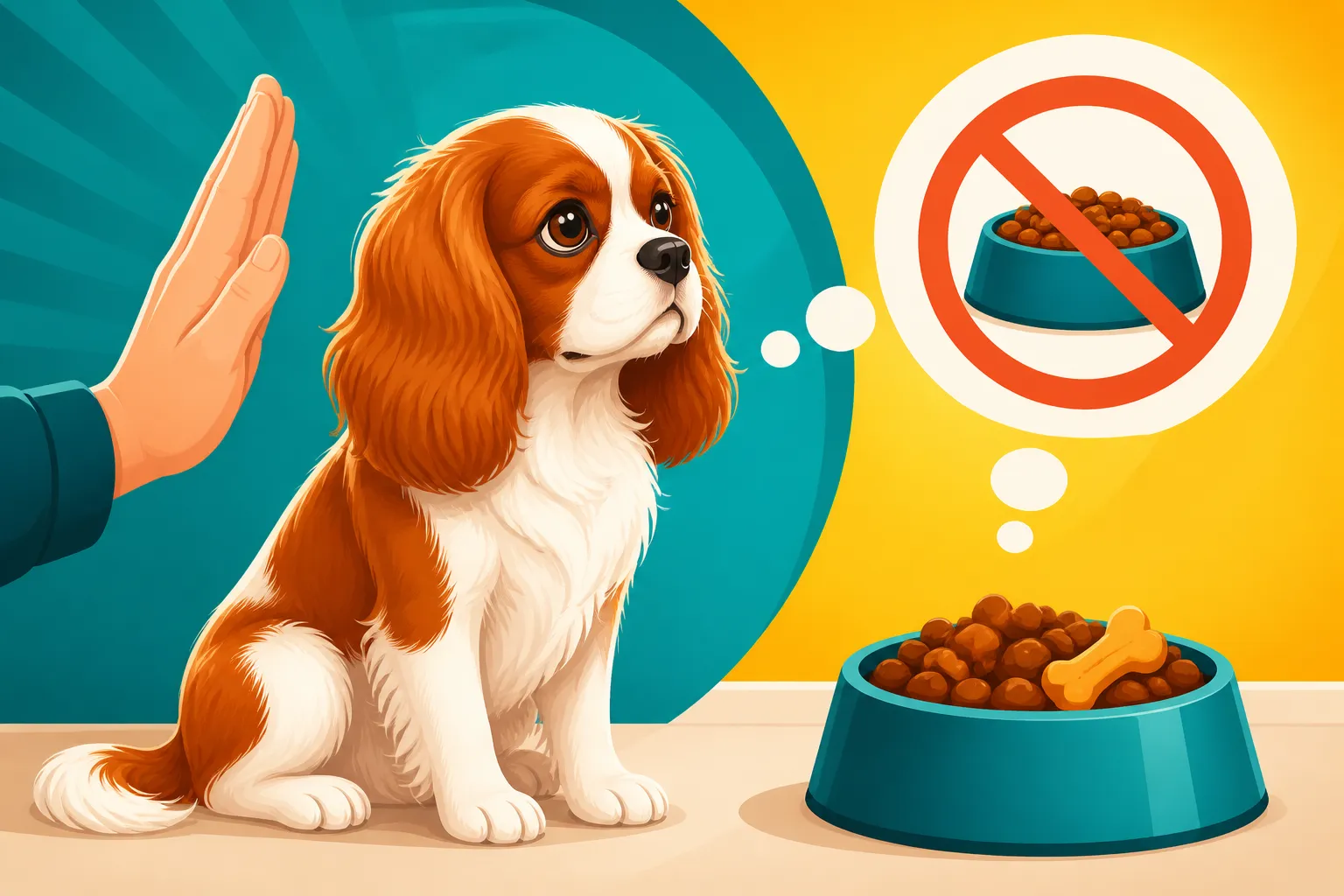
Once your Cavalier understands that focusing on you brings rewards, it's time to introduce structured commands that build impulse control around food. The "leave it" and "take it" commands are invaluable tools.
"Leave It":
- Start simple: Place a low-value treat on the floor or in your open palm.
- Cover it: As your Cavalier goes to sniff or grab it, quickly cover the treat with your hand and say "Leave it!"
- Wait for disengagement: Wait until they look away from the covered treat, even for a second, or make eye contact with you.
- Reward: The instant they disengage, mark it ("Yes!") and reward them with a different, higher-value treat from your other hand. This teaches them that leaving the "forbidden" item means getting something even better.
- Increase difficulty: Gradually increase the temptation (higher-value treats, then kibble, then actual food items), and slowly expose the treat longer before rewarding. Eventually, you'll be able to place a treat on the floor and have them ignore it until you give them a release cue.
"Take It": This command is typically used as a release cue after "leave it," or when you want them to politely take a treat from your hand.
- Hold a treat in your hand.
- Say "Take it" clearly as you offer the treat.
- Reward them for gently taking it.
The key is consistency and repetition. Practice these commands multiple times a day in short, positive sessions. Remember, you're not trying to punish them for being interested in food; you're teaching them that your cues are the most reliable way to get what they want. It's all about positive reinforcement and making the right choice easy and rewarding. For a deeper dive into this positive training philosophy, read our guide on Reward-Based Training With a Cavalier.
Taking Training Outdoors: Conquering Food Distractions
Once your Cavalier is a superstar at "leave it" and "watch me" indoors, it's time to face the real world. This is where the challenge really begins, because outdoor distractions are far more numerous and intense.
Gradually Introducing Real-World Scenarios
The biggest mistake people make is going from a perfectly controlled living room straight to a bustling city park. This is like asking a beginner swimmer to jump into the deep end of the ocean! You need to build up the exposure gradually, always setting your Cavalier up for success.
- Your Backyard First: Start with your own yard. Plant a few low-value kibbles or tiny treats on the grass, then walk your Cavalier past them on a leash. Practice "leave it." This is still a controlled environment, but it adds the element of different smells and textures.
- Quiet Neighborhood Walks: Move to very quiet streets or less-trafficked paths. Before you encounter any potential food distractions (like a dropped leaf that looks suspiciously like a snack or a discarded piece of paper), get your Cavalier's attention. Reward them for looking at you before they even notice the distraction. If you spot a dropped french fry ahead, either guide them widely around it or, if unavoidable, give your "leave it" command with strong conviction.
- Increasing Distractions: As they improve, gradually introduce more challenging environments. A slightly busier park, the edge of a cafe patio, or a sidewalk where people might drop things. Always aim to be proactive, not reactive. If you see a potential distraction, redirect their focus to you before they have a chance to fixate.
For outdoor safety and managing those moments when your Cavalier's nose takes over, consider using a long line. A 15-30 foot long line, easily found on Amazon, can give them a sense of freedom to explore scents while still allowing you to intervene safely if they find something truly tempting. It's an excellent tool for practicing recall and "leave it" in a less constrained manner. Learn more about its benefits in Long Line Practice for a Cavalier.
Using Environmental Management and High-Value Rewards
Even with the best training, there will be times when environmental management is your best friend. This means actively controlling the situation to prevent your Cavalier from encountering irresistible food.
- Leash and Harness: Always keep your Cavalier on a leash in uncontrolled environments. A well-fitting harness, rather than a collar, can also give you better control without putting pressure on their delicate neck, especially if they suddenly lunge for something. For options suitable for your Cavalier's anatomy, read Harnesses Suited to a Cavalier's Neck.
- Scanning Ahead: Develop a habit of constantly scanning the ground ahead of you on walks. If you spot a discarded chicken bone or a wrapper that might contain crumbs, you can proactively steer your Cavalier away or prepare to use your "leave it" command.
- Avoidance: Sometimes, the best strategy is simply to avoid problem areas during peak times. If the local playground is littered with dropped snacks after school lets out, maybe choose a different route or time for your walk.
When you are out and about, and you're competing with the allure of that discarded slice of pizza, your treats need to be even better than usual. Those high-value treats that work indoors might not cut it against a truly potent outdoor scent. This is where you pull out the real good stuff – maybe tiny bits of cooked salmon, liver sausage, or specialty high-reward training paste.
Here's a simple comparison of reward values to consider:
| Reward Value Category | Examples | Use Case |
|---|---|---|
| Low Value | Plain kibble, dry biscuits, standard treats | Indoor training, maintenance, simple commands |
| Medium Value | Store-bought chewy treats, mild cheese | Indoor distractions, quiet outdoor environments |
| High Value | Cooked chicken, hot dogs, freeze-dried liver | Moderate outdoor distractions, proofing commands |
| Jackpot Value | Sardines, salmon, special human food bits | Intense outdoor distractions, emergency "leave it" |
Remember, the goal isn't to make your Cavalier ignore all food forever, but to teach them that your guidance and your rewards are ultimately more satisfying and safe. This strategy ties into resources like BAXTER & Bella, which offer comprehensive online training programs that emphasize positive reinforcement and building engagement, crucial for dogs who might otherwise be overly fixated on external stimuli like food.
Addressing Specific Problem Areas and Advanced Strategies
Even with a solid foundation, there will be moments when your Cavalier's food drive seems to override everything. It’s important to have specific strategies for these common scenarios and to remember that patience is a virtue when working with such an instinctual behavior.
The Dreaded Dropped Food Scenario
We've all been there: you're walking along, perhaps enjoying a coffee, and suddenly your Cavalier spots something utterly irresistible on the ground. Maybe it's a dropped cookie, a forgotten piece of chicken, or even just a particularly interesting blob of something. Their nose hits the ground, and they're locked on like a heat-seeking missile.
Your fastest, most effective tool here is a lightning-fast "leave it" command, paired with a physical intervention if necessary. If you can, step in front of them or gently guide them away with their leash. The moment they disengage, even if you had to physically move them, immediately reward them with your absolute highest-value treat. This isn't about scolding; it's about interrupting the undesirable behavior and redirecting their focus to you, then generously rewarding the desired action (looking at you, moving away from the tempting item).
Another advanced strategy is to teach a "wait" or "stay" command, not just for polite greetings, but for real-world situations. If your Cavalier can hold a "wait" while you put a bowl of food down, you can extend this to holding a "wait" when you accidentally drop something. This requires a lot of prior practice, but it's incredibly useful. Imagine you're in the kitchen, and a piece of toast falls. If your Cavalier can hold a "wait" for a few seconds, it gives you time to pick it up or direct them to their mat. It buys you precious seconds to manage the situation safely.
Managing Food-Motivated Barking or Lunging
Sometimes, a highly food-motivated Cavalier might not just sniff; they might bark, whine, or even lunge towards food they desperately want, whether it's in a stranger's hand, a stroller, or on the ground. This behavior stems from intense frustration and excitement.
The key here is to intervene before the barking or lunging starts. As soon as you spot a potential food distraction that might trigger this reaction, increase the distance. Cross the street, take a wider berth, or turn around if necessary. The goal is to get to a point where your Cavalier can notice the food without immediately reacting.
Once you're at a manageable distance, practice your "watch me" command. Reward them generously for any focus on you. If they look at the food but then voluntarily look back at you, that's a jackpot moment – reward it heavily! You're teaching them that seeing tempting food is a cue to check in with you, not to react hysterically. If your Cavalier struggles with general outdoor distractions, you might find our article on Teaching a Cavalier to Watch You on Walks helpful, as building this general outdoor focus is a critical component.
Remember, consistency is vital. If you let them lunge sometimes and not others, you're confusing them. Every time they try to lunge, you're reinforcing that behavior. Keeping them under control with a good harness and leash, along with practicing proactive redirection, is paramount.
Consistency and Patience Are Key
Training a Cavalier around food distraction is not a quick fix; it's an ongoing journey that requires immense patience and unwavering consistency. Cavaliers are smart, but they also have deeply ingrained instincts. You're not going to eliminate their love of food, nor should you want to! You're teaching them how to manage that drive in a way that keeps them safe and makes your life together more harmonious.
- Short, Positive Sessions: Keep training sessions brief, typically no more than five minutes at a time, especially when introducing new concepts or practicing in distracting environments. Cavaliers, like all dogs, learn best in short bursts of positive reinforcement. Longer sessions can lead to frustration and burnout for both of you. For tips on effective training lengths, refer to Five-Minute Training Sessions With a Cavalier.
- Don't Get Discouraged: There will be days when your Cavalier seems to forget everything you've taught them the moment a rogue potato chip crosses their path. This is normal! Every lapse is a learning opportunity for you to refine your approach, increase your distance, or make your rewards even more enticing.
- Proofing: Once your Cavalier is good at "leave it" in one setting, practice in many different settings with varying levels of distraction. This process, called "proofing," ensures their understanding is solid and translates to all situations.
Ultimately, your Cavalier wants to please you, and they love food. By leveraging their natural drives and teaching them that focusing on you leads to even better outcomes, you can transform walks from a constant battle against temptation into enjoyable bonding experiences. It's about building trust and communication, allowing your Cavalier to navigate the food-rich world with grace and good manners.
Disclaimer
This article is for general informational purposes only and does not constitute professional advice. Laws, prices and regulations vary by location and change over time. Consult a qualified professional for guidance on your specific situation.