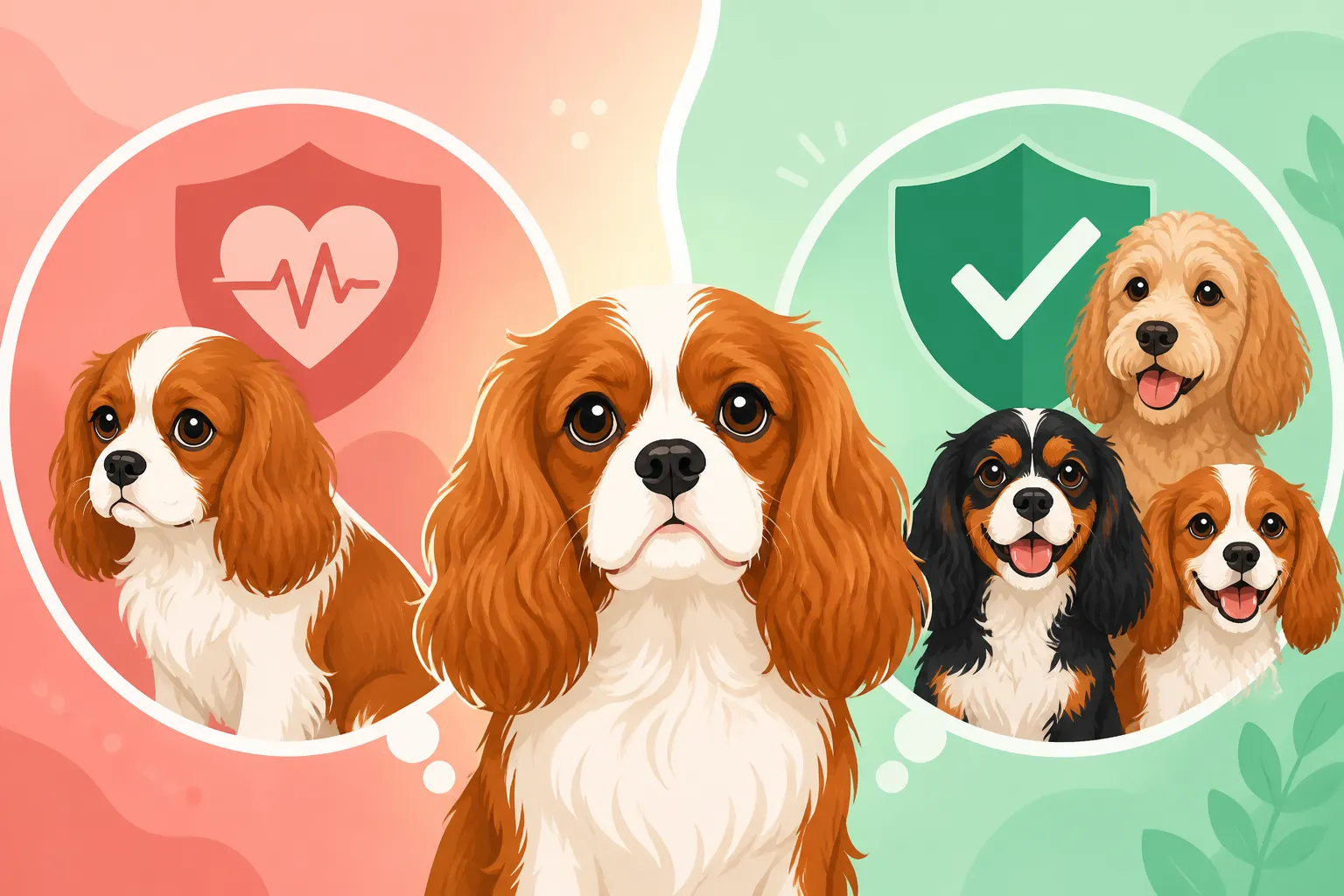
Whether Cavalier Crosses Are Healthier
A Cavalier mix can look like a healthier alternative to a purebred Cavalier, but a different coat or face does not guarantee fewer vet visits. Crosses may inherit health risks from either parent, and “hybrid vigor” is not a health certificate. This guide explains what crossbreeding can and cannot change, which records to ask for, and how to weigh a particular dog’s risks.
Why a Cavalier cross is not automatically healthier
What hybrid vigor can and cannot do
When two genetically different dogs are bred, their puppies may be less likely to inherit certain recessive conditions if both parents do not carry the same harmful variant. That possibility is one reason people talk about “hybrid vigor.” It is a potential benefit, not a blanket guarantee that a mixed-breed puppy will be healthier.
Many common canine health problems are not caused by one gene alone. Heart disease, joint problems, and some eye conditions can involve several genetic and environmental factors. A puppy may inherit a risk from either parent, even if the other parent belongs to a breed with a lower average risk for that condition. And two dogs can come from different breeds without being sufficiently unrelated genetically to reduce every inherited risk.
The label “crossbreed” also tells you very little about the individual parents. A Cavalier crossed with a Poodle, Bichon Frise, or Cocker Spaniel may have a different set of possible inherited conditions, but the Cavalier parent’s risks do not disappear. The other parent may bring its own inherited conditions into the mix. Looking at the actual parents’ health records is more useful than relying on a general claim about mixed breeds.
Cavalier risks can remain in mixes
Mitral valve disease is a significant concern in Cavaliers. A Cavalier cross can still inherit a tendency toward heart disease; having a parent from another breed does not rule it out. The same principle applies to neurological, eye, and orthopedic conditions associated with Cavaliers. Learn about the broader health picture in The Health Debate Around Breeding Cavaliers and Mitral Valve Disease in the Cavalier King Charles Spaniel.
Some risks are easier to investigate with particular tests than others. DNA testing can identify certain inherited variants, but it cannot predict every disease a dog might develop. A clear result for a specific mutation does not mean a dog is free of all inherited health problems. Likewise, a normal examination is a snapshot, not a lifelong guarantee. For a deeper look at what DNA testing can and cannot tell you, see The DNA Tests Every Cavalier Should Have.
The other parent’s breed matters too. For example, a Poodle parent’s health assessments should reflect the relevant risks for that variety and family line; a Cocker Spaniel parent’s checks should reflect that breed’s concerns. A responsible breeder should be able to explain why each test was selected, which dog was tested, and what the results mean. If the answer is simply “the puppies are a cross, so they’re healthier,” ask for more concrete evidence.
Compare the likely health risks, not the label
Start with the Cavalier parent
Ask whether the Cavalier parent has had appropriate heart assessments and whether there is a family history of early heart disease. A routine listen with a stethoscope can be useful, but it is not interchangeable with every form of cardiac evaluation. Ask what was done, when it was done, who performed it, and whether the results are documented. The Heart Testing a Cavalier Breeder Must Do explains why the details behind a clearance matter.
Also ask about neurological signs in the parent and close relatives. Scratching, sensitivity around the neck, unexplained pain, or changes in movement may warrant veterinary investigation. A breeder may not have every possible scan for every dog, but should answer questions plainly and avoid treating an absence of visible symptoms as proof that a condition is impossible. Read more about these concerns in Syringomyelia and Chiari Malformation in Cavaliers.
Eye and joint history deserve attention as well. Ask what eye examinations the parent has had, whether there have been recurring eye problems, and whether the dog has a history of lameness or kneecap issues. A puppy may appear lively and sound during a brief visit while still having inherited risks that become apparent later. Cavalier Eye Disease From Dry Eye to Cataracts and Cavalier Knees, Hips and Joint Problems offer more detail on these areas.
Investigate the other parent just as carefully
It is easy to focus on the Cavalier side because that is the familiar breed in the cross. But the other parent needs equally serious attention. Find out which health conditions are common in that breed, which screenings are appropriate, and whether the parent’s results are available for review. A breeder should not present a parent’s health testing as a favor or an optional extra; it is part of making an informed breeding decision.
The right checks depend on the breed, the individual dog, and the family history. A DNA panel may be appropriate for one risk, while an eye examination, cardiac assessment, or orthopedic evaluation may be more relevant for another. Ask the breeder to connect each test to a specific health concern. If they cannot explain why testing was or was not done, that is a reason to pause and seek independent advice.
| What to investigate | Questions to ask | What it can tell you |
|---|---|---|
| Cavalier parent’s heart health | What examination was performed, when, and by whom? | Whether there is documented evidence about the parent’s heart at that time |
| Neurological history | Have the parent or close relatives shown pain, unusual scratching, or movement changes? | Whether there are signs or family-history concerns worth discussing with a veterinarian |
| Eye health | Were the eyes examined, and are the results documented? | Whether an eye professional identified concerns during the examination |
| Joint history | Has either parent had kneecap, hip, or mobility problems? | Whether there are known orthopedic concerns in the parents or family |
| Other parent’s breed-specific risks | Which screenings are recommended for that breed, and what are the results? | Whether the breeder considered risks from both sides of the cross |
| DNA results | Which conditions were tested, and what does each result mean? | Whether the dog carries particular tested variants—not whether it is free of all disease |
How to assess a breeder’s health claims
Ask for records, not reassuring phrases
“Vet checked,” “health tested,” and “clear” can mean different things. Ask for the names of the tests, dates, and the dogs they relate to. If a test result is described verbally, request the underlying document and confirm that the dog’s identity matches the record. A puppy’s paperwork may include routine veterinary care without containing the parent health assessments needed to evaluate inherited risk.
Good questions are specific and calm: What health problems have occurred in the parents’ relatives? What screening was done before breeding? What did the results show? If a condition appears in the family, how did the breeder factor that into the decision? A responsible breeder should be willing to discuss uncertainty and limitations rather than promise a perfectly healthy puppy.
Be cautious of anyone who uses a cross’s name as proof of health. “Cavapoo,” “Cockalier,” or another blend describes ancestry, not a standardized health profile. The same cross can vary in size, coat, temperament, and inherited risk depending on the individual parents. How to Judge Whether a Cavalier Breeder Is Serious and The Cavalier Heart and MRI Papers to Ask For can help you prepare for a more useful conversation.
Consider the individual dog and your capacity for care
Even thorough screening cannot guarantee a long, illness-free life. A puppy from carefully assessed parents can develop a condition later, while a dog with an uncertain history may remain well. The purpose of health testing is to make breeding decisions more informed and reduce avoidable risks—not to promise an outcome that no one can guarantee.
Consider the practical side, too. A dog may need regular checkups, treatment, or a special diet regardless of whether it is purebred or mixed. If your veterinarian recommends a particular food, a retailer listing such as Chewy can help you locate product details, but use the veterinarian’s advice—not marketing language—to decide whether the food is suitable. For a prescribed diet, confirm the exact product with your clinic before changing what the dog eats.
If ongoing care is needed, keep a simple record of diagnoses, medications, and follow-up instructions. Some owners use Chewy to request refills for veterinarian-authorized medication, but coordinate with the clinic so the prescription and monitoring plan stay current. Retail availability does not replace veterinary guidance, especially if symptoms change or a medication causes a problem.
Choosing a Cavalier cross with realistic expectations
Use a practical decision process
Before choosing a puppy, take time to compare the parent information and the breeder’s answers. A useful approach is to:
- Identify the exact cross and parent breeds. Do not assume two dogs with the same cross label have the same likely health profile.
- List the important health risks for both breeds. Ask a veterinarian which assessments are relevant to the parents and family lines.
- Request dated records for each parent. Check what was tested, who performed it, and whether results are available.
- Ask about relatives and previous litters. A parent’s own health is important, but family history can add context.
- Notice how the breeder handles uncertainty. Clear explanations are more meaningful than claims that a cross is “healthier by nature.”
- Plan for routine and unexpected care. Think about veterinary access, time, and finances before bringing a dog home.
If a breeder will not show records, rushes you to pay, or dismisses reasonable health questions, it is sensible to step back. You can also consider an adult rescue dog, whose observed health and behavior may offer more information than a young puppy’s. That does not eliminate uncertainty, but it may help you make a decision based on the individual dog rather than assumptions about a cross.
Make the decision around evidence and fit
A Cavalier cross may suit your household well, and crossbreeding can sometimes reduce the chance of particular inherited conditions. But it does not reliably erase Cavalier-associated risks or guarantee a healthier dog. The most meaningful evidence is specific: the health of both parents, relevant screening records, family history, and a breeder who answers questions honestly.
In other words, don’t choose a dog because someone says a mix is automatically healthier. Choose based on the actual dogs and the evidence available, then be prepared to provide lifelong care. If you are comparing different mixes, Whether Designer Cavalier Crosses Are Worth the Price can help you think through the broader trade-offs beyond health claims.
Chewy can be one place to check details when locating a veterinarian-recommended food or arranging a prescribed refill, but neither a retailer listing nor a crossbreed label can tell you whether a particular puppy is healthy. For that, rely on the records, an independent veterinary discussion, and a careful look at the individual dog.
Disclaimer
This article is for general informational purposes only and does not constitute professional advice. Laws, prices and regulations vary by location and change over time. Consult a qualified professional for guidance on your specific situation.