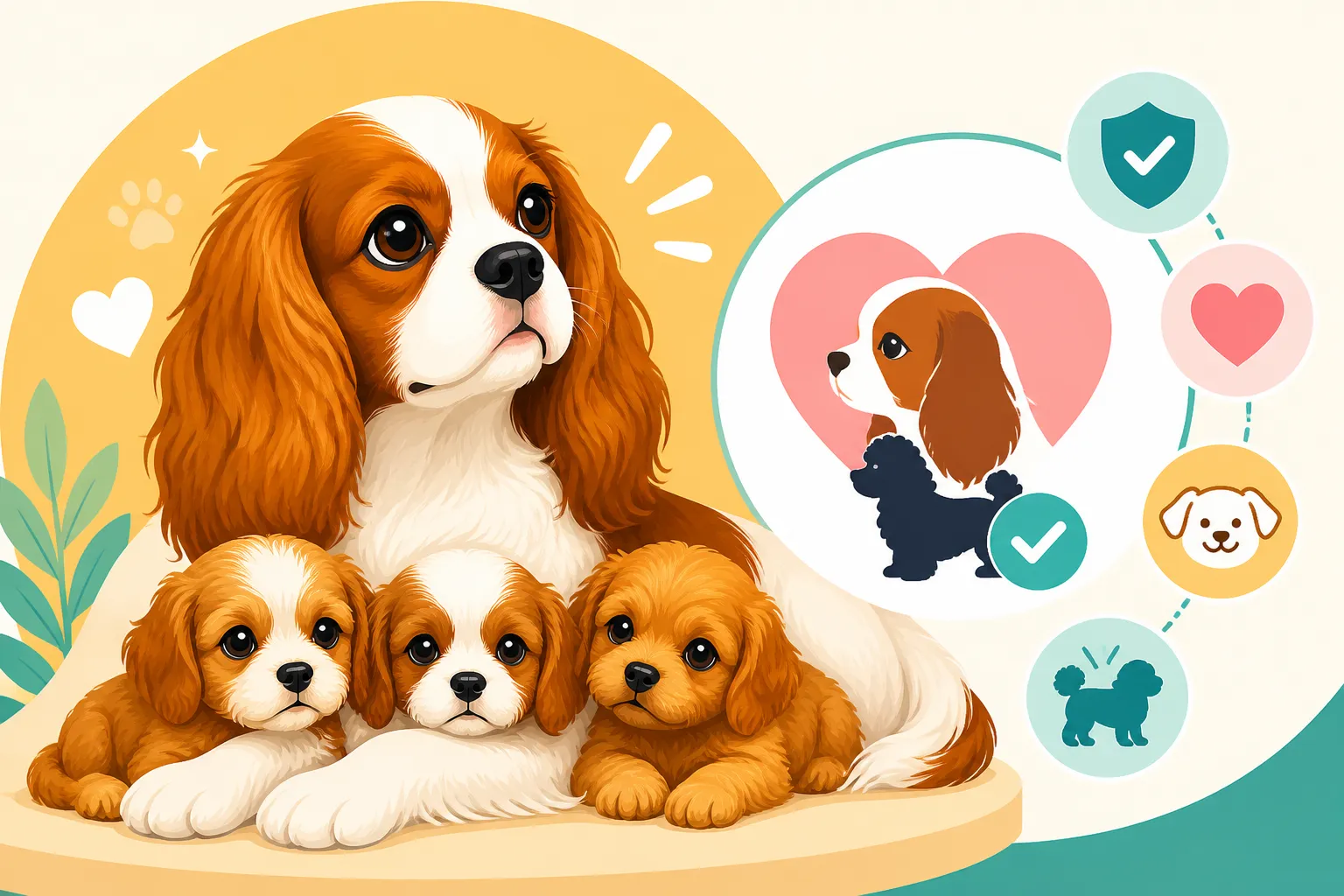
Why Cavapoo Breeders Use Cavalier Mothers
When breeders advertise Cavapoos, you’ll often find a Cavalier King Charles Spaniel mother and a Poodle father. That pairing is common, but it isn’t a guarantee of easier births, a particular coat, or a healthier puppy. Here’s why breeders may choose a Cavalier dam, what the pairing can and cannot predict, and what to check before bringing a Cavapoo home.
Why breeders often choose a Cavalier mother
A Cavapoo is a cross between a Cavalier King Charles Spaniel and a Poodle. The Cavalier is often the mother and the Poodle the father, but that is a common breeding choice—not a rule. The reasons usually involve the parents’ size, the breeder’s available dogs, and the traits they hope to combine.
Size can influence the pairing
Breeders may choose the larger dog to carry a litter, especially when the Poodle is very small. Many Cavapoos are bred using a Cavalier and a Toy or Miniature Poodle, and the actual size of each individual dog matters more than the breed label alone. A breeder may prefer a Cavalier mother if she is larger than the particular Poodle they plan to use.
That choice does not remove pregnancy or delivery risks. A dam’s size, the puppies’ size and position, her health, and other factors can all matter. Small dogs can have difficult births, and a particular pairing should be assessed by a veterinarian rather than treated as automatically safe because the mother is a Cavalier.
Nor does a Cavalier mother guarantee that the puppies will grow to a specific size. Puppies inherit genes from both parents, so adult size can vary within the same litter. If a breeder promises that every puppy will be a certain weight based only on the mother’s breed, ask how they reached that estimate and whether they can share information about the parents’ size and previous litters.
A breeder may be aiming for Cavalier traits
Cavaliers are often described as affectionate, sociable companion dogs. Some breeders hope a Cavapoo will inherit that friendly, people-oriented nature alongside traits associated with the Poodle. But a puppy’s temperament is not determined by which breed is the mother. Each puppy receives genes from both parents, and early experiences, health, and individual personality also play a role.
The Cavalier’s background includes sporting-spaniel instincts, not just lap-dog qualities. Some Cavaliers enjoy following scents, chasing birds, or investigating whatever has caught their attention. A Cavapoo may inherit some of those tendencies, just as it may inherit Poodle characteristics. For a closer look at the Cavalier’s nature, see Cavalier Temperament and the Sporting Spaniel Beneath It.
A thoughtful breeder should be able to describe the temperaments of both parents and explain why they consider them suitable for breeding. Ask what the parents are like around unfamiliar people, other dogs, grooming, and everyday household activity. A mother’s gentle behavior with visitors is useful information, but it cannot tell you exactly how every puppy in the litter will behave.
Breeder preference and practical availability matter too
Sometimes the pairing reflects the breeder’s program: they may have a healthy, suitable Cavalier female and choose a compatible Poodle male. In other cases, a breeder may have access to a particular dog through another breeder or may be trying to produce puppies of a certain size range or coat type. Those practical considerations can shape the pairing as much as a general preference for Cavalier mothers.
There is no single pairing choice that makes a Cavapoo automatically more desirable. A reputable breeder should prioritize the individual dogs’ health, structure, temperament, and suitability for breeding—not simply the fact that one parent is a Cavalier and the other is a Poodle. If the breeder cannot explain why these two particular dogs were paired, that is a reasonable reason to ask more questions.
What the mother’s breed does and does not predict
It’s easy to assume that the mother determines the puppies’ main characteristics because she carries and raises the litter. In reality, the mother’s role in pregnancy and early care is different from the genetic contribution of each parent. Both parents influence a puppy’s inherited traits, and some features are hard to predict in a mixed-breed litter.
Coat type and shedding are not guaranteed
Breeders may hope that the Poodle parent will contribute a curlier or lower-shedding coat. But a Cavapoo’s coat can be wavy, curly, or closer to the Cavalier’s longer, silky coat. Puppies from the same litter may not all have the same coat texture, and coat care needs can change as a puppy matures.
A curlier coat can still shed, and it may need frequent brushing to prevent tangles and mats. A longer, straighter coat also needs regular care, especially around the ears, legs, and areas where friction causes knots. If someone in your household has allergies, don’t rely on a breeder’s claim that a particular puppy is “hypoallergenic.” No coat type can promise an allergy-free home.
Ask the breeder what grooming the parents need and what they have observed in puppies from earlier litters. You can also learn more about how a Cavalier cross may differ from another mix in What a Cavachon Takes From Its Cavalier Parent. Whichever cross you consider, plan for routine brushing and grooming rather than assuming the Poodle parent makes coat care effortless.
Temperament comes from more than motherhood
A Cavalier mother can influence puppies through inherited traits and through the early environment she provides, but she does not dictate each puppy’s personality. A puppy’s father contributes genes too. Individual differences within a litter can be noticeable: one puppy may be bold and busy, while a sibling is more watchful or quieter.
Early handling and socialization also matter. Puppies benefit from safe, age-appropriate exposure to ordinary sounds, surfaces, people, and household routines. A well-socialized puppy still needs patient training after coming home; being raised by a friendly Cavalier does not guarantee that the puppy will be confident in every new situation.
Ask how the breeder matches puppies with households. A responsible breeder should be willing to talk about the puppies’ observed personalities, rather than choosing solely by color, coat, or sex. If your home is quiet, for instance, a breeder may help you consider which puppy seems comfortable with a calmer routine—but no observation can promise exactly how a dog will develop.
A crossbreed is not automatically healthier
Some buyers assume that crossing a Cavalier with a Poodle prevents inherited health problems. That is not a safe assumption. A Cavapoo can inherit health risks from either parent, and responsible breeding means evaluating both dogs for relevant conditions rather than relying on the word “crossbreed.”
Cavaliers are known to be at risk for health concerns including mitral valve disease and syringomyelia. Poodles also have health conditions that breeders should consider, with risks varying by size and family line. A puppy’s health depends on more than the parents’ appearance or a breeder’s claim that the dogs are healthy. Read more about the broader issue in Whether Cavalier Crosses Are Healthier and The Health Debate Around Breeding Cavaliers.
Ask what health evaluations were completed for both parents, who performed them, and whether you can see the records. A general veterinary checkup is not the same as breed-relevant screening. The details matter: which tests were done, when they were done, and whether the results belong to the actual sire and dam.
How to assess a breeder using a Cavalier dam
The pairing alone tells you very little about the breeder’s standards. A responsible breeder should welcome informed questions, provide clear records, and be candid about both the strengths and the risks of the dogs they breed. Be cautious if the conversation focuses on cute puppy photos while health and care questions are brushed aside.
Ask about health testing for both parents
Start by asking for the names and dates of the relevant health evaluations for the Cavalier mother and Poodle father. For the Cavalier, ask specifically about heart screening and other breed-related concerns. Genetic testing can be useful for certain inherited conditions, but it does not replace appropriate physical examinations or specialist assessments.
You can use The DNA Tests Every Cavalier Should Have as a starting point for understanding what genetic tests may and may not tell you. Also ask whether the breeder has heart and imaging documentation for the Cavalier, and how they interpret it. The Cavalier Heart and MRI Papers to Ask For is a useful companion topic when you are preparing questions.
A test result is only meaningful if it is clear, current where relevant, and tied to the dog being bred. If a breeder says, “The parents are clear,” ask what that means in practice: which tests, which dates, and which records? A responsible breeder should be comfortable explaining the answers without making you feel difficult for asking.
Look beyond the mother to the puppies’ early care
Ask where the puppies are raised, how often they are handled, what veterinary care they have received, and how the breeder monitors their development. You should be able to learn about the mother’s wellbeing as well as the puppies’ environment. The breeder should also explain what happens if a puppy develops a health or temperament concern and what support is available after the puppy goes home.
A breeder should not pressure you to choose immediately or make claims that cannot be supported, such as guaranteed adult size, a guaranteed non-shedding coat, or immunity from inherited disease. For more guidance on evaluating a breeding program, see How to Judge Whether a Cavalier Breeder Is Serious and Warning Signs at a Cavalier Breeding Kennel.
If you are comparing litters, keep notes on each breeder’s answers. It can be hard to remember details after several conversations, especially when you are excited about a puppy. A simple record of the parents’ health testing, the puppies’ care, and the breeder’s policies helps you compare the substance of each program instead of relying on first impressions.
Prepare for the dog you will actually bring home
Before choosing a puppy, think about the everyday work of living with a Cavapoo. Plan for training, regular grooming, routine veterinary care, and companionship. A Cavapoo may be small enough for many homes, but it still needs exercise, enrichment, and gradual practice being comfortable when left alone.
It can help to make a basic supplies list before the puppy arrives: a safe sleeping area, a properly fitted harness, food approved for the puppy’s needs, grooming tools, and cleaning supplies. Chewy is one place owners may use to compare everyday pet supplies, but equipment should fit the individual puppy and advice from your veterinarian should guide food choices. Don’t buy a large collection of treats or accessories before you know what suits your dog.
Once the puppy is home, a consistent routine will make the transition easier. Introduce grooming gently, reward calm behavior, and build up alone time in small steps. If you need to restock essentials, Chewy may be convenient for comparing products, while your veterinarian or groomer can help you decide what is appropriate for your puppy’s coat and health. For a new owner, making a shopping list through Chewy can be useful, but supplies are only one part of preparing for a dog’s long-term care.
Questions to ask before choosing a Cavapoo puppy
A breeder’s answers should help you understand the actual dogs and their breeding choices—not just the general idea of a Cavalier mother and Poodle father. Keep the conversation specific. If an answer is vague, ask for clarification or supporting documentation.
| Question to ask | What a clear answer should cover |
|---|---|
| Why was this Cavalier paired with this Poodle? | The individual dogs’ health, temperament, size, and suitability |
| What health evaluations were completed? | The tests or examinations, dates, and records for both parents |
| What are the parents like at home? | Temperament, activity level, grooming needs, and behavior around people |
| What can you tell me about expected adult size? | The parents’ actual sizes and a realistic range, not a guarantee |
| What coat types have appeared in previous litters? | Honest variation, grooming needs, and limits on predicting coat traits |
| How are puppies socialized and matched with homes? | Their early experiences and the breeder’s process for discussing fit |
| What support is available after adoption? | Guidance on health, behavior, records, and future questions |
A Cavalier mother may be chosen because of size considerations, the breeder’s preferences, or the qualities they hope to bring into a litter. But her breed does not guarantee safe delivery, a particular coat, a specific personality, or a healthier puppy. The most meaningful signs are the health and temperament of both parents, transparent records, and a breeder who treats your questions as part of responsible puppy placement.
Disclaimer
This article is for general informational purposes only and does not constitute professional advice. Laws, prices and regulations vary by location and change over time. Consult a qualified professional for guidance on your specific situation.