Whether a Cockalier Escapes Cavalier Health Problems
A Cockalier may look like a way to keep the Cavalier King Charles Spaniel’s affectionate nature while avoiding some of the breed’s health concerns. But crossing a Cavalier with a Cocker Spaniel does not guarantee a healthier dog. This guide explains which conditions a Cockalier may inherit, what responsible testing can tell you, and what to ask before bringing one home.
Why a Cockalier is not automatically free of Cavalier health problems
A Cockalier is usually a Cavalier King Charles Spaniel crossed with a Cocker Spaniel. That combination can produce a lovely companion, but the mix does not provide a predictable health shield. A puppy can inherit health risks from either parent, and the traits passed down are not neatly divided into “half Cavalier” and “half Cocker.”
That uncertainty can be frustrating when a breeder describes a cross as healthier simply because it is a cross. The more useful question is not whether Cockaliers are generally healthier, but whether the individual puppy’s parents have been appropriately screened and whether the breeder can show clear, relevant documentation.
Crossbreeding does not erase inherited risk
Inherited conditions are influenced by genes from both sides of a puppy’s family tree. A Cockalier could inherit a Cavalier-associated risk, a Cocker-associated risk, a risk present in both breeds, or none of those problems. Appearance and temperament do not reveal which genes a puppy received.
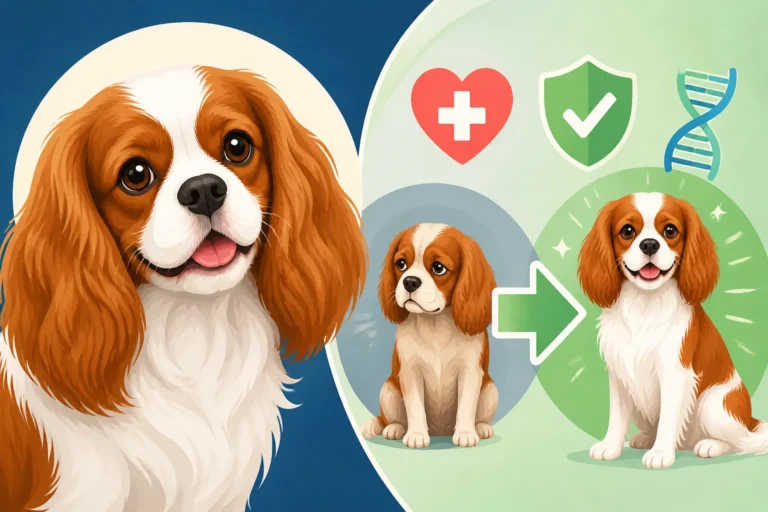
The phrase “hybrid vigor” is sometimes used to suggest that mixed-breed puppies are automatically healthier. A wider gene pool can sometimes reduce the chance that a puppy inherits two copies of a particular harmful variant, but it does not prevent every inherited disease. It also does not rule out conditions that can arise through complex genetics, age, or other factors.
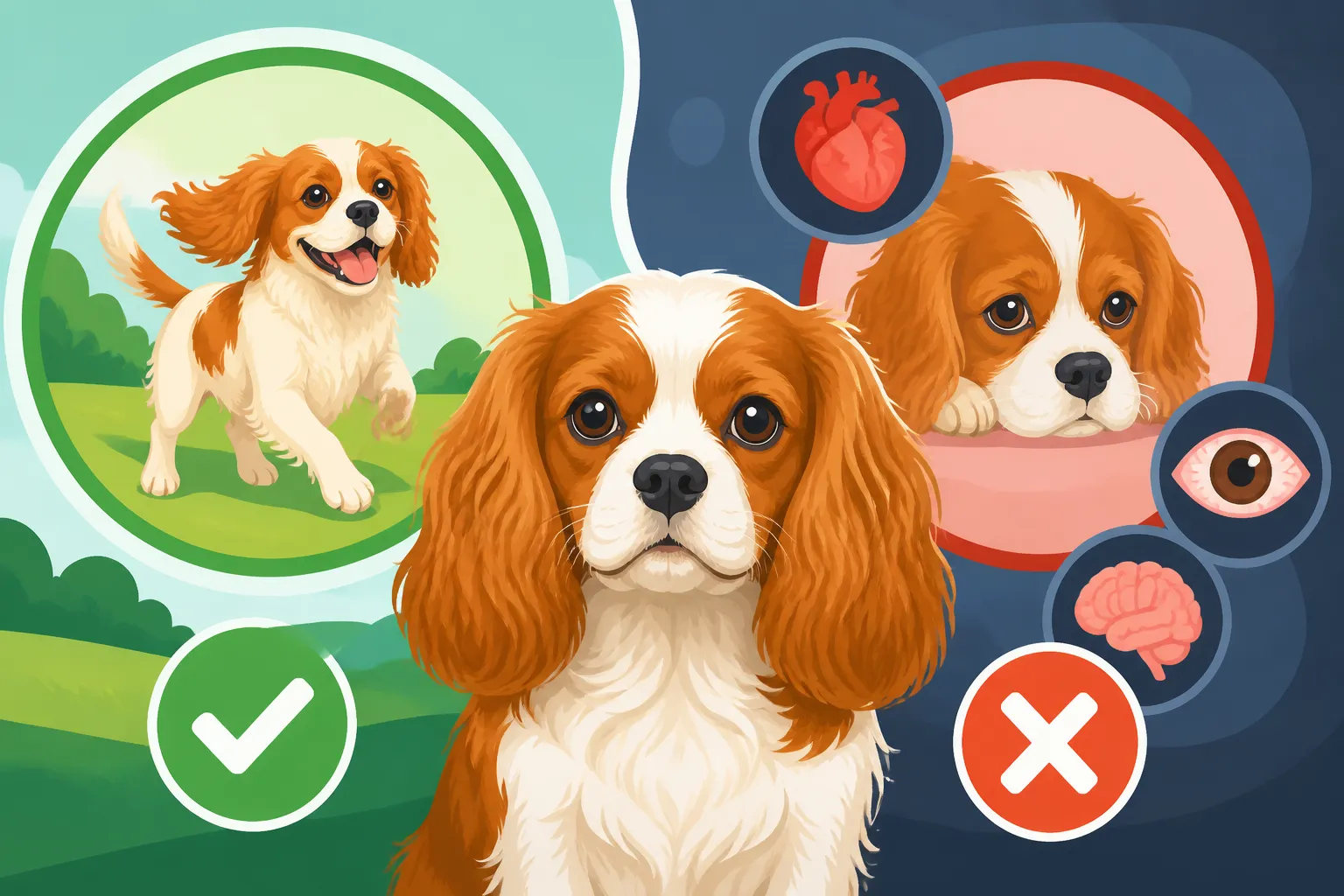
For example, a Cockalier puppy might have a Cavalier parent with a family history of heart disease and a Cocker parent with an unaddressed eye or ear problem. Mixing the breeds does not cancel out those histories. To understand what the puppy may be at risk for, you need reliable information about both parents—not just a reassuring description of the cross.
A broader introduction to the breed mix is available in Cockaliers and Other Cavalier Crosses. The essential point is that a crossbreed can be a good fit for a household, but the label itself is not a health test.
Cavalier conditions still matter in a Cockalier
Mitral valve disease, or MVD, is a significant health concern in Cavaliers. It affects the heart’s mitral valve and can progress over time. A Cockalier with a Cavalier parent may inherit susceptibility to heart disease; being a mixed breed is not evidence that this risk has disappeared. Learn what the disease involves in Mitral Valve Disease in the Cavalier King Charles Spaniel.
Chiari-like malformation and syringomyelia are also important to understand when considering a Cavalier cross. These conditions involve the shape of the skull and, in some dogs, fluid-filled cavities in the spinal cord. Not every dog with related anatomical changes has obvious signs, and symptoms can vary. A Cockalier’s mixed-breed status does not tell you whether it inherited a risk. Syringomyelia and Chiari Malformation in Cavaliers explains the Cavalier connection in more detail.
Some other concerns worth discussing include inherited eye conditions and episodic falling syndrome, a neurological disorder associated with a specific genetic variant in Cavaliers. The relevant background is covered in Cavalier Eye Disease From Dry Eye to Cataracts and The Episodic Falling DNA Test for Cavaliers. These topics do not mean a Cockalier is destined to develop the same problems. They give you a more useful checklist of questions to ask about the Cavalier parent and the puppy’s family history.
Health concerns a Cockalier may inherit from either parent
Cavalier-related risks are only one part of the picture. A Cocker Spaniel may bring its own inherited and general health concerns, and a Cockalier can inherit traits from either parent. That is why an assessment that looks only at the Cavalier side is incomplete.
A responsible breeder should be ready to discuss the health considerations relevant to both breeds and to show records for the actual parents. If the explanation focuses on how cute, friendly, or “naturally healthy” Cockaliers are, but offers little information about screening, ask more questions before moving forward.
Heart, brain, eyes, and joints deserve a closer look
For the Cavalier parent, ask about heart evaluation and family history of MVD. A DNA panel alone cannot establish that a dog is free of all heart disease. A veterinarian’s findings, the type and timing of any heart evaluation, and the dog’s age all matter when interpreting a health record. The Cavalier-specific background in The Heart Testing a Cavalier Breeder Must Do can help you understand why a simple statement such as “the parents are healthy” is not enough detail.
Ask whether the Cavalier parent has been evaluated for neurological concerns as well. Screening practices and available tests vary by condition, so it is important to understand exactly what was performed and what the result does—and does not—show. A clear test result should never be presented as a promise that a puppy will never develop a related problem.
Eye health is another area to discuss. Some eye conditions are inherited, while others can develop for different reasons over a dog’s lifetime. Ask what examinations the parents have had, who performed them, and whether the breeder can provide the written results. For joint concerns, ask about the history of hip problems or early arthritis on both sides of the pedigree. Cavalier Hip Dysplasia and Early Arthritis offers useful context about joint health in Cavaliers, though it does not replace a Cockalier’s own veterinary assessment.
Cocker Spaniel ancestry adds its own questions
Cocker Spaniels can be prone to ear problems, in part because their long, dropped ears can reduce airflow and make it harder to notice irritation early. A Cockalier may inherit ears that need regular checking and careful care. Ask whether either parent has had repeated ear infections, allergies, or chronic ear discomfort. The practical background in Cavalier Ear Infections and Why They Recur is relevant to the Cavalier side, while a veterinarian can help you understand the needs of the individual Cockalier.
Ask about the Cocker parent’s eye and joint history, too. The exact screening that is appropriate depends on the dogs’ backgrounds and the health issues their lines are known to face. A thoughtful breeder should be able to explain why each test was chosen, rather than presenting a generic list that may not cover the parents’ actual risks.
Health does not come only from test results. Ask about the everyday care and veterinary history of both parent dogs: recurring skin or ear problems, medication, previous surgeries, unusual behavior that might signal discomfort, and the ages at which relatives developed serious illness. No family history can predict everything, but a breeder who knows the lineage should be able to discuss it honestly.
How to evaluate a Cockalier puppy’s health information
Health paperwork can be confusing, particularly when a breeder sends a collection of certificates without explaining what they mean. It is reasonable to ask for time to review the documents. Focus on identifying which dog was tested, what examination or test was performed, when it happened, who conducted it, and whether the result applies to the concern being discussed.
A puppy checkup is valuable, but it cannot substitute for health screening of the parents. Likewise, a parent’s screening does not guarantee that every puppy will remain healthy. These are different pieces of information, and a responsible breeder should be comfortable explaining the distinction.
What to ask the breeder
Start by asking for the names and ages of both parents, their health histories, and copies of relevant records. Ask whether a veterinarian or specialist performed each examination, and whether the breeder can explain any result you do not understand. If the breeder says that the cross “doesn’t get” a Cavalier condition, ask what evidence supports that claim.
It is also reasonable to ask about relatives. Have close family members had heart disease, eye problems, neurological signs, joint trouble, recurring ear infections, or unexplained early deaths? The answer may not be perfect—family records can be incomplete—but a careful breeder should not treat reasonable questions as an insult.
Look for specifics rather than broad assurances. “The dogs are DNA tested” is not enough on its own. Which tests were done? Were they relevant to these parent dogs? What do the results mean for the puppies? A genetic test can address a particular variant, but it cannot screen for every disease. The DNA Tests Every Cavalier Should Have helps explain the limits and purpose of Cavalier genetic testing, and Reading a Cavalier Puppy's Health Certificates can help you make sense of the paperwork.
| What to ask about | Helpful information to request | What the answer cannot guarantee |
|---|---|---|
| Heart health | The Cavalier parent’s examination history, records, and family history | That a puppy will never develop heart disease |
| Neurological concerns | Relevant screening or veterinary assessments and any known family history | That a dog has no possible risk of a later neurological condition |
| Eye health | Written results of appropriate examinations and details of the examiner | That every inherited or age-related eye problem has been ruled out |
| Joints | Parent records and known history of hip or joint problems in close relatives | That a puppy’s joints will remain problem-free for life |
| DNA testing | The exact test, the dog tested, and an explanation of the result | That the dog has been screened for every inherited condition |
| General history | Veterinary records and a candid account of ongoing or past problems | A precise prediction of an individual puppy’s future health |
Red flags that call for more questions
Be cautious if a breeder relies on phrases like “designer breed,” “best of both breeds,” or “healthier by nature” as proof. Those descriptions do not tell you whether the parent dogs were screened. A claim that a Cockalier cannot inherit a Cavalier condition because it is mixed is also too absolute.
Other reasons to pause include pressure to pay quickly, reluctance to share parent health records, vague answers about who performed testing, or a refusal to discuss health problems in the family. A breeder may not know every detail about every distant relative, but should be willing to answer reasonable questions and acknowledge uncertainty.
You can also review How to Judge Whether a Cavalier Breeder Is Serious and The Cavalier Heart and MRI Papers to Ask For for guidance on evaluating breeder claims. The details in those resources are Cavalier-focused, so use them as a prompt for questions—not as proof that a Cockalier has been screened appropriately.
Caring for a Cockalier with its individual risks in mind
Once a Cockalier is home, health care should be guided by that dog’s veterinary history and needs, not by assumptions about its breed mix. Keep copies of parent screening and puppy health records, bring them to veterinary appointments, and tell the veterinarian what you know about the family history. That information can help your veterinary team decide what to monitor and when further evaluation might be appropriate.
It also helps to distinguish routine observation from diagnosis. Noting a new cough, changes in stamina, repeated head shaking, eye discomfort, or altered movement can give your veterinarian useful information. Those signs do not identify a specific disease by themselves, and a vet should assess persistent, severe, or sudden changes.
Make ordinary monitoring part of the routine
Keep a simple record of veterinary visits, test results, medications, and changes you notice at home. For example, if a dog who usually enjoys a walk begins stopping much earlier, write down when you first noticed it and whether it happens on every walk. That is more useful at an appointment than trying to remember a general impression after several weeks.
Check ears and eyes regularly, and mention recurring irritation rather than repeatedly treating it without advice. A dog that shakes its head often, rubs an eye, or seems uncomfortable should be assessed; the cause may not be obvious from appearance alone. Ask your veterinarian how often routine examinations are appropriate for your dog and whether its family history changes the plan.
If your Cockalier has a diagnosed condition and your veterinarian has prescribed medication or recommended a particular diet, follow the instructions you were given. Some owners use a pharmacy such as Chewy to help manage refills, but confirm the medication, prescription details, and any changes with your veterinary practice. For day-to-day care, you might also ask your vet which ear-care products are suitable before buying supplies through Chewy or elsewhere.
Plan for care without assuming the worst
Being aware of inherited risks does not mean expecting a Cockalier to become ill. It means making decisions with open eyes: choosing a breeder who provides meaningful records, arranging routine veterinary care, and taking changes seriously instead of dismissing them because the dog is a crossbreed.
A realistic plan can include setting aside time for preventive appointments, keeping health documents together, and knowing which veterinary clinic to contact if a new concern arises. If your dog needs a prescribed food or ongoing treatment, ask the veterinarian how to manage it consistently. Owners who already use Chewy for pet supplies may find it convenient to keep routine items and refill reminders organized there, while leaving medical decisions and prescription changes to the veterinary team.
The best answer to whether a Cockalier escapes Cavalier health problems is that it cannot be assumed. Some Cockaliers may remain healthy for many years; others may develop a condition associated with one parent breed or an unrelated problem. A well-documented family history and responsible screening can improve the information you have when choosing a puppy, but no test or crossbreed label can promise a lifetime without illness.
Disclaimer
This article is for general informational purposes only and does not constitute professional advice. Laws, prices and regulations vary by location and change over time. Consult a qualified professional for guidance on your specific situation.