Cavaliers That Turn Up in Portraits and Paintings
A small, long-eared dog in an old portrait can look remarkably like a Cavalier King Charles Spaniel, but that does not necessarily mean it belonged to the modern breed. This guide explains which dogs appear in historical paintings, how to recognize the resemblance, and why artists’ portraits are fascinating clues to the Cavalier’s past—not proof of a dog’s pedigree.
Why Cavaliers appear in old portraits
The paintings came before the modern breed
The Cavalier King Charles Spaniel has a long connection to the small spaniels kept as companions in European courts. But the modern breed name can be misleading when you are looking at a painting from centuries ago: the dogs in those pictures lived long before today’s breed standards and pedigree records existed.
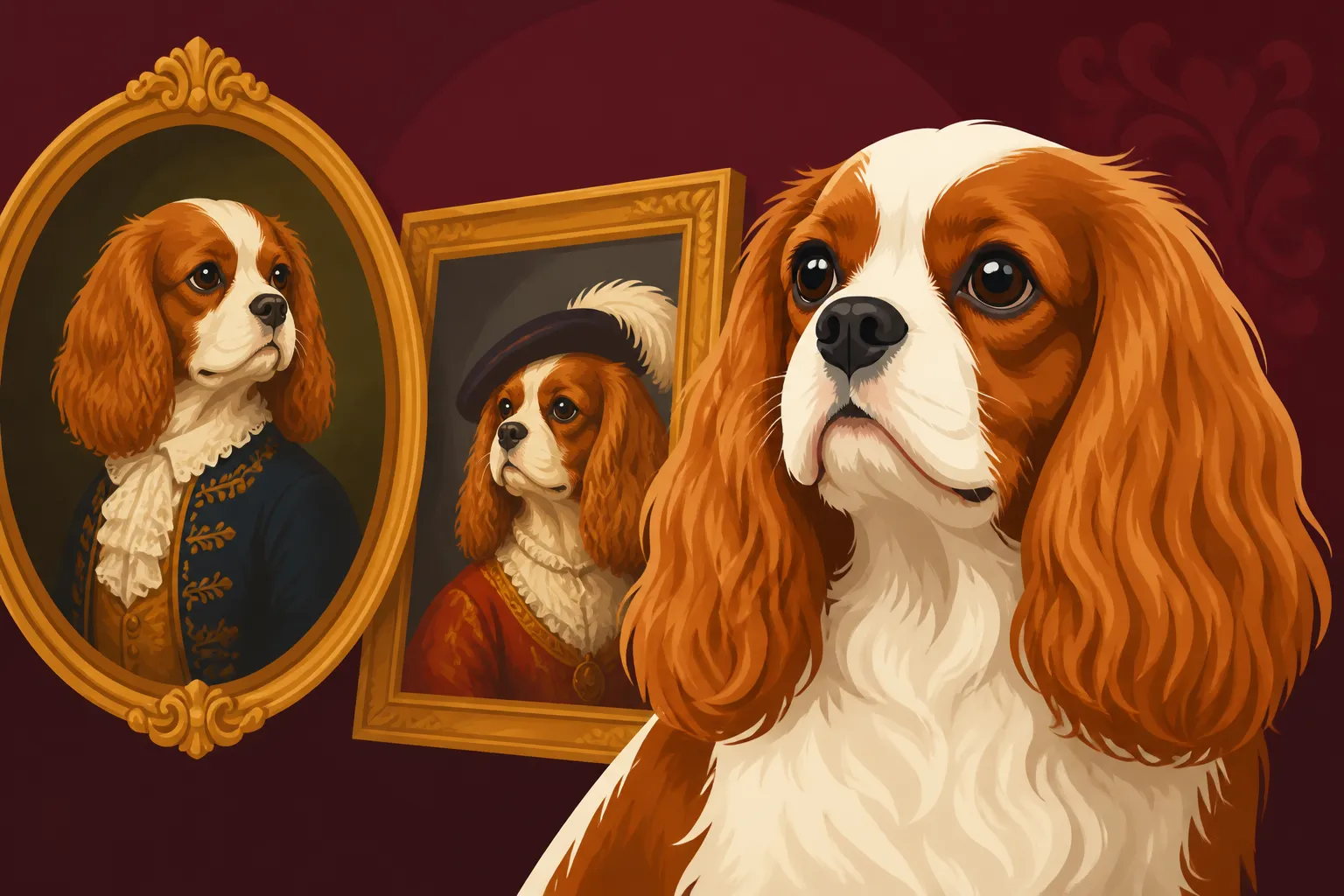
In paintings from the 16th and 17th centuries, artists sometimes included small spaniels beside wealthy sitters, children, or royal families. These dogs were part of domestic life, not just decorative accessories. A spaniel on a lap or near a chair could suggest affection, status, refinement, or simply the sitter’s attachment to a pet.
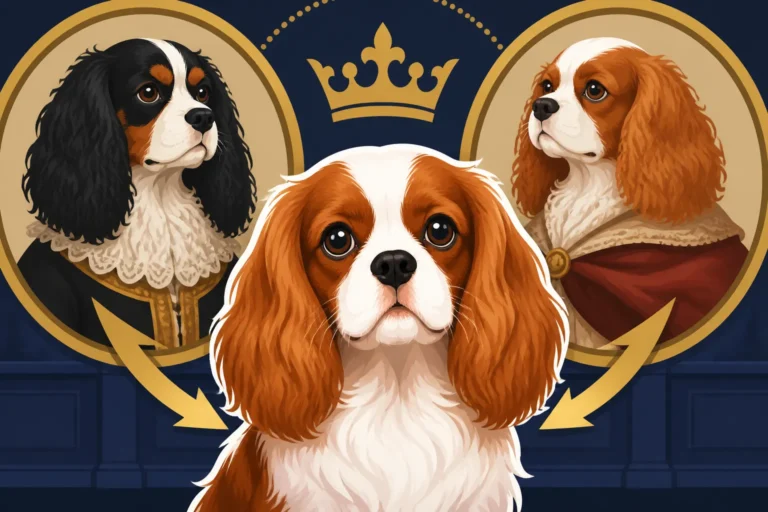
The association with the English royal court is especially strong. Charles II was famously associated with small spaniels, and dogs of this general type appear in the broader visual culture surrounding the royal household. The history is explored further in Cavalier Ancestors at the Court of Charles II and Which King the Cavalier Is Named After.
The important distinction is that a painting can show an ancestor or a dog with a similar appearance without showing a Cavalier King Charles Spaniel in the modern, formal sense. The breed developed over time, and today’s Cavaliers are not simply unchanged copies of dogs painted centuries ago. For more background on that transformation, see Why Cavalier and King Charles Spaniel Mean Two Dogs.
Portraits show family companions, not just royal symbols
A painted dog often feels surprisingly personal. It may be tucked against a child, looking up at its owner, or resting as though it has wandered into the artist’s composition on its own terms. That everyday quality is part of why viewers connect so strongly with spaniels in historical portraits.
At the same time, a portrait is a constructed image. The artist and patron chose where the dog would sit, how it would be posed, and what its presence might communicate. A small dog could represent loyalty or tenderness, but it could also signal the household’s wealth and access to fashionable companion animals.
This combination of affection and status makes it difficult to read a painting as a straightforward record of ordinary life. A noble family’s spaniel might have received careful attention from an artist, while the everyday dogs of less wealthy households were less likely to be recorded in grand portraits. The surviving images therefore show only part of the story.
How to spot a Cavalier-like dog in a painting
Look at the whole silhouette, not one feature
The most recognizable clues are often the dog’s general shape: a small body, a soft expression, long ears, and a coat with feathering on the legs or tail. Those details may remind a modern viewer of a Cavalier, especially when the dog is shown close to a person for scale.
But no single feature proves that the dog is a Cavalier. Long ears are common among spaniels, and artists often simplified or idealized the animals they painted. A dog’s coat may look unusually smooth or unusually full because of the painter’s style, the condition of the artwork, or the conventions of the period.
Try to notice the proportions rather than matching the dog to a modern breed photograph. Is the muzzle relatively long or very short? Does the head look rounded? How does the body compare with the person beside it? These observations can help you describe what you see, but they cannot establish ancestry.
| What you notice in the painting | What it may suggest | What it cannot establish |
|---|---|---|
| Long, feathered ears | A spaniel-like dog | A specific modern breed |
| A small dog beside a sitter | Companion-animal role or scale | The dog’s pedigree |
| A rounded head and soft expression | A resemblance to some Cavaliers | That the dog meets a modern breed standard |
| A red-and-white-looking coat | A possible color resemblance to Blenheim Cavaliers | The exact historical coat pattern |
| A very short muzzle | A feature that may appear in some toy spaniels | That the dog is a Cavalier rather than another type |
The modern Cavalier standard describes a specific appearance, but painters were not working from that standard when they portrayed earlier dogs. You can read more about the present-day description in The AKC Standard for the Cavalier King Charles Spaniel.
Remember how much an artist can change
Portraits are not photographs. An artist may lengthen a muzzle, soften a face, enlarge the eyes, or simplify the coat to make a dog fit the composition. Some artists were skilled at capturing animal anatomy; others used looser brushwork or gave the dog only a few strokes of attention.
The painting’s condition matters, too. Varnish can yellow with age, colors can fade, and details may be hard to see in reproductions. A pale patch that looks white on a screen might have been a different color originally, while dark areas may lose definition in an old image. It is wise to avoid making strong claims about coat color based only on a small reproduction.
Even the dog’s posture can mislead. A spaniel curled on a lap may appear especially compact, while one standing beside a chair may look longer-legged. Perspective and the position of the sitter also change how large the dog seems. A careful viewer treats resemblance as a clue to explore, not a final identification.
What old paintings can tell us about Cavalier history
They document a long tradition of companion spaniels
Although paintings cannot certify a breed, they can show that small spaniels were valued companions across generations. Their presence in royal and aristocratic portraits supports the broader history of toy spaniels in Britain and Europe. They also offer a glimpse of how people included animals in family life and public identity.
That visual record helps explain why the Cavalier is often described as having a particularly strong connection to human company. The breed’s history is closely tied to dogs kept near people, rather than to a single modern role such as herding or guarding. For the wider story of how the breed took its present form, see How the Cavalier Reached the American Show Ring and The Court Spaniels the Cavalier Descends From.
However, the paintings do not reveal everything. They cannot tell us how common a particular dog type was among ordinary households, how the dogs were bred, or whether a pictured animal had the same health and temperament traits as modern Cavaliers. They preserve an image, not a complete breeding record.
They reveal changing ideas about dogs and status
A dog included in a portrait could be an intimate companion and a symbol of social standing at the same time. Those meanings are not mutually exclusive. A sitter might genuinely adore the spaniel beside them while also appreciating what a fashionable, carefully bred pet conveyed to visitors.
The way a dog is shown can offer hints about its place in the household. A dog held close to a child may invite viewers to see the family as affectionate and tender. A dog placed prominently beside an adult sitter may emphasize refinement or wealth. These interpretations depend on the painting’s context, and they should be treated as possibilities rather than fixed rules.
Portraits also reflect what artists and patrons considered worth preserving. When a dog is included, it may have been personally important to the sitter, fashionable at the time, or visually useful to the composition. Sometimes it may have been all three. That ambiguity is part of what makes these paintings rewarding to study.
How to research a Cavalier-like dog in a painting
Start with the artwork, not a breed label
If you find a painting that seems to show a Cavalier, first identify the artwork and its date. Museum catalogues, collection records, and reputable art-history references can help establish the artist, sitter, and historical setting. The date matters because it tells you whether the painting predates the modern breed as a formalized type.
Next, look for the description used by the collection or art historians. A painting may identify the animal simply as a spaniel, a toy spaniel, or a pet dog. Those descriptions are often more historically responsible than applying a modern breed name based on appearance alone.
Then compare the dog’s visible features with historical context. Ask whether small spaniels were known in the sitter’s region and period, whether the animal is named in any accompanying records, and whether scholars have identified it more specifically. If no reliable identification exists, it is perfectly reasonable to say that the dog resembles a Cavalier or appears to be a toy spaniel.
Use a simple checklist before calling it a Cavalier
When a caption, social-media post, or article labels an old portrait dog as a Cavalier, pause before accepting the claim. A modern name can make an image feel familiar, but it can also flatten a complicated history into an easy label.
Use this checklist:
- Check the date. Was the painting made before the modern Cavalier breed was established?
- Find the original caption or catalogue record. Does it identify the dog, or is the breed label supplied by a later viewer?
- Separate resemblance from identification. “Cavalier-like” is not the same as “a Cavalier.”
- Look for historical evidence. Is there a written description, family record, or expert catalogue entry that supports a specific identification?
- Consider the artist’s style and the image’s condition. Features and colors may not be exact.
- Use cautious language when evidence is limited. Describing a dog as a small spaniel may be more accurate than assigning it a modern breed.
This approach does not make the paintings less interesting. It makes the history richer: instead of forcing an old dog into a modern category, you can appreciate the spaniel traditions that helped shape the breed. If you are curious about how the Cavalier’s appearance changed through that history, How Cavalier Ancestors Changed Shape in the 1800s offers useful context.
Disclaimer
This article is for general informational purposes only and does not constitute professional advice. Laws, prices and regulations vary by location and change over time. Consult a qualified professional for guidance on your specific situation.