Which States Have the Most Cavalier Breeders
Finding the most Cavalier King Charles Spaniel breeders by state sounds like it should be a quick search, but breeder directories change, some kennels have waiting lists, and a listing does not necessarily mean responsible breeding. This guide explains which states are worth researching first, why counts can be misleading, and how to evaluate a breeder wherever you live.
States where Cavalier breeders may be easier to find
There is no dependable, permanent state-by-state leaderboard that captures every active Cavalier breeder. Listings can be outdated, hobby breeders may have only occasional litters, and one breeder might appear in several directories. So rather than treating any state as a guaranteed “top” state, it is more useful to think in terms of places where a larger population, active dog-show communities, and regional breeder networks can make your search broader.
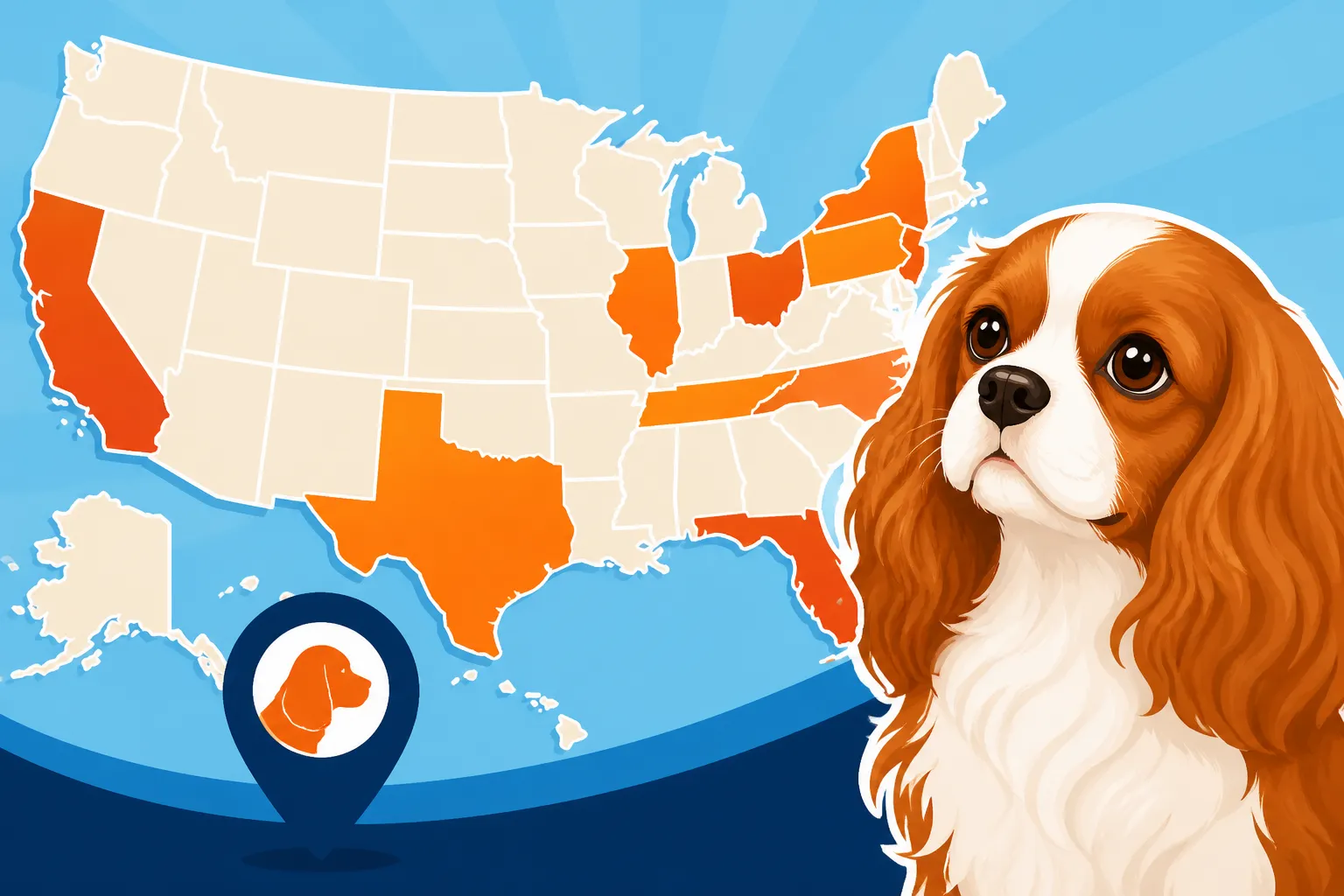
California, Texas, Florida, Pennsylvania, Ohio, and New York are sensible states to include in a wide search. They are large or populous states, so you may find more breeders listed there than in states with smaller populations. That does not mean every listed breeder has puppies available, or that these states necessarily have the highest number of ethical breeders. It simply gives you a practical starting set for your search.
Start with a broad regional search
If you live in the Northeast, look beyond your own state. A family in New Jersey, for example, might also search in Pennsylvania, New York, Connecticut, and Maryland. Someone in the Pacific Northwest might include Oregon and Washington rather than restricting the search to a single city or state. Regional searches can uncover breeders who are within reasonable driving distance but do not appear in a narrowly filtered search.
The same approach works in the South and Midwest. A prospective owner in Atlanta might investigate breeders in Georgia, Tennessee, North Carolina, and Florida. Someone in Chicago might extend a search into Wisconsin, Michigan, Indiana, and Ohio. These are search areas, not rankings; the point is to widen the map while keeping travel practical.
Search for the breed name alongside a city, state, or region, then compare results with breed-club directories and referrals. A general search result can lead to a helpful breeder, but it can also surface old listings, puppy-sale advertisements, or operations that provide little information about health testing. For background on the breed’s history and how it became distinct from its close relative, see Why Cavalier and King Charles Spaniel Mean Two Dogs.
Why a state’s breeder count can mislead
A state may have many online listings but few breeders with a planned litter in the near future. Some responsible breeders produce litters infrequently, keep a waiting list, or place puppies only after learning about each home. Others may be listed in a directory even though they have paused breeding or no longer maintain the contact information shown.
The reverse can happen too: a state with fewer visible listings may have a strong local referral network. A breeder may be known through a regional Cavalier club or veterinarian rather than appearing prominently in search results. That makes a raw listing count a poor measure of how easy it will be to find a well-matched puppy.
| What you are comparing | Why it can be misleading | A more useful question |
|---|---|---|
| Number of online listings | Some listings may be old, duplicated, or inactive | Is the breeder currently planning a litter? |
| Number of puppies advertised | A listing does not show how the puppies were raised or screened | Can the breeder explain the parents’ health testing? |
| State or city location | A nearby breeder is not automatically a responsible breeder | Does the breeder communicate openly and welcome questions? |
| Puppy availability | Immediate availability is not proof of quality or a warning by itself | What is the breeder’s process for matching homes and puppies? |
| Website appearance | Professional design does not verify health practices | Can the breeder provide clear records and references? |
Instead of asking only, “Which state has the most breeders?” try asking, “Where can I find breeders whose practices I can verify, and how far am I prepared to travel?” That question is more likely to lead to a good outcome. The right breeder may be a few hours away, while a breeder in your town may not be the right fit.
How to find and assess breeders across state lines
A sensible search combines directories, referrals, direct questions, and patience. You do not need to become an expert in every aspect of canine breeding before making contact, but you should be able to understand what health information a breeder provides and how they raise their puppies.
Use directories as starting points, not endorsements
Breed-club and kennel-club directories can help you identify breeders by location, but a directory entry is not a guarantee of quality. Treat it as a way to build a list of people to contact. Ask each breeder what health testing they perform, how they decide which dogs to pair, and whether they can explain the results in plain language.
For a Cavalier, heart health deserves particular attention. Ask what testing has been done on both parents, who performed it, and when. A brief statement such as “the parents are healthy” is not a substitute for records you can review. It is also worth understanding what a breeder means by “clearance,” since a casual listening exam and a more detailed cardiac assessment are not identical. For a useful overview of the information to request, read The Cavalier Heart and MRI Papers to Ask For and The Heart Testing a Cavalier Breeder Must Do.
Health questions should not stop at the heart. Ask about other relevant health screening, family history, and how the breeder responds when a dog develops a condition later in life. Responsible breeders cannot promise that a puppy will never become ill. They should, however, be willing to discuss known risks and provide records rather than dismissing reasonable questions. The DNA Tests Every Cavalier Should Have explains why genetic testing is one part of a broader health picture, not a substitute for veterinary care or responsible breeding choices.
Ask questions that reveal the breeder’s process
The way a breeder answers can tell you as much as the answer itself. Do they ask about your household, schedule, previous dog experience, and plans for training? Can they explain where puppies spend their time and how they introduce everyday sounds, handling, and new experiences? A thoughtful breeder usually wants to know whether the match will work for both the puppy and the family.
Ask whether you can meet the mother and see where the puppies are raised, either in person or through a live video visit when distance makes travel difficult. Clarify what documents will come with the puppy, what support is available after pickup, and what the breeder expects if you can no longer keep the dog. A breeder’s willingness to take a dog back or help with rehoming is an important sign that they view placement as a long-term responsibility.
Be cautious if you are pressured to send money before you have had a meaningful conversation, if health questions are brushed aside, or if the seller will not provide clear information about the puppy’s parents. A polished website or an attractive puppy photo cannot confirm good breeding practices. For more help recognizing concerning signs, see Warning Signs at a Cavalier Breeding Kennel and How to Judge Whether a Cavalier Breeder Is Serious.
Choosing between a local breeder and one farther away
Distance is a practical concern, especially if you are balancing work, family commitments, and travel. But it is only one part of the decision. A nearby breeder can make it easier to visit, while a breeder farther away may have more experience, better communication, or a litter that is a better fit. Neither location alone tells you whether the breeder is responsible.
Compare the full experience, not just the drive
A local breeder may allow you to visit more easily and get to know the dogs and household before making a decision. That can be reassuring, but do not let convenience replace careful questions. Ask for the same health records, background, and information about puppy socialization that you would request from someone in another state.
With a distant breeder, discuss how the puppy will travel and what arrangements protect its comfort and safety. Ask whether you can visit before deciding, whether the breeder offers a live video tour, and what happens if the puppy is not a good match when you meet. Avoid making a decision based only on photos or a fast-moving sales conversation.
Travel expenses, time away from work, and the puppy’s transition home all deserve consideration. So do future visits if the breeder provides ongoing support or wants to meet families before placement. If you are comparing the budget involved in finding a puppy, The Price Range Cavalier Breeders Actually Quote and Buying a Cavalier From a Health-Testing Breeder can help you think beyond the initial purchase and focus on the broader ownership decision.
Be wary of choosing based on immediate availability
It is understandable to feel excited when you find a puppy that seems available right away. But urgency can make it harder to notice missing information. Take time to check the breeder’s claims, review records, and decide whether the puppy’s needs suit your household. A wait for a planned litter can be frustrating, but it may give you the time to compare breeders and prepare properly.
If a breeder says that several puppies are ready to leave immediately, ask how they were raised, whether they have had veterinary examinations, and what social experiences they have had so far. Ask for a clear written agreement and understand what it says before sending a deposit or committing. A responsible breeder should be comfortable giving you time to read, ask questions, and make an informed choice.
Do not assume that a puppy is a better choice than an adult dog. A rescue or rehoming organization may have Cavaliers whose personalities and care needs are easier to assess than those of a young puppy. If you are open to that option, Where Cavaliers Come From Besides Breeders and Whether to Take an Older Cavalier Instead offer useful perspectives on expanding your search.
A practical search plan for your state
A step-by-step plan helps keep the search manageable and reduces the temptation to make a rushed decision when a puppy becomes available. Begin locally, expand by region, and keep notes so you can compare breeders fairly.
Build a shortlist and contact breeders consistently
- Set a realistic travel radius. Decide how far you can drive comfortably, and whether you would consider travel farther away for a breeder who meets your standards.
- Search by state and region. Use several nearby states rather than relying on one city or one directory.
- Create a shortlist. Record the breeder’s location, contact details, expected timing, and the health information they say they can provide.
- Ask the same core questions. Use a consistent set of questions about parent health, puppy care, socialization, records, and support after placement.
- Review the answers before committing. Look for clear, specific responses and a willingness to discuss both the appealing and difficult parts of Cavalier ownership.
- Make a visit or video call. Whenever possible, see how the puppies and adult dogs are cared for before making a decision.
- Read the agreement carefully. Make sure you understand the breeder’s responsibilities and your own before paying a deposit or bringing a puppy home.
A simple comparison sheet can prevent small details from blurring together after several calls. Note whether each breeder provided parent health records, explained the puppies’ daily routine, asked you questions, and described what happens if the placement does not work out. You are not looking for a perfect script; you are looking for an honest, consistent relationship.
Prepare for ownership while you wait
Use the waiting period to learn about Cavalier care, locate a veterinarian, and plan for routine expenses and unexpected health needs. Cavaliers are affectionate companion dogs, but the breed has health concerns that deserve serious attention. A good breeder should be part of your preparation, not the only source of information.
You can also prepare everyday supplies before bringing a dog home. Chewy may be useful for comparing routine items such as food, a comfortable bed, grooming tools, and a well-fitted harness; confirm food choices and any special-care products with your veterinarian when needed. Shopping for supplies is separate from evaluating a breeder, so do not treat a retailer’s product listing as a source of health or breeding verification.
Once your dog is home, keep track of veterinary recommendations and the records you received from the breeder. If a question comes up about food, grooming, or basic equipment, Chewy can be one place to review product options, while your veterinarian remains the person to consult about medical needs. For a deeper look at preparing for the breed’s long-term care, see Cavalier Temperament and the Sporting Spaniel Beneath It and The Health Debate Around Breeding Cavaliers.
The most useful answer to “Which states have the most Cavalier breeders?” is not a fixed list of winners. Begin with populous states and nearby regional networks, then evaluate each breeder by their transparency, health documentation, puppy-raising practices, and willingness to support you. A broader search can help you find more possibilities, but careful questions are what help you choose wisely.
Disclaimer
This article is for general informational purposes only and does not constitute professional advice. Laws, prices and regulations vary by location and change over time. Consult a qualified professional for guidance on your specific situation.