The Titian Spaniel and Other Old Cavalier Names
The name “Titian Spaniel” can make the Cavalier King Charles Spaniel’s history feel like a tangle of breeds, paintings, and royal nicknames. It usually refers to an old-fashioned type of toy spaniel, not a separate modern breed. This guide explains the term, how it relates to names such as Blenheim Spaniel and King Charles Spaniel, and what changed when the Cavalier became distinct.
What the name Titian Spaniel means
A historical nickname, not a separate breed
“Titian Spaniel” is an old name associated with toy spaniels thought to resemble dogs shown in paintings by the Italian artist Titian. Those images are often discussed when people describe the longer-faced, less domed-headed spaniels that some fanciers admired before Victorian fashions reshaped the popular toy spaniel.
The name can sound like an official breed label, but it is better understood as a historical or descriptive term. It does not identify a recognized breed separate from the Cavalier King Charles Spaniel, and it is not a reliable way to identify a modern dog’s ancestry. The word may appear in writing about the old type of spaniel, but the exact meaning can vary with the writer and period.
That distinction matters if you have come across the term in a book, a family story, or a description of an old portrait. A painting or historical nickname can offer clues about the kind of dog people admired, but it cannot establish that a present-day dog belongs to a particular breed. For the broader background on the spaniels behind the modern dog, see The Court Spaniels the Cavalier Descends From.
Why Titian’s name became connected with spaniels
Artists’ portraits are one reason people connect the Cavalier’s history with old-fashioned spaniels. Dogs in paintings can preserve a sense of the appearance valued in a particular era: a longer muzzle, a less rounded head, and a body that looks different from the short-faced toy spaniels that later became fashionable. Titian’s name became a shorthand for that imagined or admired earlier look.
But paintings are not breed standards or veterinary records. Artists may stylize animals, and a dog’s appearance in a portrait does not prove its precise lineage. Historical descriptions also use words differently from modern kennel clubs. So when you see “Titian Spaniel,” treat it as a clue about the type of spaniel being discussed, not a precise genetic or registration category.
This is also why the term is most useful in a historical conversation. If you are comparing old portraits with modern dogs, it can help explain what some Cavalier enthusiasts mean by an “old type.” If you are trying to confirm what breed a dog is, however, use contemporary records, pedigree information, and knowledgeable professional guidance rather than relying on a historical nickname.
How old Cavalier names overlap
King Charles Spaniel and English Toy Spaniel
“King Charles Spaniel” is one of the names most closely connected to the Cavalier’s history, but it can refer to a different modern breed depending on where and how the name is used. The Cavalier King Charles Spaniel and the King Charles Spaniel share historical roots, yet they are distinct breeds today. In the United States, the breed called the English Toy Spaniel is generally known as the King Charles Spaniel in the United Kingdom.
The names can be confusing because older writing may use “King Charles Spaniel” broadly for small toy spaniels associated with the royal court. Modern breed names are more specific. A historical source might be talking about a type of dog that predates today’s formal breed distinctions, while a current breeder or registry is referring to a defined breed.
A practical rule is to check the context and the date. If the source is discussing royal history or early toy spaniels, the name may be used loosely. If it is a contemporary breed listing, the precise modern label matters. The distinction is explained further in Why Cavalier and King Charles Spaniel Mean Two Dogs.
Blenheim Spaniel and other color-related names
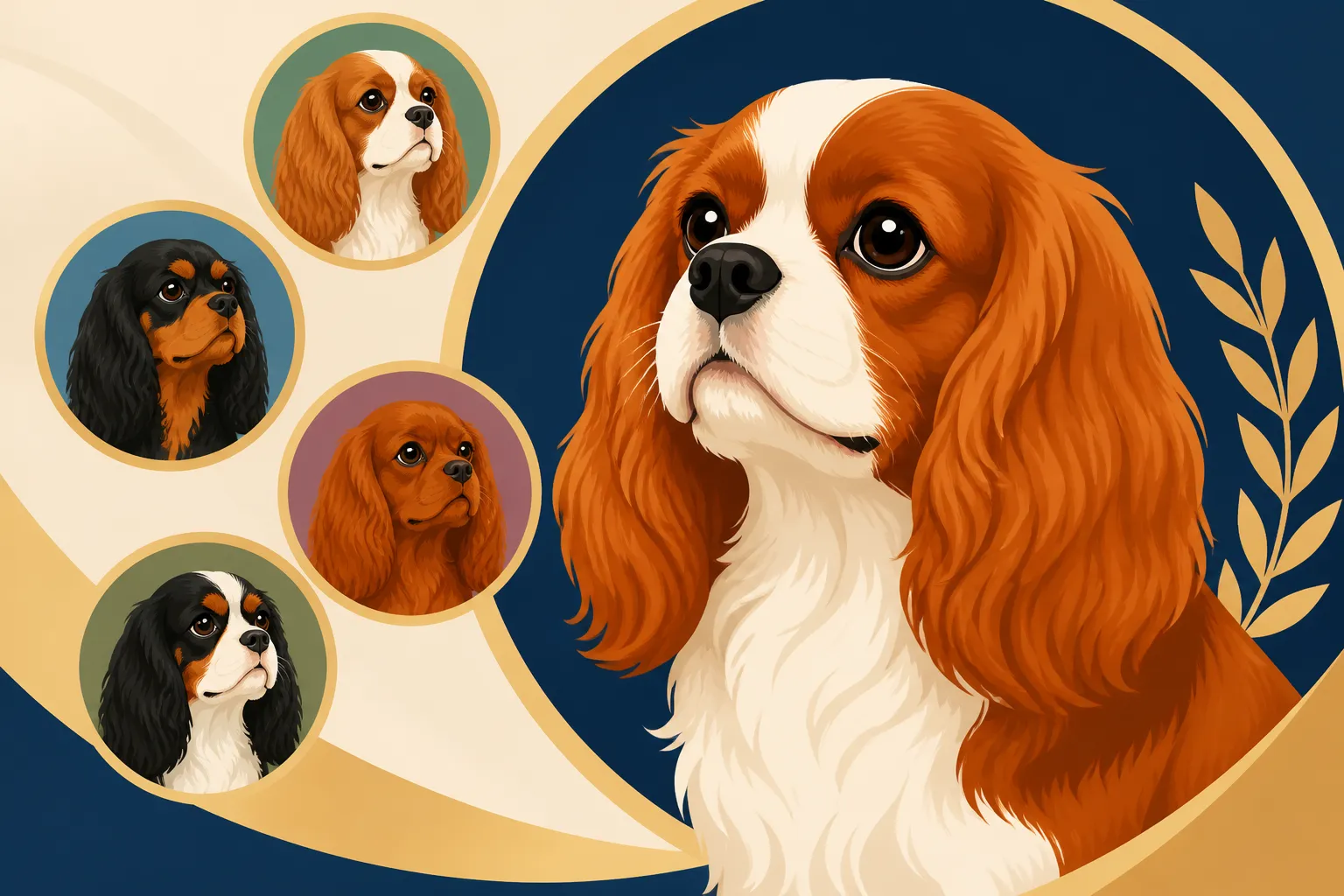
“Blenheim Spaniel” is another name that appears in histories of toy spaniels. Blenheim is strongly associated with chestnut-and-white spaniels and the estate of Blenheim Palace, where the family of the Duke of Marlborough kept these dogs. In modern Cavalier terminology, Blenheim describes one of the breed’s recognized coat colors; it does not name a separate breed.
Other old descriptions may refer to dogs by coat color or pattern rather than by a modern breed name. Ruby and black-and-tan spaniels, for example, may be described in historical or informal writing using labels that do not line up neatly with the names used today. A color name can tell you something about appearance, but not necessarily about the dog’s formal breed identity.
| Historical or modern term | How to understand it | What it does not establish |
|---|---|---|
| Titian Spaniel | A historical or descriptive name associated with an old-fashioned toy spaniel type | A separate modern breed or proven ancestry |
| Blenheim Spaniel | A historical name linked to chestnut-and-white spaniels; Blenheim is also a Cavalier coat color | That every dog called Blenheim Spaniel is a modern Cavalier |
| King Charles Spaniel | A historical term, and also a modern breed name in some regions | That it always means Cavalier King Charles Spaniel |
| English Toy Spaniel | The name commonly used in the United States for the breed called King Charles Spaniel in the United Kingdom | An interchangeable name for the Cavalier |
| Cavalier King Charles Spaniel | The modern breed name for the Cavalier | That every old portrait or historical spaniel belonged to the modern breed |
If a label appears in a family document or an old advertisement, keep the original wording when recording it, then add a note that its meaning may be historical rather than precise. That approach preserves the evidence without making a stronger claim than the source supports. For more on the dogs and place behind the Blenheim name, see The Blenheim Palace Dogs Behind the Cavalier.
How the Cavalier became a distinct breed
The old type and changing Victorian fashions
The Cavalier’s story includes a split between two ideas of what a toy spaniel should look like. Over time, fashion favored a shorter muzzle and a more domed head in some toy spaniels. The dogs associated with that appearance became the ancestors of the modern King Charles Spaniel or English Toy Spaniel, depending on regional naming.
Other enthusiasts preferred the longer-faced spaniel they believed resembled earlier dogs in paintings and descriptions. They did not necessarily use one consistent name for this preferred type. “Old type” and “Titian Spaniel” are among the terms people may encounter when reading accounts of the movement to bring back that look.
The historical record is not as tidy as a modern breed directory. Names shifted, descriptions were not always standardized, and a person using an old label might not have meant exactly what a later breeder meant by it. If you want to understand the appearance advocates hoped to restore, The Old Type of Cavalier Eldridge Wanted Back offers helpful context.
Roswell Eldridge and the Cavalier revival
The modern Cavalier’s revival is closely associated with Roswell Eldridge, an American who wanted to see toy spaniels resembling the older type. At Crufts in 1926, he offered prize money for dogs of that appearance. His effort encouraged breeders and fanciers to seek out and develop dogs that matched the look he had in mind.
The revival did not instantly create the modern breed as we know it. Early dogs were shown and discussed as old-type King Charles Spaniels, and fanciers had to build agreement around the dogs’ appearance and identity. Over time, the Cavalier King Charles Spaniel became a distinct breed with its own name and standard. For the story of Eldridge’s role, read How Roswell Eldridge Brought Back the Cavalier and The 1926 Advertisement That Revived the Cavalier.
This history helps explain why “Titian Spaniel” and “Cavalier” sometimes appear near each other in discussions of old spaniels. The names point toward a shared interest in a longer-faced, less domed-headed appearance, but they are not identical labels. “Titian Spaniel” belongs to the historical vocabulary around old types; “Cavalier King Charles Spaniel” is the modern breed name.
How to interpret old names today
When researching a portrait, pedigree, or family record
If you find “Titian Spaniel” in an old book, newspaper, or family record, note the date, location, and surrounding wording. Ask whether the writer is describing a specific dog, a general type, or a fashionable nickname. It may help to compare the description with other names used in the same source, but avoid treating a single phrase as proof of breed.
For a portrait, record what can be observed—coat color, apparent size, head shape, and the date or artist if known—separately from what is inferred. A dog painted with a long muzzle may resemble the type later associated with the Cavalier, but appearance alone cannot confirm its exact lineage. This careful distinction is especially useful when a family story says an ancestor owned a “Titian Spaniel.” You can preserve that story while noting that the label may not correspond to a modern registration category.
For a living dog, rely on current identification sources rather than historical terminology. A pedigree, rescue record, or veterinary file may provide more useful information than a description copied from an old text. If the records are incomplete, it is reasonable to say “described in the family record as a Titian Spaniel” rather than translating the name into a modern breed with certainty.
Searching with the right terms
When researching online, try several spellings and related names. Searching only “Titian Spaniel” may bring up a narrow set of historical references, while “old type King Charles Spaniel,” “Cavalier history,” or “Blenheim Spaniel” may reveal more context. Compare sources rather than assuming that every result uses the terms in the same way.
Modern shopping and care listings are a separate matter. If you are looking for contemporary supplies on a retailer such as Chewy, the current breed name “Cavalier King Charles Spaniel” is more useful than “Titian Spaniel.” A product listing under a modern breed label is not evidence about historical ancestry, and a historic search term is not a substitute for a dog’s health or pedigree records.
The same caution applies if you are comparing breed descriptions across websites. Chewy or another retailer may organize products by familiar present-day breed names, while historical books may use older labels or color descriptions. Treat those as different kinds of information: one helps you find current care products, and the other helps you understand the past. Chewy’s breed-related search terms, like any retail category, should not be read as formal proof of a dog’s lineage.
Ultimately, “Titian Spaniel” is best understood as a historical name connected with the old-fashioned toy spaniel type that Cavalier enthusiasts admired. It illuminates a chapter in the breed’s story, but it is not a separate modern Cavalier variety. Keeping that distinction in mind makes old descriptions easier to read—and helps avoid turning an evocative nickname into a claim the historical evidence cannot support.
Disclaimer
This article is for general informational purposes only and does not constitute professional advice. Laws, prices and regulations vary by location and change over time. Consult a qualified professional for guidance on your specific situation.