Losing a Cavalier to Traffic and How It Happens
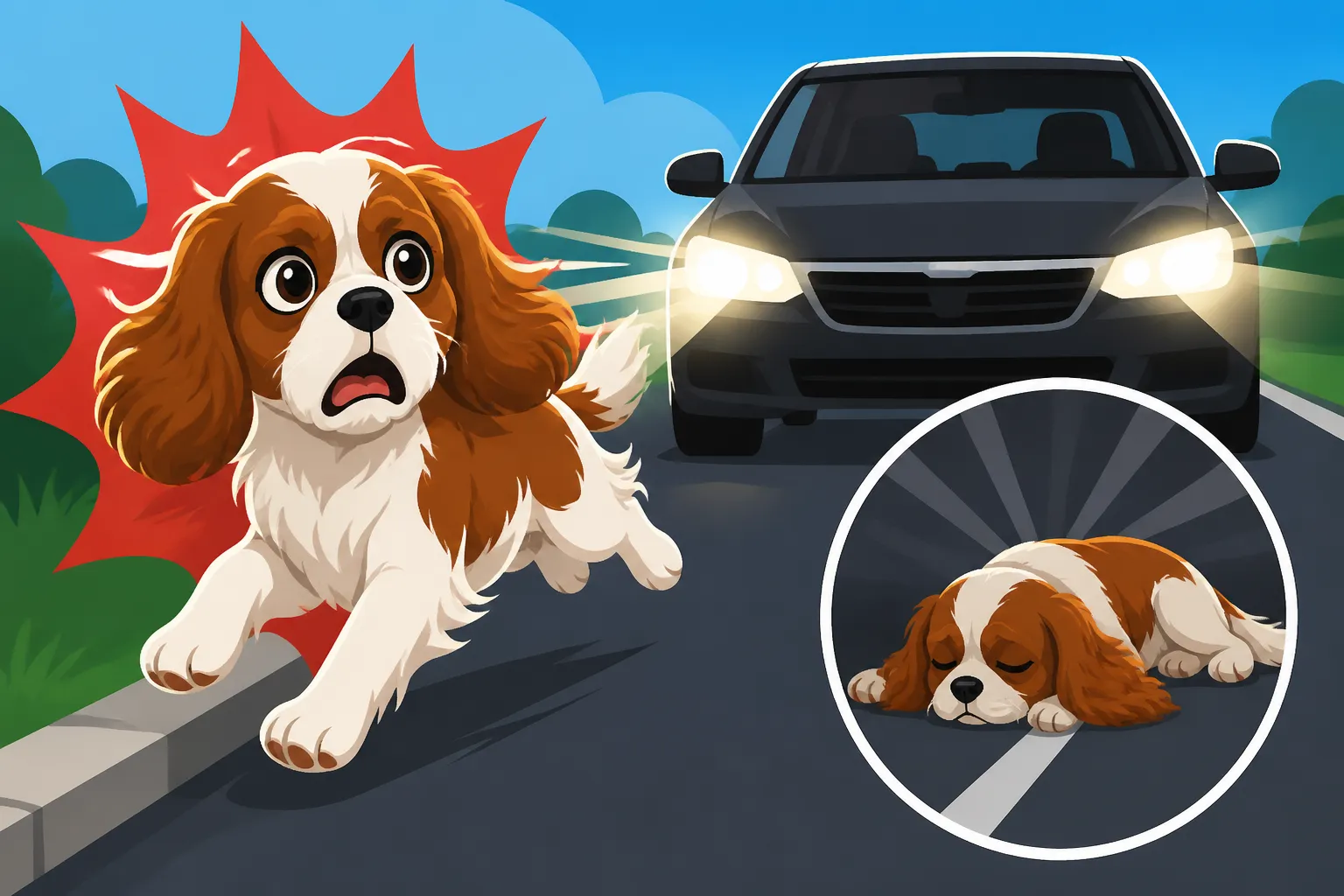
It’s every Cavalier owner’s deepest fear: that heart-stopping moment when your beloved companion, so full of joy and trust, darts unexpectedly into the path of a vehicle. Despite their affectionate nature and generally biddable personalities, Cavaliers can be alarmingly oblivious to the immediate dangers of traffic. This guide aims to thoroughly explore the specific traits and common scenarios that unfortunately lead to Cavaliers being hit by cars, and crucially, provides detailed, actionable strategies to help you protect your cherished family member from this preventable tragedy.
The Cavalier's Instinctual Blind Spot to Danger
Cavalier King Charles Spaniels are renowned for their sweet, gentle, and utterly devoted temperaments. They are bred to be companion dogs, thriving on human interaction and affection. However, these very traits, combined with certain breed characteristics, can inadvertently make them quite vulnerable in situations involving traffic. Unlike some breeds with strong territorial instincts or a deep-seated suspicion of strangers, Cavaliers are often eager to greet everyone and explore everything with boundless enthusiasm, sometimes to their detriment.
The Friendly Nature and Lack of "Street Smarts"
One of the most endearing qualities of a Cavalier is their inherent friendliness. They rarely meet a stranger they don't love, whether that's a person, another dog, or even a curious squirrel. While this makes them wonderful companions, it can translate into a startling lack of caution around potential dangers. A Cavalier seeing a person they want to greet on the other side of a street, or catching a whiff of something interesting, might simply not register the speed and sound of an approaching car as a threat. They don't typically have the innate "street smarts" that make some dogs hesitate at a curb. Their world is often focused on positive interactions and exploration, not self-preservation in the face of machinery.
This trusting nature means they aren't scanning for danger in the same way a dog with a stronger fight-or-flight instinct might. A sudden loud noise might startle them, but their primary response is often to bolt towards what they perceive as safety (which could still be across a road) or to simply continue their investigation, rather than to freeze or retreat to a safe space. This makes reliable leash handling and secure containment paramount for this breed.
The Spaniel Drive and Distractibility
Beneath the cuddly companion exterior, the Cavalier still carries the instincts of its spaniel ancestors. While they may not have the intense prey drive of a Border Collie or a Jack Russell, they certainly have a strong inclination to follow their nose and explore. A particularly enticing scent, a bird fluttering past, or even another dog playing can capture their attention completely, overriding any training or awareness of their surroundings. You might have seen your Cavalier suddenly lock onto a scent trail during a walk, dragging their nose along the ground with singular focus. This intense focus, while charming in a park, is a critical vulnerability near roads.
Their curious nature means they are easily distracted. If they are off-leash, even for a moment, and something catches their eye or nose across a busy street, their instinct to investigate can quickly overwhelm their training or your verbal commands. This is particularly true for things like squirrels or birds, which can trigger a chase response, as detailed in Why a Cavalier Chases Birds Into the Road. For a Cavalier, the allure of the chase or the promise of an exciting smell can be far more compelling than the sound of traffic or your urgent calls.
Common Scenarios Where Cavaliers Get Into Traffic Trouble
It's easy to assume that accidents only happen to "other people" or to poorly trained dogs. However, the reality is that many traffic incidents involving Cavaliers occur in what seem like everyday, innocent situations. Understanding these common scenarios is the first step toward preventing them.
The Open Door or Gate Escape Artist
This is perhaps the most frequent and heartbreaking scenario. Cavaliers are quick. A door left ajar for "just a second," a child accidentally leaving the gate unlatched, or a delivery person not fully closing a barrier – these brief lapses are all it takes. A Cavalier sees an opening, a new world to explore, and bolts. They don't linger to check for cars; they simply go. Their small size and speed mean they can be out of sight and into traffic before you even realize what's happened.
Think about common household routines: bringing in groceries, grabbing mail, welcoming guests. Each instance creates a potential escape route. For homes with multiple entry points, or where children are frequently coming and going, the risk multiplies. A simple breeze can sometimes swing an improperly latched gate open just enough for a determined little dog to squeeze through. The trust they place in their human family means they often don't have a concept of the dangerous "outside" beyond the property line.
Bolting from the Leash or Harness Malfunction
While leashes are our primary tool for safety, they are only as secure as the equipment and our handling. A common occurrence is a Cavalier slipping their collar or harness due to a poor fit or a sudden, unexpected pull. Cavaliers, with their sometimes delicate necks and deep chests, require a well-fitting harness that cannot be backed out of. A standard flat collar can be easily slipped if the dog is determined or startled, especially if it's not snug enough.
Beyond equipment, human error can play a part. Perhaps a leash is dropped during a sudden lurch, or the clip on the leash malfunctions. These are rare but devastating events. Even more common is a Cavalier pulling so hard after a scent or a person that the leash is yanked from an owner's hand. This is why cultivating good Leash Manners for a Cavalier That Pulls is crucial, not just for comfort, but for absolute safety. Many owners swear by a Y-front harness, easily found on platforms like Amazon, as it distributes pressure more comfortably and makes escape much harder compared to a traditional collar.
Sudden Movements on Walks Near Roads
Even with the best intentions, walks near roads can be perilous. A Cavalier might be happily trotting along, and then something unexpected happens: a loud truck backfires, a bicycle whizzes past, or another dog lunges from a yard. These sudden, startling events can cause even the calmest Cavalier to panic and lunge, twist, or attempt to run. If this happens while you're close to a curb, they can easily end up in the street.
The issue is compounded by the fact that many Cavaliers have a fairly low center of gravity and can be surprisingly strong for their size when they decide to pull. A quick, unexpected jerk can throw an owner off balance, particularly if they are not anticipating it. It's a stark reminder that even a well-behaved dog can react unpredictably when genuinely frightened or suddenly overstimulated.
Preventative Measures to Keep Your Cavalier Safe
Preventing traffic accidents is a multi-faceted approach, combining secure containment, vigilant supervision, and appropriate equipment. It’s about building layers of safety to account for both human error and canine instinct.
The Leash as a Lifeline: No Exceptions Near Roads
Let's be blunt: near any road, a Cavalier should always be on a leash. There is simply no level of training that guarantees 100% reliability against the unpredictable variables of traffic, other animals, loud noises, or sudden enticing scents. Even a perfectly trained dog can have an "off" day, or be momentarily overwhelmed. The idea of "just for a second" off-leash near a road is a gamble with the highest possible stakes. Many owners tragically learn Whether a Cavalier Can Ever Be Off Leash the hard way.
Choose a leash that is sturdy and comfortable for your hand, and ensure the clip mechanism is robust. Combine this with a properly fitted harness that discourages slipping. As mentioned before, a Y-front harness is often recommended over a collar for Cavaliers, especially around busy areas, as it reduces pressure on their delicate trachea and makes backing out significantly harder. You can find many reputable brands of such harnesses, as well as sturdy leashes, readily available on Amazon. For added security, some owners even practice double-leashing, attaching one leash to the harness and another to a flat collar, or using a leash that clips to two points on a harness.
Secure Fencing and Home Management
Your home environment is the first line of defense. If your Cavalier has access to a yard, that yard must be securely fenced. This means checking for gaps, loose panels, or areas where your dog could dig under. Given their small size, a small gap can be a big problem. Regular checks for wear and tear are essential. For those without a fenced yard, or for temporary situations, portable pet gates can create a secure "airlock" system at entryways, providing a buffer zone between an exiting door and the street.
Inside the home, establish clear rules about doors. Everyone in the household, from adults to older children, needs to understand the importance of keeping exterior doors closed and secure. Consider installing spring-loaded hinges or automatic door closers on frequently used doors, or even alarm systems that chime when a door is opened. For a truly determined escape artist, even installing a small, secure outdoor kennel run (with a roof, to prevent jumping) can provide safe outdoor time without direct road exposure. Creating a truly Fencing a Yard a Cavalier Will Not Leave requires vigilance and attention to detail.
Car Safety: Restraints and Carriers
The journey to safe walking areas also carries risks. An unrestrained Cavalier in a car can be a projectile in an accident, or, just as dangerously, can interfere with the driver, or even jump out of an open window or door at a stop light. Always use appropriate car restraints. This could be a crash-tested car seat designed for small dogs, a sturdy crate securely fastened in the vehicle, or a harness that clips into a seatbelt. These not only protect your Cavalier in case of a collision but also prevent them from becoming a distraction or an escape risk when doors are opened. Investing in proper Car Seats and Restraints for a Cavalier is a non-negotiable part of responsible ownership.
| Containment Method | Pros | Cons | Best Use Case |
|---|---|---|---|
| Flat Collar & Leash | Easy to put on, widely available | Can slip out of, tracheal pressure, less control | Low-risk, calm walks, identification |
| Y-Front Harness & Leash | Secure against slipping, pressure distributed | Can be trickier to fit, less common than collars | Everyday walks, training, dogs prone to pulling/slipping |
| Double Leash (Harness & Collar) | Maximum security, backup in case of failure | More equipment to manage, can feel bulky for dog | High-traffic areas, anxious dogs, emergency prevention |
| Secure Fenced Yard | Off-leash freedom at home, safe play area | Requires regular maintenance, escape-proof checks | Daily exercise, unsupervised outdoor time at home |
| Car Crate/Restraint | Critical safety in vehicles, prevents distraction | Takes up space, dog might not enjoy confinement | Car travel, vet visits, preventing car escapes |
| Indoor Gates/Airlocks | Prevents door-dashing, creates safe zones | Requires consistent human use, can be jumped by some dogs | Entryways, open floor plans, preventing household escapes |
Training Strategies for Road Safety
While physical barriers and restraints are crucial, targeted training can significantly enhance your Cavalier's safety and your peace of mind. The goal isn't to make your Cavalier "road-savvy" enough to go off-leash, but to build a foundation of focus and responsiveness that acts as an additional layer of protection in unexpected situations.
Cultivating a Reliable Emergency Recall
A solid recall is paramount for any dog, but especially for a Cavalier. This isn't just about calling them in from the park; it's about an emergency recall that overrides powerful distractions. This needs to be practiced relentlessly in increasingly distracting environments, but never near an open road where failure could be catastrophic. Start indoors, then move to a securely fenced yard, and finally to a long line in an open field, like practicing Long Line Practice for a Cavalier.
Your recall word should be distinct and used only for recall, never for scolding or other commands. Make coming to you the most rewarding thing your Cavalier can do, with high-value treats and enthusiastic praise. Building this foundation means that if they ever do accidentally get loose near a road, you have a fighting chance. While no recall is foolproof, especially for a Cavalier who "forgets" cars exist, a strong, happy association with coming to you can literally be a lifesaver. Resources like BAXTER & Bella offer comprehensive online puppy and dog training programs that include detailed recall instruction, which can be invaluable for owners.
The Power of "Leave It" and "Watch Me"
Two commands that are incredibly useful for road safety are "Leave It" and "Watch Me." "Leave It" teaches your Cavalier to disengage from something tempting – whether it's a discarded chicken bone on the sidewalk or a bird on the grass near the curb. Practicing this command consistently, starting with low-value distractions and gradually increasing the challenge, can prevent them from darting towards dangerous objects.
"Watch Me" (or "Look at Me") teaches your Cavalier to make eye contact with you on cue, shifting their focus from the environment to you. This is invaluable when you're approaching a busy intersection, hear a loud noise, or see a potential distraction ahead. It's a quick way to regain their attention and reinforce their connection to you, allowing you to calmly navigate them past a potential hazard. This command helps address the Cavalier's tendency to simply not notice cars, as discussed in Whether a Cavalier Notices Cars At All. Consistent practice means they are less likely to get so engrossed that they become oblivious to your guidance.
Controlled Exposure and Desensitization
While you should never deliberately expose your Cavalier to uncontrolled road traffic, you can work on desensitizing them to the sights and sounds of the environment from a safe distance. Spend time with your Cavalier on a leash in areas near roads (but not immediately adjacent) where you can observe traffic safely. Reward calm behavior, and use "Watch Me" to draw their attention to you when large trucks or loud motorcycles pass by. The goal is not for them to ignore traffic, but to learn to remain calm and focused on you despite the surrounding activity.
This controlled exposure helps to make traffic less of a sudden, startling event and more of a predictable background noise. It helps prevent those panic-induced lunges that can lead to accidents. Always remember that for Cavaliers, their natural inclination is often to be happy and engaged with their human. By fostering that bond and reinforcing good behavior in the face of distractions, you build trust and responsiveness that can serve as an emergency brake in a dangerous situation. It's an ongoing process, and the safety of your Cavalier is always worth the effort.
Disclaimer
This article is for general informational purposes only and does not constitute professional advice. Laws, prices and regulations vary by location and change over time. Consult a qualified professional for guidance on your specific situation.