What a Tricolor Cavalier’s Markings Should Look Like
Many aspiring Cavalier King Charles Spaniel owners fall in love with the striking appearance of a Tricolor, a beautiful tapestry of black, white, and tan. However, understanding what constitutes the "correct" markings according to breed standards can feel a bit like deciphering a secret code, leaving you wondering if a particular patch is "right" or "wrong." This guide will meticulously break down the ideal Tricolor Cavalier markings, helping you appreciate their distinct beauty and understand what to look for, whether you're admiring a show dog or choosing a beloved pet.
Understanding the Tricolor Cavalier Standard
The Cavalier King Charles Spaniel breed standard is essentially the blueprint for what an ideal Cavalier should look like, describing everything from their head shape to their tail set, and, of course, their coat colors and markings. For the Tricolor, this standard paints a very specific picture of how the black, white, and tan should be distributed to create that classic, eye-catching appearance. It’s not just about having three colors; it's about where those colors lie and how they create balance.
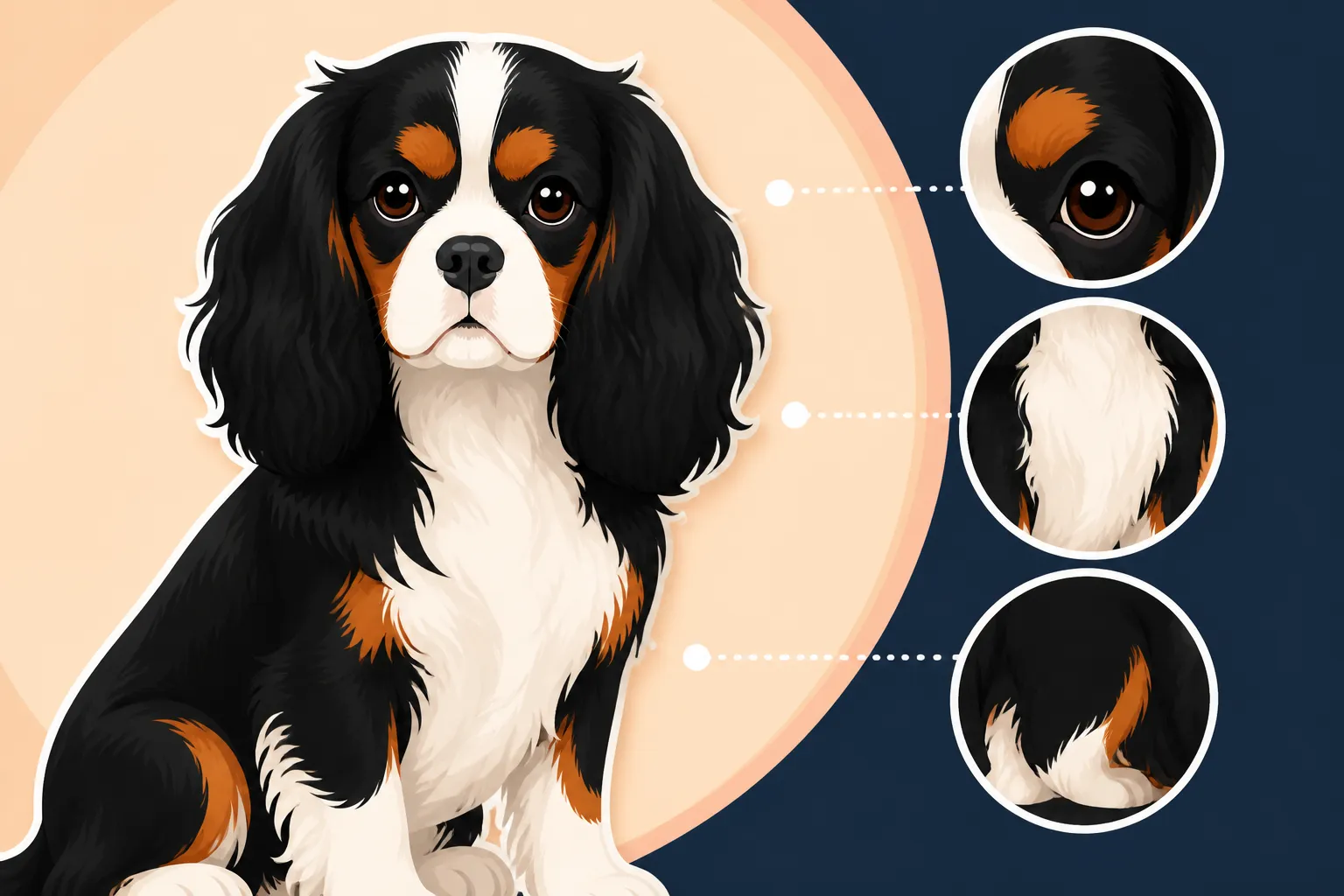
The expectation for a Tricolor Cavalier is often described as "black and white, well broken up, with tan markings over the eyes, on the cheeks, inside the ears, and on the underside of the tail." This might sound like a lot of jargon if you're new to the breed, but it's really quite straightforward once you visualize it. The goal is a clear, crisp division between the colors, with each playing a distinct role in the overall pattern. Think of it as a painter meticulously placing each shade for maximum effect.
While the standard sets an ideal, it's important to remember that not every perfect pet Cavalier will perfectly match every single nuance. The standard is primarily for show dogs, defining the ideal to strive for in the breeding program. For a family companion, these specific placements might matter less, but understanding them certainly enhances your appreciation for the breed's beauty and heritage. It also gives you a deeper insight into the thought process behind what makes The AKC Standard for the Cavalier King Charles Spaniel what it is.
The Significance of "Well Broken Up"
When the standard mentions "well broken up," it's specifically referring to the black and white portions of the coat. This means you shouldn't see large, solid sheets of black or white across the body. Instead, the white should break up the black patches, creating distinct, irregular shapes. Imagine a canvas with bold black strokes, then white filling in around them, preventing any one color from dominating too much.
This "broken up" pattern is what gives the Tricolor its dynamic look, moving away from a solid black dog with white patches, or a solid white dog with black patches. It’s about a harmonious interplay. On the back, for example, you would typically see a saddle of black broken by white, rather than just a completely black back. This intricate dance of color adds to the charm and individuality of each Tricolor.
Sometimes, puppies might have very large black patches, or conversely, be almost entirely white with just a few black spots. While these variations don't impact their health or their loving nature, they might not align with the "well broken up" ideal sought in the show ring. However, they are still beautiful and unique The Tricolor Cavalier in their own right, and those slight differences often become cherished quirks to their families.
Anatomy of a Tricolor Cavalier's Markings
Let's get down to the nitty-gritty of where these beautiful colors are expected to be. A Tricolor Cavalier is a masterclass in pattern, with specific points for each of its three hues: the crisp white base, the rich black patches, and the warm tan accents. Each color has its designated areas, contributing to the breed's signature look. It's truly fascinating how consistently these patterns appear, generation after generation, when breeders adhere to careful selection protocols.
Understanding these specific placements can also help you differentiate a Tricolor from other patterned Cavaliers, or even from mixed breeds that might resemble them. It's a key part of appreciating Whole Colors Against Particolors in Cavaliers and what makes each pattern unique to the breed.
The Face: A Canvas of Three Colors
The face of a Tricolor Cavalier is perhaps where the most intricate and recognizable markings are found. Typically, the muzzle should be white, extending up between the eyes to form a blaze. This white blaze should be symmetrical and clear, acting as a clean divide between the black and tan on either side of the head. It's like a perfectly drawn line down the center.
On either side of this white blaze, you'll find prominent black patches covering the cheeks and ears. Within these black patches, the tan markings are crucial: a distinct tan spot should sit above each eye, almost like eyebrows, and tan should also be present on the cheeks, often blending with the black. The inside of the ears should also show tan, even if the outside is black. These tan points give the Tricolor an incredibly expressive and endearing face, almost as if they're constantly raising an eyebrow at you.
Sometimes, you might see a Tricolor with a very minimal white blaze, or even a solid black head with tan points. While still adorable, these variations stray from the ideal of the clear, white facial stripe. The tan points, particularly those above the eyes, are considered highly characteristic and add significantly to the "sweet expression" that Cavaliers are famous for.
Body and Legs: Patches and Pockets of Color
Moving to the body, the standard asks for the black and white to be "well broken up." This means large, distinct black patches on a predominantly white body. The ideal scenario sees black patching over the back, flanks, and sometimes a patch on the tail. The white should act as a background, creating contrast and definition. It’s not a dappled or speckled pattern; it’s bold, clear patches.
The legs and chest are typically predominantly white, with minimal black patching. You might see small black spots, often referred to as "ticking," on the white areas, particularly on the legs. While some ticking is generally accepted, excessive ticking can sometimes be seen as less desirable in the show ring, as it can muddy the crisp white appearance. However, for a pet, these little freckles just add to their charm.
The tan markings on the body are less extensive than on the face. You'll typically find tan on the underside of the tail, where the white meets the black. Occasionally, you might see a faint wash of tan on the elbows or around the hocks, but these are secondary to the primary tan points on the face and tail. The overall effect should be a clear definition between the black, white, and tan, showcasing the distinct patches.
Variations and What They Mean for Your Cavalier
While the breed standard provides a clear picture of the ideal Tricolor markings, nature often has its own plans. Cavaliers are born with a wonderful array of variations, and it's rare to find a dog that's a perfect photocopy of the standard's description. These variations don't make a Cavalier any less valuable as a companion; they simply indicate a deviation from what's considered ideal for the show ring. Understanding these differences can help you appreciate your dog's unique beauty and know what to expect when looking at Cavalier Puppy Prices From a Reputable Breeder or even older rescue dogs.
For most pet owners, these subtle differences are part of what makes their Cavalier special. It's about loving the dog in front of you, regardless of whether their facial blaze is exactly symmetrical or if they have a few extra spots. The core Cavalier temperament—sweet, affectionate, and eager to please—remains constant across all colors and patterns.
Too Much or Too Little White
One common variation is the amount of white on a Tricolor. Some Cavaliers might have too much white, appearing almost entirely white with just a few small black and tan patches. Conversely, some might have very limited white, giving them a predominantly black and tan appearance with only small white breaks. Neither of these extremes is considered ideal for the show ring, but they are perfectly healthy and normal variations.
A Cavalier with excessive white might lack the "well broken up" appearance, instead presenting as a white dog with sparse patches. On the other hand, a Cavalier with too little white might look more like a solid black and tan dog that happens to have a few white splashes. Both are still Tricolors by definition, but they illustrate the spectrum of how these three colors can manifest.
When it comes to the white, clarity and crispness are highly valued. Any blurring or muddiness between the colors is usually less desirable. For example, if the white on the legs is heavily ticked with black, it might not look as clean as the standard suggests. But let's be honest, a little ticking often gives them a charming, almost mischievous look.
Misplaced or Faded Tan Markings
The tan markings are the heart of the "tricolor" aspect, giving the black and white its warmth and depth. Variations in these tan points are quite common. You might see a Cavalier where the tan spots above the eyes are very faint or completely absent, leading to a more stark black-and-white face. Or, the tan on the cheeks might be minimal, not as richly colored or as extensive as desired.
Sometimes, the tan might appear in unexpected places, such as small tan smudges on the white areas of the body or legs. While the standard specifies tan points primarily on the face, inside the ears, and under the tail, these additional tan flecks don't diminish the dog's quality as a companion. They are simply variations in pigment distribution.
Another aspect is the intensity of the tan. Ideally, the tan should be a rich, clear chestnut color. Some Cavaliers might have very pale tan, almost cream-colored, which can make the markings less distinct. Others might have very dark tan that almost blends into the black. These variations are often genetically determined and are part of the wonderful diversity within the breed.
What to Look for in a Tricolor Puppy
When you're looking for a Tricolor Cavalier puppy, especially if you're interested in the breed standard or simply want a dog with the classic look, there are a few things to keep in mind. While perfect markings aren't necessary for a perfect pet, knowing what to look for can help you identify a puppy that aligns with your preferences. Remember, even puppies with "non-standard" markings can grow into magnificent, loving companions.
It's also crucial to focus on health and temperament above all else. A beautifully marked puppy won't be a joy if it has significant health issues or a poor disposition. Always prioritize a breeder who performs all recommended health clearances, such as those discussed in The Heart Testing a Cavalier Breeder Must Do and The DNA Tests Every Cavalier Should Have.
| Feature | Ideal Tricolor Markings (Breed Standard) | Common Variations (Still Lovely Pets!) |
|---|---|---|
| Facial Blaze | Clear, symmetrical white blaze between eyes, up the muzzle. | Narrow, wide, or off-center blaze; sometimes interrupted by black/tan. |
| Eye Spots | Distinct, rich tan spots above each eye, like "eyebrows." | Faint, small, or absent tan eye spots; can be uneven. |
| Cheeks & Ears | Black cheeks with clear tan accents; tan inside ears. | Predominantly black cheeks with minimal tan; tan may be faint or absent inside ears. |
| Body Patches | Black patches "well broken up" by white; distinct, clear edges. | Large, solid black patches; very sparse black patches; muddy edges. |
| Legs & Chest | Predominantly white; minimal black patches, light ticking acceptable. | Significant black patching on legs/chest; heavy ticking (freckles) on white areas. |
| Tail | Black patch on top, white tip, tan underneath. | All black tail; all white tail with black/tan base; tan on top of tail. |
Evaluating a Puppy's Markings
When you visit a litter, take a good look at the puppies' faces. Do they have that characteristic white blaze and distinct tan eyebrows? Is the white on their chest and legs relatively clean, or do they have a lot of tiny black freckles (ticking)? While ticking can appear more prominently as a puppy grows, you can usually get a good sense of its potential extent. Whether a Cavalier Puppy's Color Changes can give you more insight into how their coat develops.
Observe the distribution of black and white on their bodies. Are the black patches clearly defined against the white? Is there a good balance, or does one color seem to overwhelm the other? For instance, a puppy that appears nearly all white with only a few small black patches might not fit the classic Tricolor image, but could still be an exceptionally sweet family member.
Remember, a puppy’s coat will continue to mature, but the basic pattern of a Tricolor is usually evident from a very young age. Don't be shy about asking the breeder about their specific lineage and how the markings tend to develop in their lines. A knowledgeable and ethical breeder will be happy to discuss what a Cavalier breeder's heart clearance is current and other health aspects too.
Beyond the Markings: Prioritizing Health and Temperament
While it's fun to analyze markings, never let the desire for a specific look overshadow the importance of health and temperament. A Cavalier King Charles Spaniel should first and foremost be a healthy, well-adjusted dog. This means choosing a puppy from parents who have undergone extensive health testing for conditions common to the breed, such as Mitral Valve Disease and Syringomyelia. How Common Chiari Malformation Is in Cavaliers is a critical area for responsible breeders to address.
A good breeder will also focus on socializing their puppies, ensuring they are confident, friendly, and ready to adapt to a new home. They'll spend time with each puppy, giving them the best start in life. A puppy with perfect markings but a timid or anxious personality, or one prone to serious health issues, will ultimately bring more heartache than joy.
So, while you might have a preference for certain Tricolor markings, let it be a secondary consideration to the puppy's overall well-being. A Cavalier, regardless of its exact pattern, is a devoted and loving companion. The true beauty of your dog will always be found in their heart and the joy they bring into your home, not just in the precise placement of their black, white, and tan.
Disclaimer
This article is for general informational purposes only and does not constitute professional advice. Laws, prices and regulations vary by location and change over time. Consult a qualified professional for guidance on your specific situation.