Why a Cavalier Barks at Every Delivery
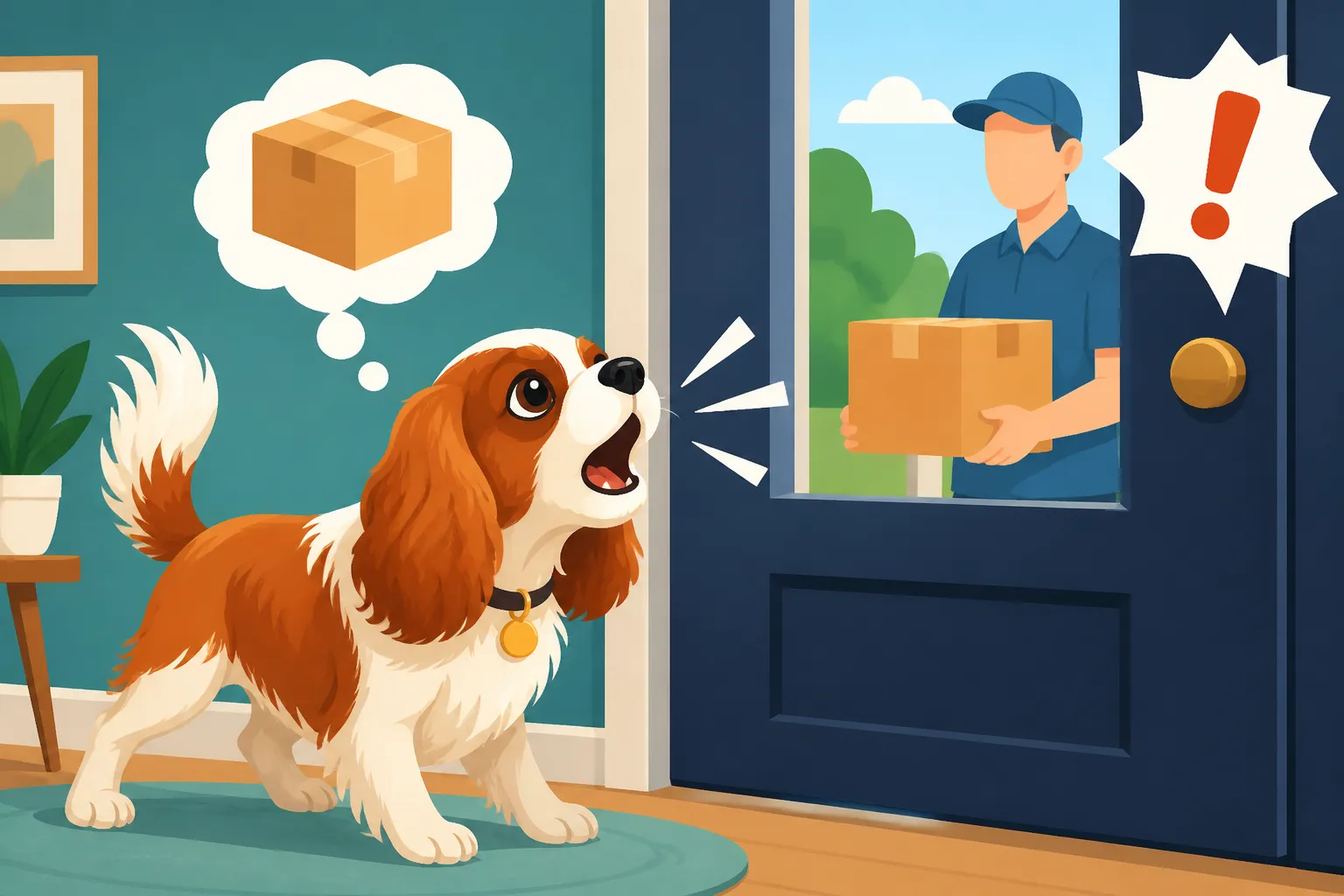
There's nothing quite like the sudden, ear-splitting bark of your beloved Cavalier when the delivery driver pulls up, is there? One minute, they're curled up sweetly on your lap, the next, they've transformed into a furry, yapping alarm system, sending your heart rate soaring and potentially startling the poor person just trying to drop off a package. This guide is here to help you understand why your Cavalier reacts so strongly to deliveries and, more importantly, what you can do to bring some much-needed peace back to your doorstep.
The Cavalier's Natural Instincts and Alertness
It’s easy to think of our Cavaliers as simply adorable, cuddly lapdogs, perfectly content with a life of snoozes and gentle walks. While they absolutely excel at being devoted companions, tucked away beneath that silky coat and sweet expression are the instincts of their spaniel ancestors. These aren't just fluffy ornaments; they're dogs, and dogs have a natural inclination to observe, react, and protect their perceived territory and family.
More Than Just a Lapdog: Hidden Spaniel Traits
Think back to the Cavaliers of old – the "Comforter Spaniels" that warmed laps and graced royal courts. While their primary role evolved to be companions, they still possess a keen awareness of their surroundings. Their original spaniel purpose involved flushing out birds and working alongside humans, which means they were bred to be attentive and responsive to cues and changes in their environment. This inherent alertness, coupled with their strong bond with their human family, often translates into a desire to "notify" you of anything out of the ordinary.
So, when the FedEx truck rumbles down the street or the Amazon van pulls up, your Cavalier isn't just being "naughty." They're tapping into that primal instinct to be vigilant. They might see a large, unfamiliar vehicle, hear strange sounds, or catch an unusual scent, all of which trigger their internal alarm system. Their barking is often their way of saying, "Hey! Something's happening! Are you seeing this? Should we be worried?" It's their attempt to be a tiny, furry neighborhood watch, even if their methods are a bit… loud.
Furthermore, these tiny spaniels were historically kept in bustling households, full of activity and people coming and going. They learned to be part of the household fabric, and an element of that was being aware of who was present and who was arriving. While it wasn't about guarding in an aggressive sense, it was certainly about being part of the social dynamic. Modern deliveries, with their often impersonal and abrupt nature, can be a jarring interruption to their carefully observed routine, triggering a more intense reaction than a familiar guest.
Consider, too, that despite their small size, Cavaliers have excellent hearing and scent detection capabilities. What might seem like a subtle change to us – the barely audible crunch of gravel or the faint smell of a different uniform – can be a symphony of new information to your dog. They process these stimuli far more intensely than we do, leading to a heightened state of alert. For them, a delivery isn't just a package; it's a sensory event demanding their full, vocal attention.
The "Velcro Dog" Effect and Territoriality
Cavaliers are famously known as "Velcro dogs" for a reason – they adore being close to their people, often following you from room to room. This deep attachment is one of their most endearing qualities, but it also plays a significant role in their delivery barking. When someone new approaches your home, your Cavalier perceives this as an intrusion into their territory and, more importantly, your shared space. Their barking isn't necessarily aggressive, but rather a protective declaration: "This is our home, and my humans are here. Who are you, and what do you want?"
This territorial instinct is amplified by their strong bond with you. They see themselves as part of your family unit, and protecting that unit, even from a friendly delivery person, becomes a priority in their little dog brains. They aren't trying to be a nuisance; they're trying to do their job as your loyal companion. This can be especially true if they are alone with you when a delivery arrives, as they might feel an even stronger responsibility to alert you to the perceived "threat." For more on this bond, you might find Why a Cavalier Follows You Room to Room sheds some light on their clingy nature.
It’s also worth noting that because they are so often at our side, Cavaliers are highly attuned to our own behaviors and reactions. If we tense up, rush to the door, or even murmur "Oh no, it's the postman," our dogs pick up on that subtle shift in our demeanor. They learn to associate these human reactions with the arrival of the delivery person, further reinforcing their own alert behavior. They might think, "My human is reacting, so this must be important!" and their barking intensifies as a result.
The perception of "territory" for a Cavalier can be quite expansive, extending beyond just the four walls of your house. It can include the yard, the sidewalk directly in front of your property, and even the general street view they have from a window. Anything or anyone entering this perceived zone can trigger their protective instincts. Their small size doesn't diminish their sense of responsibility; in fact, some smaller breeds tend to bark more as a compensatory mechanism, trying to appear larger and more formidable than they actually are to ward off perceived threats.
Understanding the Triggers: Why Deliveries Are Such a Big Deal
It’s not just the delivery person themselves; it's the whole sensory experience that ramps up your Cavalier. Imagine your day as a Cavalier: mostly quiet, predictable, filled with naps and cuddles. Then, suddenly, a large, noisy vehicle appears, a stranger walks to your door, makes noises, and leaves an object. It's a lot for a small dog to process, and their reaction is often a mixture of surprise, curiosity, and a dash of "get off my lawn!"
The Unexpected Sights, Sounds, and Smells
For a Cavalier, a delivery isn't just a visual event. It's a full sensory assault. The sudden rumble of a heavy truck engine, the squeal of brakes, the slam of a car door, footsteps on the porch, a knock or ring – these are all distinct and often jarring sounds that break the silence of their day. They can hear and feel the vibrations of these vehicles long before we even register them. The unfamiliar uniform, the quick movement of the driver, and even the scent of a new person or vehicle (which is far more potent to a dog than to us) all contribute to an overwhelming sensory experience.
Think about it from their perspective. They might be enjoying a peaceful nap, only to be jolted awake by a sudden, loud noise. Their innate "startle reflex" kicks in, and the easiest, most immediate way for a dog to react to something unexpected or potentially alarming is to vocalize. It’s their way of both expressing their surprise and attempting to communicate with the perceived intruder. This is especially true if they spend a lot of time near a window, where they have a front-row seat to every passing truck and car.
Moreover, the routine of different delivery services often means different vehicles, different uniforms, and different patterns of approach. This inconsistency means your Cavalier rarely "gets used" to a single delivery person. Each new truck, each new face, is a novel event that demands investigation and a vocal announcement. The unfamiliarity prevents habituation, keeping their alert system on high alert. This constant novelty can make it really tough for them to learn that these visitors are, in fact, harmless.
Sometimes, it's even the small details, like the squeak of a package being placed on the porch or the brief shadow cast by the driver, that can set them off. Their acute senses pick up on these nuances that we completely miss. The combination of these auditory, visual, and olfactory stimuli creates a perfect storm for a highly sensitive and attentive breed like the Cavalier, leading to that characteristic burst of barks and excited tail wags (or sometimes anxious tail tucks).
Reinforcement: When Barking "Works"
One of the biggest reasons barking at deliveries becomes a persistent problem is because, from your Cavalier's perspective, it works. When they bark, the delivery person eventually leaves. They might drop the package and walk away, or perhaps you open the door, take the package, and the person departs. To your dog, this sequence of events teaches them a simple, yet powerful lesson: "My barking made the scary (or exciting) person go away!" This is a classic example of operant conditioning, where a behavior is strengthened because it achieves a desired outcome.
Every single time this happens, the behavior is reinforced. Your Cavalier is not being defiant; they are simply repeating a behavior that has proven successful in their past experience. It’s a very natural canine response. They don't understand that the delivery person was going to leave anyway; they only see that their actions (barking) were followed by the "intruder's" departure. This makes it a self-rewarding behavior, making it incredibly difficult to extinguish without consistent intervention.
Furthermore, sometimes we inadvertently reinforce the barking. When your Cavalier starts barking, you might rush to the door, perhaps say "No!" or "Quiet!" to them, or even pick them up to soothe them. While your intention is to stop the barking, these reactions can actually be perceived by your dog as attention – even negative attention is still attention. In their minds, they've successfully gotten your focus, further reinforcing that barking is an effective way to engage with you when something "important" happens. They might even interpret your rushing to the door as you joining them in their alarm call, thinking, "See? My human is worried too!"
Even if you ignore the barking entirely, the mere departure of the delivery person can be enough reinforcement. The key is to break this cycle of self-reinforcement. We need to teach them that barking doesn't make the person leave, or more effectively, that quiet behavior earns a much better reward. This requires a conscious effort to change the sequence of events and how your Cavalier perceives the outcome of their vocalizations.
Common Reasons for Barking at Deliveries
When your Cavalier launches into a barking frenzy at the sight of a delivery driver, it's not always for the same reason. Dogs bark for a variety of motivations, and understanding why your specific Cavalier is barking is the first step toward finding an effective solution. Is it genuine alarm, a cry for attention, pure frustration, or a hint of anxiety? Often, it's a mix of a few things!
Alarm Barking: "Intruder Alert!"
This is perhaps the most common reason for delivery barking. Your Cavalier, in their role as your tiny guardian, genuinely believes they are alerting you to a potential threat or anomaly. They see a stranger approaching their territory – your home – and their instinct is to sound the alarm. The barking is loud, insistent, and often accompanied by stiff body language, erect ears, and focused attention on the window or door. They are communicating, "Hey! Look! Someone's here, and I don't know them!"
For a Cavalier, their territory might extend beyond the physical boundaries of your house to encompass the front yard, the driveway, and even the street view from their favorite window perch. They feel a deep-seated responsibility to protect their den and their family. This type of barking often stops once the perceived "threat" (the delivery person) has left, reinforcing their belief that their valiant efforts successfully drove the intruder away. It's a completely natural, albeit often inconvenient, canine behavior rooted in their protective instincts.
Sometimes, this alarm barking isn't necessarily about fear, but about communicating a change in the environment. It's less "danger!" and more "notice me, notice this!" They are excellent communicators, and barking is a primary form of expression. They see the vehicle, the person, the package, and they want to make sure you are fully aware of this new information. It's a cooperative effort, in their minds, to keep the household informed and safe.
The intensity of alarm barking can vary. Some Cavaliers might offer a few sharp "woofs," while others might go into a sustained, high-pitched vocalization. This can also be influenced by the breed’s overall sensitivity. A more sensitive Cavalier might be startled more easily and, therefore, react more vehemently. This type of barking often occurs regardless of whether you are home or not, as the perceived intrusion is the primary trigger. If you're looking for broader insights into canine vocalizations, reading about Why a Cavalier Announces Everyone Who Walks Past can offer additional context.
Attention-Seeking Barking: "Look at Me!"
While alarm barking is about the perceived intruder, attention-seeking barking is more about you. Your Cavalier has quickly learned that when the delivery person arrives and they start barking, they get your immediate attention. You might rush over, speak to them, try to quiet them, or even give them a pat. From their perspective, "Aha! Barking makes my human notice me!" This can be incredibly reinforcing, even if the attention is negative. For a dog that thrives on companionship like a Cavalier, any attention is better than none.
This type of barking often looks a bit different from pure alarm barking. It might be less intense, perhaps more varied in tone, and your dog might glance at you periodically as if to check if their performance is having the desired effect. They might even wag their tail a bit more, showing excitement rather than pure vigilance. They're not necessarily worried about the delivery person; they're more interested in getting a reaction from you. They've made a connection between the doorbell/delivery and getting your focus.
The habit forms easily, especially if you've inadvertently rewarded it in the past by engaging with them, even to scold them. For example, if you say "No barking!" and then gently push them away from the window, they've still received physical and verbal interaction. To break this cycle, you need to teach your Cavalier that quiet behavior is what earns your positive attention, not the ruckus at the door. It takes consistency, but it's certainly doable to shift their motivation.
A good way to differentiate attention-seeking barking is to observe their reaction when the delivery person leaves. If they quickly quiet down and immediately look to you for a treat or praise, it’s a strong indicator that they were seeking your engagement. They know the show is over, and now it's time for their "payment." This is why redirection strategies are so important, channeling that desire for interaction into a more appropriate, calm behavior.
Frustration Barking: "I Can't Get To It!"
Frustration barking often arises when your Cavalier wants to engage with the delivery person (whether out of excitement or a desire to "chase away") but is prevented from doing so by a window, door, or leash. They're all revved up, full of energy and intent, but physical barriers stop them. This builds up immense frustration, which they release through barking. It's like a child throwing a tantrum because they can't get what they want.
This type of barking can be particularly intense, often accompanied by jumping at the window, pawing at the door, or pulling furiously on their leash if you're holding them. Their body language might be a mixture of excitement and agitation – a wagging tail but also tense muscles. They're expressing their internal conflict between their desire to act and their inability to do so. The barking is their vent for that pent-up energy and thwarted intention.
You might notice this more if your Cavalier is generally quite outgoing or has a strong prey drive. They see the moving "object" (the delivery person) and want to react, but are held back. The frustration can be even greater if they can see the person clearly but can't reach them. This is where managing their environment by blocking their view can be incredibly helpful, as it removes the visual trigger that builds this frustrated energy.
This form of barking can be quite common in highly social breeds who are used to greeting everyone, or in those with a strong sense of purpose. When that purpose (be it greeting or "guarding") is interrupted by a barrier, the resulting emotional overload often manifests as excessive barking. It highlights the importance of not just managing the barking itself, but understanding and addressing the underlying emotional state of your Cavalier.
Fear or Anxiety: "What Is That Thing?"
While many Cavaliers are friendly, some can be naturally more timid or have had negative experiences that lead to fear or anxiety-based barking. For these dogs, the delivery person isn't an intruder to be chased away, but a scary, unpredictable presence. The barking is a coping mechanism – an attempt to make the scary thing go away, or a plea for you to protect them. This type of barking is often higher pitched, more frantic, and may be accompanied by other signs of fear, such as a tucked tail, flattened ears, trembling, or retreating behavior after a few barks.
A Cavalier might develop fear of delivery people due to a single startling event, like a loud bang, or a perceived threat that they couldn't understand. If a delivery person has ever accidentally startled them, perhaps by moving too quickly or speaking loudly, it can create a lasting negative association. This anxiety can also be generalized, meaning if they are fearful of one type of delivery (e.g., mail carrier), they might become fearful of all deliveries.
For these dogs, the goal isn't just to stop the barking, but to help them feel safer and more secure in the presence of delivery personnel. Punishment for barking will only heighten their fear and worsen the problem. Instead, you need to focus on positive reinforcement, desensitization, and counter-conditioning to change their emotional response from fear to a more neutral or even positive one. This might mean working at a distance where they feel safe and slowly decreasing that distance over time.
It's also crucial to consider if there are broader anxiety issues at play, such as separation anxiety or generalized anxiety. A dog already prone to anxiety might find the sudden, unpredictable nature of deliveries particularly distressing. In such cases, managing the delivery barking might be part of a larger plan to address their overall anxiety levels, possibly even with the help of calming supplements or veterinary consultation. Calming Supplements for an Anxious Cavalier or Medication for Cavalier Separation Anxiety might be relevant resources if anxiety is a significant factor.
| Reason for Barking | Primary Motivation | Typical Body Language | Key Indicator |
|---|---|---|---|
| Alarm Barking | Alerting to perceived threat/stranger | Stiff, erect posture, ears forward, focused stare, intense barks | Stops when stranger leaves, then dog may relax |
| Attention-Seeking | Getting human's notice/engagement | May glance at owner, varied barks, loose or excited tail wag | Looks to owner for reaction; often seeks reward after barking |
| Frustration Barking | Desire to engage/act thwarted by barrier | Jumping, pawing at window/door, pulling on leash, agitated | Intense barking at barrier; restless until trigger is gone |
| Fear or Anxiety | Making scary thing go away; seeking protection | Tucked tail, flattened ears, trembling, retreating after barking | High-pitched/frantic barks; dog may cower or try to hide |
Strategies for Managing Delivery Barking
Once you understand why your Cavalier is barking, you can start to implement targeted strategies. The goal isn't just to silence them, but to help them feel more comfortable and secure with deliveries, and to teach them a more appropriate way to react. Consistency and patience are absolutely key here.
Environmental Management: Blocking the View and Muffling Sound
One of the simplest and most effective strategies is to manage your Cavalier's environment to reduce their exposure to triggers. If they can’t see the delivery truck approaching or the person walking to the door, they’re far less likely to react. This isn't a long-term fix for the underlying issue, but it's an excellent way to prevent the behavior from being practiced and reinforced while you work on training.
Consider using window film, privacy screens, or even simply closing blinds or curtains on windows that face the street or your front door. If your Cavalier jumps on furniture to get a better view, consider limiting access to those specific pieces during peak delivery times or when you know a delivery is expected. You might also move their bed or crate to a quieter room, away from the front of the house, so they aren't constantly on "alert duty."
Muffling sounds can also help, especially if your Cavalier is particularly sensitive to noise. Playing classical music, a podcast, or a white noise machine can help mask the sounds of approaching vehicles or knocks at the door. Some people even use heavy curtains or sound-dampening panels in critical areas. The idea is to reduce the intensity of the stimuli so that your Cavalier doesn't feel the need to react so strongly, allowing you to begin working on other training methods.
This approach is about setting your Cavalier up for success. If they are constantly triggered, they are constantly practicing the unwanted behavior. By temporarily removing or reducing those triggers, you give both yourself and your dog a much-needed break from the constant barking, creating a calmer environment where learning can actually take place. It's not a substitute for training, but it's a vital first step in managing the situation.
Redirection and Positive Reinforcement
This is where you start actively teaching your Cavalier a new, desirable behavior to perform instead of barking. The moment you anticipate a delivery (or when one happens), you need to be ready to redirect their attention to something else that they love, and reward them for that behavior. The key is to catch them before the barking starts, or at least at the very beginning of it.
For example, when you see a delivery truck approach, quickly call your Cavalier to you. Ask them to sit, lie down on their mat (check out Teaching a Cavalier to Lie on a Mat Nearby for tips), or go to another room. As soon as they comply and are quiet, immediately reward them with a high-value treat, a favorite toy, or enthusiastic praise. The timing is crucial: the reward must be given for the quiet and alternative behavior, not for the barking. This teaches them, "Ah, when the truck comes, if I come to my human and am quiet, I get something awesome!"
You can also use a "find it" game. Keep a jar of irresistible treats by the door. As the delivery person approaches, calmly toss a handful of treats onto the floor, scattering them away from the door. This engages their powerful sense of smell and redirects their focus from the outside world to a fun, rewarding activity indoors. By the time they've sniffed out all the treats, the delivery person is often gone, and your Cavalier has been rewarded for sniffing and searching quietly, rather than barking.
Another effective redirection technique is to teach a "quiet" cue. When your Cavalier barks, let them bark once or twice, then gently interrupt them with a sound (like a shush or a clap) and immediately offer a treat the moment they quiet down, even for a second. Gradually extend the period of quietness before the reward. Eventually, you can pair this with a verbal cue like "Quiet" or "Enough." For more detailed steps, refer to Teaching a Cavalier to Stop Barking on Cue. The goal is to make being quiet more rewarding than barking, breaking the old reinforcement cycle.
Desensitization and Counter-Conditioning
These are powerful, long-term training techniques aimed at changing your Cavalier's emotional response to deliveries. Desensitization means gradually exposing your dog to the trigger (the delivery scenario) at a level where they don't react, and slowly increasing the intensity over time. Counter-conditioning means changing their negative (or over-excited) association with the trigger to a positive one.
Start by replicating the delivery scenario at a very low intensity. This might mean playing recordings of doorbell rings or truck sounds at a very low volume. The moment your Cavalier hears the sound without reacting, reward them. Slowly increase the volume over many sessions, always ensuring they remain calm and rewarding their calm behavior. You could also have a friend or family member dress up in an unfamiliar hat and jacket, walk past your house, or approach the door without knocking, again, rewarding calm.
Once they're comfortable with sounds, you can move to visual triggers. Start with your Cavalier far away from the window, looking out from a distance. If they remain calm as someone walks by (or even as a delivery vehicle passes further down the street), reward them. Gradually decrease the distance to the window or increase the proximity of the "delivery person," always staying below their reaction threshold. If they start to react, you’ve gone too fast; move back to a point where they were calm.
The essence of counter-conditioning is pairing the trigger with something wonderful. Every time the doorbell rings (or the truck pulls up), instead of barking, your Cavalier learns that it means a high-value treat or a favorite game is about to happen. You are changing their emotional association from "danger/excitement" to "good things happen!" This takes immense patience and consistency, but it fundamentally reshapes their perception of deliveries.
It’s crucial that throughout these exercises, you avoid pushing your Cavalier over their threshold. If they start barking frantically, you’ve gone too far, too fast. The goal is calm exposure and rewarding that calm. This is a marathon, not a sprint. Consider filming your Cavalier's reactions while you're out or practicing to identify their triggers and thresholds, which can be immensely helpful – Filming a Cavalier While You Are Out provides good tips.
Advanced Training and Professional Help
Sometimes, despite your best efforts, the barking persists, or perhaps your Cavalier's reactions are rooted in deeper anxiety or reactivity issues. This is when it's perfectly okay, and often highly beneficial, to seek out more structured training or professional guidance. You don't have to tackle every behavioral challenge alone.
Structured Training Programs
Enrolling your Cavalier in a positive-reinforcement based training class can provide a structured environment to address barking and other behaviors. Group classes often cover impulse control, "leave it" commands, and "place" training, all of which are invaluable for managing delivery reactions. The presence of other dogs and new environments can also help with generalization, teaching your Cavalier to remain calm amidst distractions.
Many reputable training facilities offer specific courses for "feisty fidos" or "reactive rangers" that focus on dogs who bark, lunge, or become overly excited by triggers. These classes typically utilize desensitization and counter-conditioning methods in a controlled setting, often with experienced trainers who can guide you through the process step-by-step. It also provides an opportunity to practice these skills with varied stimuli, mimicking real-world scenarios.
Another benefit of structured programs, especially online ones, is the comprehensive curriculum and support they offer. Brands like BAXTER & Bella provide online puppy and dog training programs that focus on positive methods and offer personalized support. These kinds of programs can be fantastic for consistent, step-by-step guidance from the comfort of your home, with trainers available to help troubleshoot specific issues like delivery barking. This can be particularly useful if your Cavalier is stressed by new environments or if your schedule makes in-person classes difficult.
Even if you don't do a full program, dedicating time each day to short, focused training sessions on impulse control and quiet cues will yield results. Consistent, five-minute sessions throughout the day are often more effective than one long, sporadic session. Teaching a solid "stay" or "settle" command can be a game-changer when you know a delivery is coming, giving you a reliable tool to manage their behavior proactively.
When to Call in a Professional
If you've tried the above strategies consistently for several weeks or months and aren't seeing significant improvement, or if your Cavalier's barking is accompanied by signs of extreme distress, aggression, or a complete inability to calm down, it's time to consult with a certified professional. This could be a certified professional dog trainer (CPDT-KA), a certified dog behavior consultant (CDBC), or a veterinary behaviorist.
A professional can conduct a thorough assessment of your Cavalier, observing their behavior in various contexts and helping you pinpoint the exact motivation behind the barking. They can then develop a customized behavior modification plan tailored to your dog's specific needs, temperament, and your household dynamics. They can also identify if there are underlying medical issues or anxiety disorders contributing to the barking, which might require a veterinary intervention in conjunction with behavior modification.
For deep-seated fear or anxiety-driven barking, especially if your Cavalier shows signs of panic or aggression, a veterinary behaviorist is often the most appropriate professional. These are veterinarians who have specialized in animal behavior and can prescribe medication if necessary, alongside behavior modification techniques. Medication is never a standalone solution but can be a valuable tool to help reduce anxiety to a level where training can be more effective.
Don't view seeking professional help as a failure on your part. It's a proactive and responsible step to ensure your Cavalier lives a happier, less stressed life, and that your home environment is more peaceful. Behavior challenges are complex, and sometimes an outside, expert perspective is exactly what's needed to unlock a solution. Remember that training takes time, effort, and sometimes, a little expert guidance.
Preventing the Problem in Cavalier Puppies
It's much easier to prevent excessive delivery barking from becoming a habit than it is to break an entrenched one. If you're bringing home a Cavalier puppy, you have a fantastic opportunity to set them up for a lifetime of calm, polite reactions to visitors and deliveries. Early exposure and positive experiences are the cornerstones of prevention.
Early Socialization and Exposure
From the moment you bring your Cavalier puppy home (after they've had their initial vaccinations), focus on gentle, positive socialization. This means exposing them to a wide variety of sights, sounds, people, and experiences in a positive and controlled way. The goal isn't to overwhelm them, but to show them that the world is a generally safe and interesting place. A well-socialized puppy is less likely to react fearfully or with extreme alarm to novel stimuli. You can learn more about this in Socializing a Cavalier Puppy Gently.
Specifically for deliveries, try to make every interaction with a delivery person a positive one. If possible, ask friends or family to wear hats, carry boxes, and approach your door in different ways, then reward your puppy with treats and praise for remaining calm. Let them see and hear these "delivery people" from a distance, gradually moving closer as long as your puppy remains relaxed. Offer high-value treats (like small pieces of chicken or cheese) every time a delivery person is near, creating a strong positive association.
Never force your puppy into an interaction they seem uncomfortable with, and always keep the experience short and sweet. The idea is to build confidence and positive associations, not to create fear. This early, deliberate exposure helps them understand that people approaching the house, even strangers with packages, are generally not a threat and often bring good things (treats!). This foundation will be invaluable as they grow up.
Remember that socialization isn't just about meeting people and dogs; it's about experiencing the world. Expose your puppy to different sounds, like car engines, doorbells, knocks, and even the rustling of packages. You can find recordings of these sounds online and play them softly, rewarding your puppy for calm behavior. This creates a mental database of "normal" experiences, so when a real delivery happens, it's less likely to be a startling, alarm-inducing event.
Establishing Calmness from the Start
Beyond direct exposure, fostering an overall calm demeanor in your Cavalier puppy is crucial. Teach them that not every new sound or sight requires an immediate, frantic reaction. Practice "settle" or "place" commands in various rooms, rewarding them for relaxing on their mat or bed even when there's activity around. This teaches them impulse control and the ability to switch off when asked.
When the doorbell rings or someone knocks, instead of rushing to the door in a panic, calmly walk your puppy to their designated "place" (e.g., a dog bed in a quiet corner of the living room), give them a high-value chew or a puzzle toy, and only then answer the door. This teaches them that the doorbell means "go to your place and get a reward," rather than "rush to the door and bark." Over time, they'll learn to associate the doorbell with calm, rewarding behavior instead of frantic alerting. This is a great habit to start early.
Additionally, avoid inadvertently reinforcing barking. If your puppy barks at every little sound, try to ignore it when it’s mild and not directed at something specific. Only reward quietness. If you consistently rush to them, pick them up, or talk to them every time they bark, you are teaching them that barking gets your attention. Establishing clear boundaries and expectations from the beginning will make a huge difference in managing their future vocalizations.
Finally, consider establishing consistent Departure Routines That Calm a Cavalier if you anticipate any anxiety related to being alone when deliveries happen. A calm, secure puppy is less likely to develop reactivity stemming from underlying insecurity. Building confidence through positive reinforcement, gentle handling, and predictable routines will help your Cavalier grow into a well-adjusted adult who can handle the hustle and bustle of daily life, including those pesky delivery trucks, with grace and quiet dignity.
Disclaimer
This article is for general informational purposes only and does not constitute professional advice. Laws, prices and regulations vary by location and change over time. Consult a qualified professional for guidance on your specific situation.