Predicting Cavalier Colors From the Parents
It's completely normal to have a vision of your future Cavalier puppy, right down to their specific coat color! Many prospective owners fall in love with a particular shade, whether it's the classic Blenheim or the rich Ruby. But when you look at a litter, or even consider breeding two Cavaliers, the question of what colors you might get can feel like trying to solve a complicated puzzle. It's often not as simple as "red dog plus red dog equals red puppies," and that can be a real head-scratcher. This guide aims to clear up the mystery, helping you understand how genetics work their magic to determine those beautiful Cavalier coats based on the parents' colors.
Understanding the Basic Genetics of Cavalier Coat Colors
Predicting a Cavalier's coat color isn't quite as straightforward as mixing paint, but it's also not pure guesswork once you understand a few basic genetic principles. It's all about what genes the parents carry and pass down to their puppies. Think of it like a deck of cards: each parent contributes half a hand, and the combination determines the outcome.
Dominant and Recessive Genes
At the heart of color inheritance are dominant and recessive genes. A dominant gene will always express itself if present, essentially "winning" over a recessive gene. A recessive gene, on the other hand, only shows up if the dog inherits two copies of it – one from each parent. If a dog has one dominant and one recessive gene for a certain trait, it will display the dominant trait but still carry the recessive one, meaning it can pass it on to its offspring. This is why you might see two seemingly similar parents produce a puppy of an unexpected color. They might be carrying hidden recessive genes!
For Cavaliers, the primary genes influencing coat color determine whether the dog will be a "whole color" (like Ruby or Black & Tan) or a "parti-color" (like Blenheim or Tricolor, which have white markings). Then, other genes dictate which specific pigment will be present. It's a fascinating interplay, and understanding these fundamental roles is the first step in unlocking the secrets of those adorable puppy coats.
Whole Colors Versus Parti-Colors
This is one of the biggest distinctions in Cavalier genetics. A "whole color" Cavalier, like a Ruby or Black & Tan, is essentially a solid color with no white markings, except perhaps a tiny splash on the chest which is technically a fault in the show ring but common enough. A "parti-color" Cavalier, however, has distinct patches of color on a white background. This includes Blenheims (chestnut and white) and Tricolors (black, white, and tan).
The gene responsible for this difference is called the "S" locus, for spotting. The solid color (non-white) gene is dominant, let's call it 'S'. The parti-color (white spotting) gene is recessive, let's call it 's'.
- A Cavalier that is SS or Ss will be a solid or whole color. If it's Ss, it's a "whole color carrier of parti-color."
- A Cavalier that is ss will be a parti-color.
This means that two solid-colored Cavaliers could produce parti-colored puppies if both parents are carriers (Ss). However, two parti-colored Cavaliers (ss) can only produce parti-colored puppies because they don't carry the dominant 'S' gene to pass on. It's a fundamental concept that helps explain why certain pairings yield specific results, and it's something breeders pay close attention to. If you've ever seen a litter with a mix of solid and parti puppies, this gene is the reason. Whole Colors Against Particolors in Cavaliers delves deeper into these distinctions.
The Four Classic Cavalier Colors and Their Genetic Blueprint
The Cavalier King Charles Spaniel breed standard recognizes four beautiful coat colors: Blenheim, Tricolor, Ruby, and Black & Tan. Each of these has a specific genetic basis that determines how they are inherited. Knowing these can help you better understand what to expect when planning a litter or choosing a puppy.
Blenheim: Chestnut and White
The Blenheim is arguably the most iconic Cavalier color, with its rich chestnut markings on a pearly white base. This classic combination is named after Blenheim Palace, where the Dukes of Marlborough bred their chestnut and white spaniels. Genetically, a Blenheim is a parti-color (meaning it has two copies of the recessive 's' gene for spotting). The chestnut color itself is a variation of red pigment. This particular shade of red on the white background is distinctive. Many Blenheims also have a unique The Blenheim Cavalier and Its Lozenge, a chestnut spot on their forehead, which is considered a mark of quality.
For a puppy to be Blenheim, it must inherit the genes for parti-coloration and the specific genes that produce chestnut rather than black pigment. It's a wonderful combination that gives them such a sweet, expressive face.
Tricolor: Black, White, and Tan
The Tricolor Cavalier is another striking parti-color, boasting jet black patches on a white background, accented with tan markings over the eyes, on the cheeks, and sometimes on the underside of the ears and tail. Like the Blenheim, the Tricolor is genetically a parti-color (ss). The key difference lies in the other genes that determine the pigment colors.
Tricolors carry genes for both black and tan points. The 'tan points' gene, known as the 'at' allele at the 'A' (Agouti) locus, is recessive. This means a dog needs two copies of 'at' (atat) to express tan points. Black pigment is generally dominant over red. So, for a Tricolor, you need the parti-color gene, the gene for black pigment, and the genes for those distinctive tan points. The Tricolor Cavalier showcases this elegant color in all its glory.
Ruby: Solid Rich Red
Oh, the Ruby Cavalier! This is a truly stunning whole color, a solid, rich reddish-brown all over, without any white markings. The intensity of the red can vary from a deep mahogany to a lighter golden chestnut, but the key is the absence of white. Genetically, a Ruby Cavalier is a whole color (SS or Ss) and expresses only red pigment, meaning it doesn't carry the gene for black.
The gene responsible for red pigment, without the overlay of black, is often related to the 'E' locus (extension). If a dog inherits two copies of the recessive 'e' gene (ee), it will be red. So, a Ruby Cavalier is genetically a whole color (SS or Ss) with the 'ee' combination that gives it its beautiful, unadulterated red coat. It's What Makes a Ruby Cavalier a Whole Color that captivates so many, though they can be harder to find than their parti-colored cousins.
Black and Tan: Solid Black With Tan Points
The Black & Tan Cavalier is another exquisite whole color. These dogs have a solid, glossy black coat with clearly defined tan markings over the eyes, on the cheeks, inside the ears, on the chest, legs, and under the tail. Just like the Ruby, a Black & Tan Cavalier is genetically a whole color (SS or Ss).
The difference from the Ruby lies in the presence of black pigment and the 'tan points' gene. A Black & Tan Cavalier has the dominant gene for black pigment and two copies of the recessive 'at' (tan points) allele at the 'A' locus. So, they are SS or Ss, and carry the genetic code for black with those characteristic tan accents. The Black and Tan Cavalier exemplifies this striking, sophisticated coloring.
Predicting Your Cavalier Puppy's Shade: Common Parent Combinations
Now that we've covered the basics of Cavalier color genetics, let's dive into some practical scenarios. Understanding what genes each parent carries is key to predicting the likelihood of certain colors in their offspring. Remember, these are probabilities, and nature sometimes throws delightful surprises! Reputable breeders will often have a good idea of their dogs' genetic makeup and can share insights into previous litters.
Parti-Color x Parti-Color Pairings
When you breed two parti-colored Cavaliers (Blenheim x Blenheim, Tricolor x Tricolor, or Blenheim x Tricolor), all puppies will be parti-colored. This is because both parents carry two copies of the recessive 's' gene (ss), meaning they can only pass on 's'. There's no dominant 'S' gene for solid color in their genetic pool.
- Blenheim x Blenheim: All puppies will be Blenheim. The parents only have the genes for chestnut pigment and parti-coloration to pass on.
- Tricolor x Tricolor: All puppies will be Tricolor. Both parents have the genes for black pigment, tan points, and parti-coloration.
- Blenheim x Tricolor: This is where it gets interesting! You can get a mix of Blenheim and Tricolor puppies. Both parents provide the 's' gene for parti-color. The Tricolor parent provides genes for black and tan points, while the Blenheim provides genes for chestnut. The dominant black gene will determine if a puppy is Tricolor, while the recessive chestnut (red) will show if no black gene is inherited.
Whole Color x Whole Color Pairings
This scenario can be a bit more complex, as whole-colored Cavaliers can carry the recessive parti-color gene ('s') without showing it.
- Ruby x Ruby:
- If both Rubies are genetically pure whole colors (SS), all puppies will be Ruby.
- If both Rubies are carriers of the parti-color gene (Ss), you could get Ruby puppies (SS or Ss) and even Blenheim puppies (ss). This can sometimes be a delightful surprise if you weren't expecting parti-colors!
- Black & Tan x Black & Tan:
- Similar to Rubies, if both are SS, all puppies will be Black & Tan.
- If both are Ss carriers, you could have Black & Tan puppies (SS or Ss) and Tricolor puppies (ss).
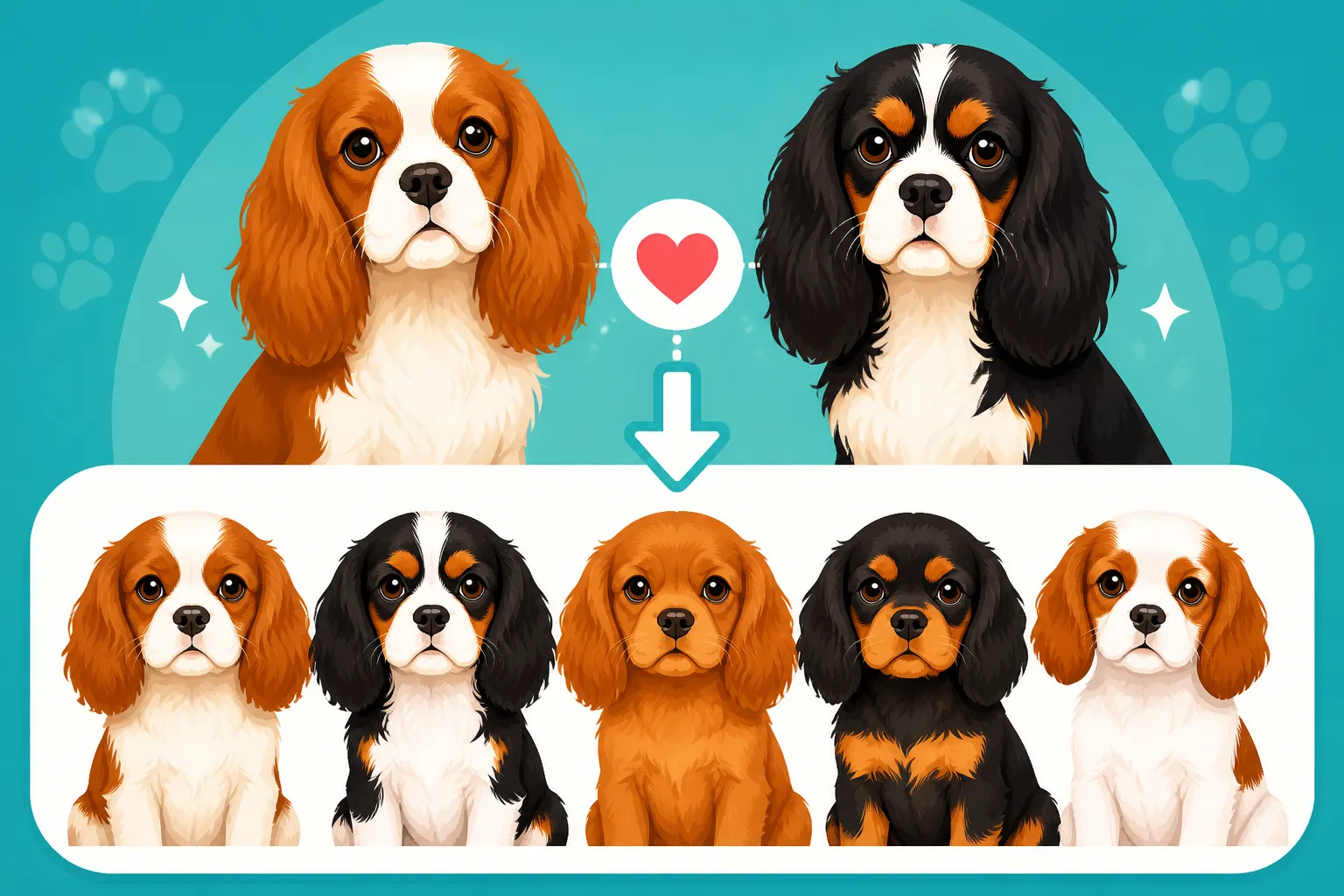
- Ruby x Black & Tan: This pairing is very common and can produce all four colors, especially if both parents are carriers of the parti-color gene (Ss). The presence of black (from the B&T) and red (from the Ruby) genes, along with the tan point gene (from the B&T), allows for a wide spectrum of possibilities. You could see Rubies, Black & Tans, Blenheims, and Tricolors! This is because the Black & Tan parent carries the gene for tan points, and if it also carries the recessive red gene (e) or the Ruby parent carries the dominant black gene (B), a variety of combinations become possible.
Parti-Color x Whole Color Pairings
These pairings almost always result in a mixed litter, which can be very exciting!
- Blenheim x Ruby:
- If the Ruby parent is a pure whole color (SS), all puppies will be whole colors (Rubies) but will all carry the parti-color gene (Ss). They won't show white, but they'll be able to produce parti-colored puppies later if bred to another carrier or a parti-color.
- If the Ruby parent is a carrier of parti-color (Ss), you will get a mix of Ruby (whole color, SS or Ss) and Blenheim (parti-color, ss) puppies.
- Blenheim x Black & Tan:
- If the Black & Tan parent is a pure whole color (SS), all puppies will be whole colors. They will be Black & Tans, but will all carry the parti-color gene (Ss). They will also carry genes for both black and tan points.
- If the Black & Tan parent is a carrier (Ss), you will get a mix of Black & Tan (whole color, SS or Ss) and Tricolor (parti-color, ss) puppies. The Blenheim parent provides the 's' for parti-color, and the Black & Tan provides the black and tan point genes.
- Tricolor x Ruby:
- If the Ruby is SS, all puppies will be whole colors (Ss). These could be Rubies or Black & Tans, depending on the black/tan point genes from the Tricolor. They will all carry the parti-color gene.
- If the Ruby is Ss, you can get a mixture of whole colors (Rubies or Black & Tans) and parti-colors (Blenheims or Tricolors). The combinations here become quite broad due to the mix of black, red, and tan point genes, plus the whole/parti possibility.
This table provides a simplified overview of expected outcomes for common pairings, assuming both parents are health-tested and clear of genetic issues. For specific predictions, a genetic color panel from a reputable lab is invaluable.
| Parent 1 Color | Parent 2 Color | Possible Puppy Colors (assuming parents' full genetic potential) | Key Genetic Factors at Play |
|---|---|---|---|
| Blenheim (ss, ee) | Blenheim (ss, ee) | Blenheim | Only parti-color and red pigment genes present. |
| Tricolor (ss, B_, atat) | Tricolor (ss, B_, atat) | Tricolor | Only parti-color and black/tan pigment genes present. |
| Ruby (S_ee) | Ruby (S_ee) | Ruby, Blenheim (if both S_ are Ss carriers) | Depends on whether whole color parents carry recessive parti-color gene. |
| Black & Tan (S_B_atat) | Black & Tan (S_B_atat) | Black & Tan, Tricolor (if both S_ are Ss carriers) | Depends on whether whole color parents carry recessive parti-color gene. |
| Blenheim (ss, ee) | Ruby (S_ee) | Ruby, Blenheim (if Ruby is Ss carrier) | Mix of whole/parti, red pigment focus. |
| Blenheim (ss, ee) | Black & Tan (S_B_atat) | Black & Tan, Tricolor (if B&T is Ss carrier) | Mix of whole/parti, black pigment and tan points. |
| Tricolor (ss, B_, atat) | Ruby (S_ee) | Ruby, Black & Tan, Blenheim, Tricolor (if Ruby is Ss carrier) | Most variable; mix of whole/parti, black/red pigment, tan points. |
This table only considers the main color genes. Other modifying genes can slightly influence the shade or intensity of the color, but these are the primary drivers of the four recognized Cavalier colors.
Beyond the Standard: What Else to Know About Cavalier Color Expression
While the four recognized colors cover most Cavaliers, there are other nuances and factors that can influence how a coat looks, or even introduce colors not officially acknowledged by the breed standard. It’s important for prospective owners to understand that a puppy’s color can sometimes shift a little as they mature, and to appreciate the diversity within the breed.
Fading and Changes in Coat Intensity
One common observation is that a Cavalier's coat color can change in intensity as they age. A vibrant Ruby puppy might soften to a lighter chestnut red, or a deep Black & Tan might develop a slightly less intense tan. Environmental factors, sun exposure, and even diet can play a small role, but genetics are primarily at play. For instance, the genes that control the intensity of red pigment can vary. Some Cavaliers might inherit genes that cause their red pigment to "fade" over time, appearing lighter than their puppy coat. This isn't usually a cause for concern; it's just part of how their unique genetic blueprint expresses itself. Whether a Cavalier Puppy's Color Changes discusses these shifts in more detail.
When you're choosing a puppy, especially a Ruby or Black & Tan, it's a good idea to look at the parents if possible. Their adult coat color can give you a hint about how intense your puppy's color might remain. Don't be too surprised if that deep, rich ruby puppy softens a bit over the first couple of years – it's a natural process for many of them.
Unrecognized Colors and "Phantom" Carriers
Sometimes, you might hear about or even see Cavaliers with colors not officially recognized by the breed standard, such as solid black, solid white, or even "dilute" colors like blue or lilac. These colors are usually the result of specific recessive genes that are present in some lines but are not considered standard. For example, a solid black Cavalier would typically be a whole-colored dog that carries two copies of a gene that prevents any tan points or red pigment from showing. These colors are not bred for by reputable breeders adhering to the standard, but they do sometimes appear.
It's also worth noting the concept of a "phantom" carrier. This refers to a whole-colored Cavalier (like a Ruby or Black & Tan) that carries the recessive parti-color gene ('s'). They look solid, but can produce parti-colored puppies if bred to another carrier or a parti-colored dog. Genetic testing can reveal if a dog is a phantom carrier, which is crucial for breeders who want to predict their litters accurately. When considering a puppy from a breeder, asking about genetic color panels can be very insightful. You can often find useful products for Cavalier care, including grooming supplies that cater to various coat types, on sites like Chewy, no matter what color your dog turns out to be. Cavalier Colors That Are Not Recognized further explores these genetic variations.
The Importance of Health Over Hue
While it's absolutely fine to have a favorite Cavalier color, it's crucial to prioritize health and temperament above all else. A puppy's color is a lovely characteristic, but it pales in comparison to a healthy dog with a loving disposition. Reputable breeders focus on breeding healthy dogs that conform to the breed standard in terms of temperament and structure, with color being a secondary consideration that falls within the established parameters.
When looking for a Cavalier puppy, always prioritize a breeder who conducts thorough health testing on their breeding dogs, particularly for common Cavalier ailments like heart disease, syringomyelia, and eye conditions. Ask to see health clearances for the parents and inquire about their breeding protocols. A beautiful coat color is wonderful, but a long, healthy life with your Cavalier is priceless. Remember to also stock up on essentials like high-quality food and engaging toys from places like Chewy, ensuring your new family member has everything they need for a happy, healthy start. The Heart Testing a Cavalier Breeder Must Do and Getting a Cavalier Scanned for Syringomyelia are vital resources for understanding these health considerations.
Ultimately, the genetics of Cavalier coat colors are a fascinating aspect of the breed. By understanding how these genes interact, you can better appreciate the variety and beauty within each litter. Whether you end up with a Blenheim, Tricolor, Ruby, or Black & Tan, each Cavalier carries a unique genetic story expressed in their beautiful coat.
Disclaimer
This article is for general informational purposes only and does not constitute professional advice. Laws, prices and regulations vary by location and change over time. Consult a qualified professional for guidance on your specific situation.