Whether a Whistle Works on a Cavalier
Oh, the age-old quest for that perfectly reliable recall! If you're anything like me, you've probably stood in a park, calling your adorable Cavalier's name repeatedly, only for them to give you a fleeting glance before continuing their important sniff-mission. It's frustrating, and sometimes, it can be genuinely terrifying when they wander too far. This guide is all about tackling that common problem, specifically exploring whether a simple whistle can actually transform your Cavalier's recall and bring you some much-needed peace of mind during your outings.
The Appeal of Whistle Training for Cavaliers
Let's face it, Cavaliers are charming, affectionate, and utterly devoted… indoors. Outdoors, however, their spaniel heritage often kicks in, and suddenly, that deep bond can feel a little, shall we say, flexible. It’s a common scenario for Cavalier owners, and it leads many of us to seek alternatives to traditional voice commands.
Why Traditional Voice Commands Can Fall Short
We love our Cavaliers, and we speak to them constantly, often in varying tones depending on our mood, the situation, or simply how cute they're being. This variability, while natural for human-dog interaction, can actually make our voice commands less effective, especially for crucial behaviors like recall. Imagine you're at the park, and your Cavalier, utterly engrossed in tracking a particularly interesting scent left by another dog, suddenly appears deaf to your increasingly panicked "COME!" Your voice might be tinged with anxiety, or even a hint of anger, which your sensitive Cavalier picks up on, making them less likely to want to approach.
The human voice also has its limits. Wind, traffic noise, children playing, or even just distance can easily drown out your voice. And let's not forget the sheer number of times we use our Cavalier's name throughout the day for mundane things – "Buddy, stop chewing that!" or "Daisy, do you want a treat?" – which can dilute the urgency of a recall command. For a breed that thrives on consistency and positive reinforcement, inconsistent vocal cues can be a real hurdle.
The Unique Benefits a Whistle Offers
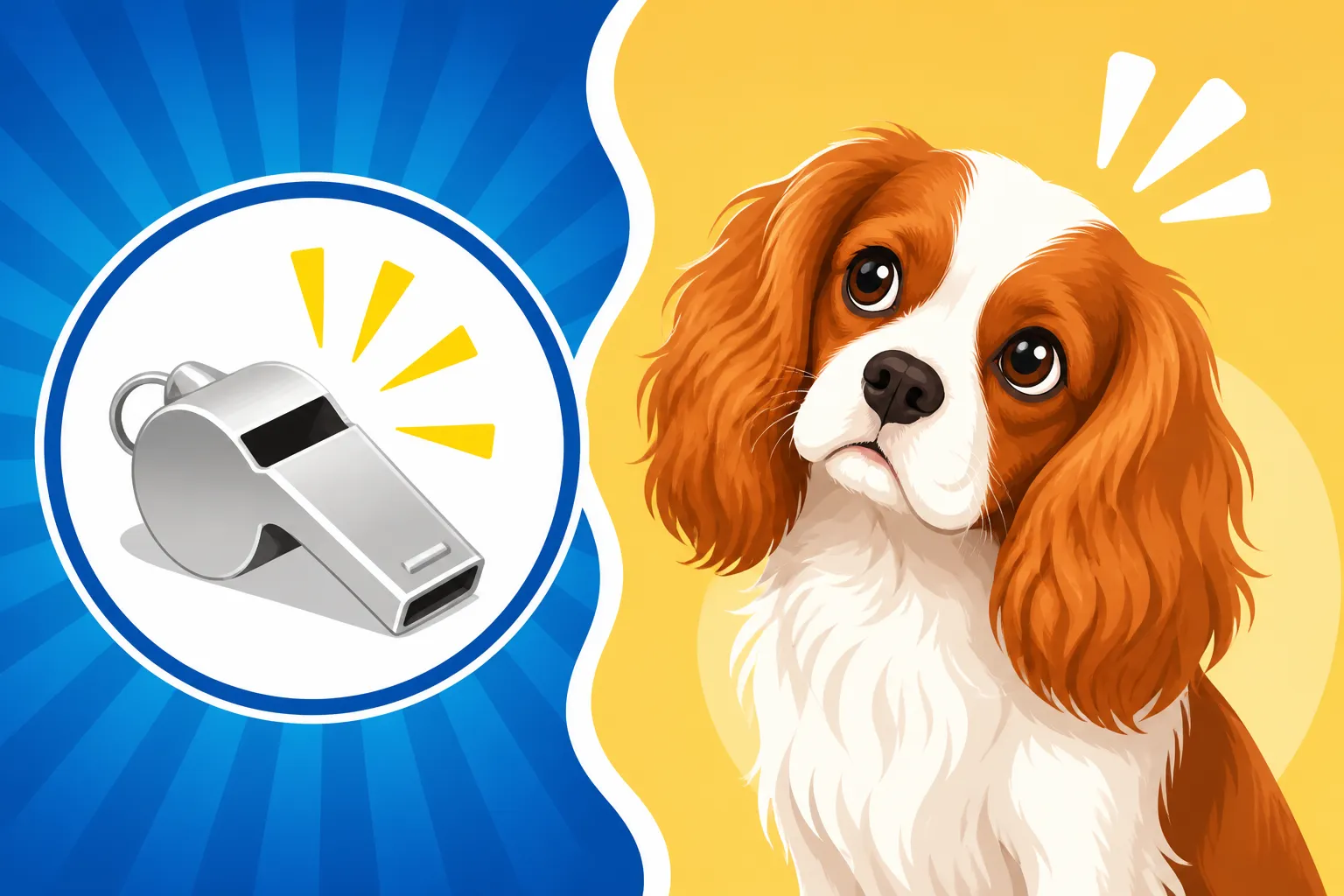
This is where a whistle can become your secret weapon. Unlike your voice, a dog whistle produces a sound that is incredibly consistent in pitch and volume every single time. It cuts through environmental noise in a way a human voice simply can't, making it audible over much longer distances. Think about it: whether you're calm, stressed, or exhilarated, the whistle sounds exactly the same. This eliminates the emotional variability that can confuse a Cavalier and ensures clarity in communication.
Furthermore, a whistle is often associated exclusively with training or specific commands, unlike a dog's name which gets used in a multitude of contexts. This focused association helps your Cavalier understand instantly that a specific action is required. For us, it means less shouting and more effective communication, leading to a much more harmonious and safer outdoor experience. For a dog that might tune out repeated vocal commands, a distinct, consistent whistle can be a game-changer.
Understanding Your Cavalier's Hearing and Instincts
Before diving into how to use a whistle, it's really helpful to understand your Cavalier from the inside out. They might be small, but they're packed with sensory abilities and ingrained behaviors that influence how they react to the world, and indeed, to your training.
How Cavaliers Perceive Sound
Cavaliers, like most dogs, have an impressive range of hearing, far superior to ours. They can detect higher frequencies and softer sounds. However, this doesn't mean they're always listening to what we want them to hear. Just because they can hear it doesn't mean they will respond to it, especially if they're focused on something far more interesting to their canine brain. They can be incredibly sensitive to harsh or sudden noises, sometimes startling or even becoming fearful. This is why a shrill, piercing whistle might not be the best choice initially.
The key is that while they have keen hearing, they also have the ability to filter out what they deem irrelevant. A consistent, distinct sound that you've conditioned to mean "return for reward" will bypass this filtering much more effectively than your voice, which is often just background noise in their busy world of smells and sights. We also need to be mindful of any underlying health issues, as Deafness and Hearing Loss in Cavaliers can impact their ability to hear the whistle effectively, making other training methods more suitable.
The Strong Spaniel Prey Drive
It's easy to forget that beneath that adorable, cuddly exterior, your Cavalier King Charles Spaniel carries the genes of centuries of working spaniels. They were bred to flush birds and small game, and those instincts are still very much alive, even if your Cavalier's hunting ground is limited to the local park. This means they often possess a surprisingly strong prey drive, especially for birds, squirrels, or anything that moves quickly. The Spaniel Instincts Left in a Cavalier are potent!
I've seen many a Cavalier owner gasp as their sweet, docile dog transforms into a determined, single-minded hunter, bolting after a pigeon across a busy street. This isn't disobedience; it's instinct. They're not being malicious; they're simply following their genetic programming. This is why a reliable recall, whether vocal or whistle-based, is not just about convenience – it's about safety. When a Cavalier is locked onto a target, like The Bird Chase a Cavalier Cannot Resist, their ability to process your voice commands plummets. A whistle, with its distinct and consistent sound, has a better chance of breaking that focus.
Practicalities of Whistle Training a Cavalier
Okay, so you're convinced a whistle could be the answer. Now, how do you actually make it work for your little shadow? It's not about blowing the whistle and magically expecting perfect recall; it's a process of careful conditioning and consistent practice.
Choosing the Right Whistle and Initial Setup
First things first, let's talk about the whistle itself. There are generally two main types of dog whistles: pea whistles and pea-less whistles. Pea whistles produce a trilling sound, while pea-less whistles offer a clear, single tone. Then there are "silent" or ultrasonic whistles, which produce frequencies mostly audible to dogs, but less so to humans. For a Cavalier, with their potential sensitivity to sound, I often recommend starting with a pea-less whistle that has an adjustable frequency, or even a simple plastic pea-less whistle. You want a clear, consistent sound that isn't overly harsh or startling. You can find a good variety on Amazon, allowing you to try a few until you find one that feels right for you and your dog.
Before you even think about blowing it, choose a quiet, low-distraction environment. Your living room, perhaps, or a very secure backyard. The goal at this stage is to create a strong, positive association with the whistle, free from any competing sights or sounds. You'll also want to have a stash of incredibly high-value treats – think tiny pieces of cooked chicken, cheese, or whatever your Cavalier goes absolutely bonkers for. These aren't your everyday kibble rewards; these are the "jackpot" treats.
Introducing the Whistle: A Step-by-Step Approach
The foundation of whistle training is classical conditioning, which means teaching your Cavalier that the sound of the whistle predicts something wonderful is about to happen. This is often called "charging the whistle."
- The "Blow and Treat" Game: With your Cavalier near you in a quiet room, give a short, consistent blast on the whistle (I recommend a single, quick toot, or two short toots – choose one and stick with it). The instant the sound stops, pop a high-value treat into their mouth. Don't wait for them to do anything; just blow, then treat.
- Repeat, Repeat, Repeat: Do this about 10-15 times in a session, then take a break. Repeat these sessions several times a day for a few days. The idea is to create an immediate, Pavlovian response: whistle sound = delicious food. You want them to hear the whistle and immediately think, "Where's my snack?!"
- No Commands Yet: Resist the urge to add "come" or any other verbal command at this stage. The whistle is a distinct cue on its own.
- Observe the Reaction: After a few days, you should notice your Cavalier's ears perk up or their head turn towards you expectantly the moment they hear the whistle. This tells you they've made the association.
This initial phase is all about positive reinforcement and building excitement around the whistle. Remember, Reward-Based Training With a Cavalier is the most effective way to build strong, lasting behaviors with this sensitive breed. Keep your sessions short and fun – think Five-Minute Training Sessions With a Cavalier to maintain their engagement.
Building a Reliable Recall with the Whistle
Once your Cavalier has that strong, positive association with the whistle, you can start to introduce it as a recall cue.
- Start Close: In your quiet, low-distraction area, move a few steps away from your Cavalier. Blow your chosen whistle signal. The moment they turn towards you or start to move in your direction, mark that behavior with a verbal "Yes!" or a clicker, and then reward them with a jackpot treat as they reach you.
- Gradually Increase Distance: Over subsequent sessions, slowly increase the distance between you and your Cavalier. Continue to blow the whistle, mark the immediate response, and reward generously when they reach you.
- Introduce Mild Distractions: Once they're reliably coming back from a distance in a quiet environment, it's time to introduce very mild distractions. This might be another person quietly sitting nearby, or a few toys scattered on the floor that aren't too exciting. Always set your Cavalier up for success by starting with easy distractions and rewarding heavily.
- Move to New Environments: Progress to more stimulating, but still secure, environments like a fenced yard or a quiet park on a long line. A good quality Long Line Practice for a Cavalier is invaluable here, allowing you to practice "off-leash" recall safely while maintaining control. This is a critical step in generalizing the behavior.
- Always Reward: This is the golden rule of recall. Every single time your Cavalier comes back when you blow the whistle, they must receive a high-value reward. Do not scold or punish if they take too long or get distracted; that only teaches them that coming back is sometimes a negative experience. Instead, make coming back the most wonderful thing in their world. You want them to come back quickly and happily, not slowly and hesitantly, which is often why Why a Cavalier Comes Back Slowly happens.
- Consistency is Key: Use the whistle only for recall, and always follow through with a reward. Avoid blowing it idly or when you can't guarantee a successful return and reward. Over time, your Cavalier will associate that specific whistle sound with the absolute best things happening, making their recall lightning-fast. For more structured guidance, training programs like those offered by BAXTER & Bella often incorporate various recall techniques that can be adapted for whistle training. They provide step-by-step video tutorials and support that can be really helpful for ensuring consistency and proper technique.
Common Challenges and Troubleshooting
Even with the best intentions, whistle training can present a few bumps in the road. Cavaliers, with their unique personalities, might react differently, and it’s important to know how to navigate these challenges.
Cavalier Indifference or Fear of the Whistle
What if your Cavalier just ignores the whistle, or worse, seems scared by it? This can be disheartening, but it's solvable!
- Too Loud or Too Sharp? If your Cavalier startles or hides, the whistle might be too shrill or too loud for their sensitive ears. Try a different type of whistle – maybe a lower frequency or a softer tone. If you're using an adjustable whistle, try a lower setting. You can also start by holding the whistle further away from their ears or even putting a piece of tape over the opening to slightly muffle the sound initially.
- Insufficient Reward: If they're indifferent, the rewards might not be high-value enough. Is that piece of kibble really worth interrupting their intense garden sniff-session? Probably not. Break out the cooked chicken, hot dogs, or whatever makes their eyes light up. The treat needs to be exciting enough to override whatever distraction they're currently focused on.
- Lack of Association: Have you "charged" the whistle enough? Go back to basics: blow the whistle, immediately deliver a treat, repeat many, many times in a quiet environment until you see that expectant response. Don't move on until this association is rock-solid.
Inconsistent Recall: Why It Happens
You've done the training, they're great in the garden, but then at the park, it's like the whistle doesn't exist. This inconsistency is maddening, and it’s typically due to a few common pitfalls:
- Too Much, Too Soon: You might have progressed to high-distraction environments before the recall was fully solid in lower-distraction settings. Go back a step or two. Ensure success in each stage before moving to the next.
- Inconsistent Rewards: Are you sometimes forgetting to reward them, or offering a lower-value treat when they eventually come back? Every single recall needs to be reinforced strongly, especially in the early stages. If you call them and don't reward, you're weakening the behavior.
- Making Yourself Boring: When you call your Cavalier, are you just standing there, arms crossed, waiting? Or are you getting excited, maybe even running backward a few steps to encourage them? You need to make coming to you the most exciting option available. If you're just standing there while there's a fascinating smell or another dog to play with, you've lost the battle.
- Environmental Overwhelm: Sometimes the environment is just too stimulating. A new dog park with dozens of unfamiliar smells and dogs might be overwhelming. Choose quieter times or smaller, less busy areas to practice. Remember, the goal is for your Cavalier to choose you over every other distraction, and that takes time and careful planning. This is often linked to the core issue of Cavalier Recall and Its Limits in highly stimulating environments.
Integrating Whistle Training with Other Commands
The whistle isn't meant to replace all your verbal commands; rather, it's a powerful addition to your communication toolkit. Think of it as a specialized tool for a specific, crucial job – recall.
You can still use your verbal "come" command, but now you have an extra layer of reliability. Some owners even pair the verbal cue with the whistle in the initial training stages ("Buddy, come!" whistle toot then treat) to strengthen both. However, once the whistle is well-established, many prefer to use it independently for those situations where vocal commands might fail.
You can also use different whistle patterns for different cues. For example, a single long blast for "stay," or three short toots for "here." Just ensure that each pattern is distinctly different and consistently associated with one command and one reward. The key is to keep it simple, consistent, and always positive.
The Long-Term Benefits for Cavalier Owners
Successfully whistle training your Cavalier isn't just about showing off; it's about a fundamental improvement in your shared life, leading to greater freedom and a stronger bond.
Enhanced Safety and Peace of Mind
This is, for many of us, the primary driver behind investing time and effort into a reliable recall. Cavaliers, for all their charm, can be surprisingly unaware of dangers like oncoming traffic or aggressive dogs. Their small size makes them particularly vulnerable. Imagine being able to confidently call your Cavalier back from chasing a squirrel near a busy road, or from interacting with an unknown dog whose body language is unclear. That feeling of control, born from effective communication, is truly invaluable.
With a solid whistle recall, you can potentially allow your Cavalier more freedom in safe, fenced areas, knowing you have a reliable way to get them back. This freedom to explore, sniff, and run builds their confidence and provides vital mental and physical enrichment. It mitigates the risk of Losing a Cavalier to Traffic and How It Happens, a truly heartbreaking scenario that many Cavalier owners fear.
Of course, it's essential to remember that Whether a Cavalier Can Ever Be Off Leash in all environments is a nuanced question, depending on local regulations, your dog's individual temperament, and the reliability of their training. But a strong whistle recall certainly opens up more possibilities for supervised off-leash enjoyment.
Strengthening Your Bond Through Training
Beyond the practical safety benefits, whistle training, like all positive reinforcement training, deepens the relationship you have with your Cavalier. When you use methods based on trust, clear communication, and generous rewards, your Cavalier learns that you are a source of good things, and that listening to you is always worthwhile.
Training a Cavalier With Praise Rather Than Pressure fosters a confident and happy dog, rather than one who is fearful or resentful of commands. Each successful recall, ending with a treat and enthusiastic praise, reinforces your bond. It's not just about teaching a command; it's about building a language that you both understand, fostering a partnership where your Cavalier chooses to engage with you. The consistency of the whistle helps create a clear, unambiguous connection, enhancing that feeling of mutual understanding that makes owning a Cavalier so special.
| Whistle Type | Sound Profile | Pros | Cons | Best For Cavalier? |
|---|---|---|---|---|
| Pea Whistle | Trilling, varied | Familiar, easy to produce a sound | Less consistent, can be too sharp | Perhaps not ideal initially; try others first. |
| Pea-less Whistle | Clear, single tone | Consistent sound, cuts through noise | Can still be loud if not adjustable | Good starting point, especially adjustable frequency. |
| Silent/Ultrasonic | High frequency, barely audible to humans | Less startling for sensitive dogs, long distance | Difficult for handler to verify sound, easy to misuse | Potentially useful once basic conditioning is solid, but harder to gauge. |
| Electronic Whistle | Multiple tones, consistent | Versatile with different sounds, consistent | Battery dependent, can be costly | Good for advanced training or specific needs if a traditional whistle isn't working. |
This table provides a quick overview, but personal preference and your dog's reaction should always guide your choice!
Disclaimer
This article is for general informational purposes only and does not constitute professional advice. Laws, prices and regulations vary by location and change over time. Consult a qualified professional for guidance on your specific situation.