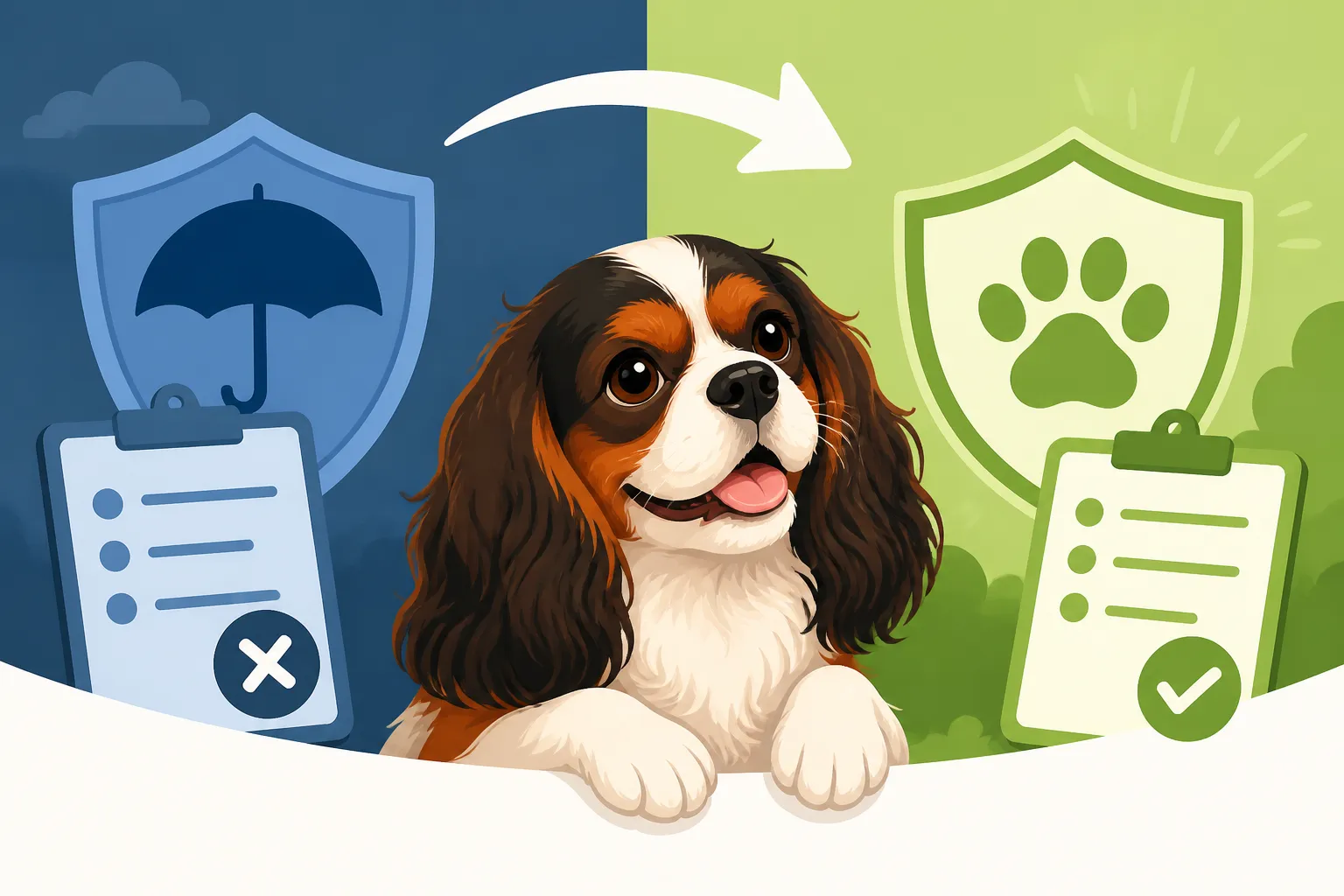
Switching Insurers With a Cavalier
It’s a scenario many Cavalier King Charles Spaniel owners know all too well: you’re paying for pet insurance, hoping for peace of mind, but then the premiums start climbing, or you find the coverage isn't quite what you expected. Contemplating a switch to a new insurer for your beloved Cavalier can feel like navigating a minefield, especially with their unique health vulnerabilities. This guide will help you understand the complexities of changing pet insurance providers, weighing the potential benefits against the significant risks involved for your furry family member.
Why You Might Be Thinking About Changing Your Cavalier's Insurance
Life with a Cavalier is full of joy, but also, for many of us, a quiet awareness of their breed-specific health challenges. When it comes to pet insurance, the calculus often changes over time. What felt like a good deal when your puppy was tiny can become a source of stress as they mature.
When Premiums Creep Up or Skyrocket
It's a common story in the pet insurance world: you sign up for a perfectly reasonable rate, and for a year or two, things seem steady. Then, with each passing year, that renewal notice arrives with a higher number. This isn't always about your specific claims history, though that can play a part. Premiums generally increase as your Cavalier ages, reflecting the higher likelihood of health issues in senior dogs. Insurers also adjust rates based on overall claims experience in your region or for the breed. What might have been an affordable monthly payment in their puppyhood can feel like a financial strain now, especially when you're already budgeting for What a Cavalier Costs a Year Before Any Heart Bills. You might start wondering if you could find a better deal elsewhere, prompting you to investigate other options.
Sometimes, a single large claim can trigger a significant premium increase, leaving you feeling penalized for using the very service you pay for. It’s a frustrating cycle where you need the insurance most after a diagnosis, but that diagnosis then impacts the affordability of your coverage. This is particularly poignant for Cavaliers, where a sudden illness or a developing chronic condition can lead to substantial veterinary bills, even if it's something routine like Cavalier Ear Infections and Why They Recur. The constant rise can make you feel trapped, debating whether to keep paying more or jump ship to an unknown policy.
Unhappy with Your Current Policy or Customer Service
Beyond cost, dissatisfaction with your current pet insurance provider often stems from the practical experience of actually using the policy. Perhaps you’ve had a claim denied that you felt should have been covered, leaving you with unexpected out-ofpocket expenses. The claims process itself might be cumbersome, slow, or require an unreasonable amount of documentation, adding stress to an already anxious time when your Cavalier isn't feeling well. Dealing with confusing explanations or unhelpful customer service representatives can quickly erode your trust and patience.
Maybe the policy limits themselves are proving insufficient. For example, if your Cavalier develops a serious condition like Mitral Valve Disease in the Cavalier King Charles Spaniel or Syringomyelia and Chiari Malformation in Cavaliers, the costs for diagnosis, medication, and ongoing care can be substantial. If your current policy has low annual limits or strict per-condition caps, you might find yourself hitting those limits quickly, negating much of the benefit of having insurance in the first place. You might start to feel like you're paying for protection that simply isn't robust enough for your Cavalier's potential needs, leading you to seek a provider that offers more comprehensive coverage or higher reimbursement rates, such as those you might find advertised by companies known for their extensive coverage, like Healthy Paws.
Spotting a Potentially Better Deal or More Comprehensive Coverage Elsewhere
The pet insurance market isn't static. New providers emerge, existing ones refine their plans, and innovative options become available. You might see advertising for a new company that boasts a simpler claims process, higher reimbursement percentages, or lower deductibles, all of which could sound incredibly appealing. Perhaps a new plan offers an unlimited annual payout, which is a huge draw for owners worried about the lifetime costs associated with chronic breed-specific diseases.
It’s also possible that you've simply become more educated about what to look for in a policy since you first enrolled. You might now understand the importance of things like dental coverage, rehabilitation therapy, or even alternative treatments, which your current policy either doesn't cover or only covers minimally. When you compare your existing plan to a shiny new offering, the perceived value gap can become significant. You might even discover that some providers offer discounts for multiple pets or for enrolling early in your Cavalier's life, though for an older dog, such discounts might be less impactful. The desire to secure the best possible care for your Cavalier without breaking the bank is a powerful motivator to explore your options.
The Giant Elephant in the Room: Pre-Existing Conditions
When considering switching pet insurers for your Cavalier, there's one monumental factor that overshadows almost everything else: pre-existing conditions. This is where the complexities of pet insurance truly hit home, especially for a breed with well-documented genetic predispositions.
Defining "Pre-Existing" for Your Cavalier
Every pet insurance company has its own specific definition of what constitutes a pre-existing condition, but generally, it refers to any illness, injury, or symptom that was observed, diagnosed, or treated by a veterinarian before your new policy's effective date or during its mandatory waiting period. The key here is "observed." Even if a formal diagnosis wasn't made, if a vet noted a symptom in your Cavalier's records – perhaps a cough, a limp, or a scratchy ear – and that symptom later leads to a diagnosis, it can often be flagged as pre-existing. This is particularly critical for Cavaliers, where seemingly innocuous signs can be early indicators of serious issues. For instance, a subtle change in temperament might precede A Cavalier That Snaps Because Its Neck Hurts due to Syringomyelia and Chiari Malformation in Cavaliers.
The implications of this definition are profound. If your Cavalier already has a documented heart murmur, for instance, even if it's currently asymptomatic, it's almost certainly going to be considered pre-existing by a new insurer. The same applies to conditions like patellar luxation if your vet noted A Cavalier That Skips on One Back Leg before you signed up for the new policy. Understanding every entry in your Cavalier's veterinary history is paramount, as new insurers will request these records and scrutinize them thoroughly to identify any potential pre-existing exclusions.
How Pre-Existing Conditions Impact New Coverage
Here's the stark reality: if your Cavalier has a pre-existing condition, a new pet insurance policy will almost certainly not cover it. This is not a malicious act by insurers; it's fundamental to how insurance works – it's designed to cover unforeseen events, not issues that already exist. This means if your Cavalier has a diagnosed heart murmur, any subsequent treatment for Mitral Valve Disease in the Cavalier King Charles Spaniel, including medication, specialist visits, or even potential surgery, would be entirely out-of-pocket if you switch to a new insurer that now deems it pre-existing.
Think about the most common Cavalier health concerns. If your dog already has a murmur, a new policy won't cover its progression or associated care. If Syringomyelia as a Pre-Existing Cavalier Condition has been diagnosed or even suspected and noted in records, the significant costs of MRIs, neurological consultations, and ongoing pain management medications like Gabapentin would be your responsibility. This is why the advice to enroll your Cavalier in pet insurance while they are still a young puppy, ideally before any symptoms appear, is so frequently given. Insuring a Cavalier Before the Murmur Arrives is a common strategy to ensure maximum coverage over their lifetime. The financial implications can be staggering, effectively nullifying much of the reason you might consider switching in the first place.
The "Curable" Condition and Look-Back Periods
While the general rule is that pre-existing conditions are excluded, there's a very narrow and specific exception that some (but not all) pet insurance policies offer: the "curable" pre-existing condition. This typically applies to acute issues that resolve completely and show no recurrence for a specified "look-back" period, often 6 to 12 months. For example, if your Cavalier had a single ear infection that was treated and has not recurred for over a year, a new insurer might consider it no longer pre-existing and cover future, unrelated ear infections. Similarly, a minor bout of kennel cough or a single urinary tract infection could potentially fall into this category.
However, it's crucial to understand that this "curable" clause very rarely applies to the chronic, genetic, or progressive conditions that are so prevalent in Cavaliers. A heart murmur, by its nature, is a symptom of a progressive disease, not a curable one. Neurological issues like syringomyelia are ongoing. Orthopedic problems like Loose Kneecaps in a Thirteen-Pound Cavalier are typically chronic. Therefore, while it's worth asking about look-back periods for specific, past, acute issues, do not rely on this clause to cover major breed-specific health challenges if they've already been diagnosed or exhibited symptoms. Always read the fine print very carefully and discuss specific conditions with the potential new insurer before making any decisions, as Claims Refused Because a Cavalier Murmur Predated Cover is a harsh reality for many.
Navigating the Switch: Steps and Considerations
Despite the significant hurdles posed by pre-existing conditions, some owners still find themselves needing or wanting to explore switching insurers. If you decide to go down this path, it requires meticulous research and a clear-eyed understanding of what you stand to gain and, more importantly, what you risk losing.
Doing Your Homework: Reviewing Your Cavalier's Vet Records
Before you even begin comparing new policies, the very first and most critical step is to obtain a complete, detailed copy of your Cavalier's veterinary medical history. This isn't just a casual glance; you need to thoroughly review every single entry. Look for every symptom noted, every diagnosis made, every medication prescribed, and every specialist referral. This includes even minor observations, like "slight cough noted," "limping after play," or "skin irritation on ear." Insurers will scrutinize these records to identify anything that could be flagged as a pre-existing condition, even if you never filed a claim for it with your previous provider.
Understanding this history allows you to anticipate what a new insurer will exclude. You'll have a much clearer picture of your Cavalier's health profile from their perspective. For instance, if you see multiple mentions of "heart murmur" starting at age three, you know unequivocally that this will be a pre-existing condition with any new insurer. This comprehensive review prepares you to ask targeted questions to potential new providers and helps you avoid nasty surprises later on. Knowing exactly what’s in those records is your best defense.
Getting Multiple Quotes and Asking the Hard Questions
Once you have a firm grasp of your Cavalier’s medical history, it's time to gather quotes from several different pet insurance providers. Don't just look at the premium price on the surface. Dig deep into the policy details. Focus specifically on the clauses related to pre-existing conditions, waiting periods, annual limits, deductibles, and reimbursement percentages. While getting quotes online can be a good starting point (many companies, like Healthy Paws, offer easy online quote tools), it is absolutely essential to call their customer service lines and speak to a representative directly.
Be completely transparent about your Cavalier's health history, especially any breed-specific conditions like heart murmurs, Episodic Falling Syndrome in a Cavalier, or signs of neurological issues. Ask explicit questions: "My Cavalier has a Grade 2 heart murmur diagnosed last year. Will a new policy cover any future treatment for MVD?" "He had an ear infection six months ago; would that be considered pre-existing if it recurs?" Get as much as you can in writing, or at least document the names of the representatives you speak with and the dates of your conversations. Pay close attention to What a Cavalier Policy Costs Monthly, and compare not just the premium, but also how it impacts your Choosing an Annual Limit for a Cavalier and Setting a Deductible Against Cavalier Heart Bills. This due diligence is crucial because what looks like a great price could come with significant exclusions.
Weighing the Benefits of Staying vs. Going
This step requires a cold, hard evaluation of your current situation versus a hypothetical new one. Create a comprehensive pro/con list, not just for the premium cost, but for the entire scope of coverage.
On the "stay" side, list:
- Existing conditions covered: This is typically the biggest advantage. If your Cavalier already has MVD, SM, or another chronic issue, your current policy is likely still covering it (assuming it wasn't pre-existing when you first enrolled). Losing this coverage could be catastrophic financially.
- Established relationship: You know the claims process, you know the customer service (for better or worse), and you don't have new waiting periods to contend with.
- Coverage for new, unrelated issues: Your current policy will cover any new health problems that arise, even if your Cavalier has existing conditions.
On the "go" side, list:
- Potential lower premiums: If you can find a significantly cheaper policy for the coverage you can get (i.e., excluding existing conditions).
- Better customer service or claims process: If your current experience is truly miserable.
- Improved coverage for future unknown issues: A new policy might offer higher limits or better reimbursement for completely new conditions that haven't yet manifested.
It’s often a difficult trade-off. Saving a few dollars a month on premiums might seem appealing, but if it means paying thousands out of pocket for a recurring or progressing pre-existing condition, it's a false economy. Remember that many Cavalier owners also buy prescription foods or supplements from retailers like Chewy or Ollie to manage health, and these costs are separate from insurance claims.
When Sticking with Your Current Insurer is the Best Bet
For many Cavalier owners, especially those with middle-aged or senior dogs, the decision to switch pet insurance ultimately leads back to the conclusion that staying put, despite rising costs, is the lesser of two evils. The security of known coverage often outweighs the allure of potential savings.
The Cost of Losing Existing Coverage
This is usually the most significant deterrent for switching. If your Cavalier has already been diagnosed with a heart murmur, or has shown neurological symptoms, or has developed any other chronic condition common to the breed, your current insurance policy is likely still covering those issues (assuming they weren't pre-existing when you first purchased the policy). The moment you switch insurers, those conditions immediately become pre-existing for the new provider and will be excluded from coverage. This means any and all future costs associated with that condition – medication, specialist visits, diagnostics, or even emergency care – will be entirely your financial responsibility.
Imagine your Cavalier has a heart murmur and is just starting on heart medications like Pimobendan. What Cavalier Heart Disease Costs to Treat can be substantial over their remaining years. If you switch insurers, you'd save on the premium, but then you'd be paying for those medications out of pocket every month, year after year, along with regular cardiologist visits and follow-up echocardiograms. The supposed savings on premiums would quickly be dwarfed by the direct cost of managing the pre-existing condition. It's a gamble that, for many, is simply too risky to take given the high probability of these conditions in Cavaliers.
The Peace of Mind of Continuous Protection
Beyond existing conditions, there's immense value in the continuous protection your current policy offers for new and unrelated health problems. Even if your Cavalier has a pre-existing heart condition, they could still develop cancer, suffer an unexpected injury, or contract an acute illness that is completely separate from their existing issues. With your current policy, these new problems would be covered, providing you with invaluable peace of mind.
If you switch, not only are existing conditions excluded, but you also face new waiting periods for accidents and illnesses with the new insurer. This means if something new happens during that waiting period, it won't be covered either. The financial and emotional stress of a sudden, severe illness or accident, coupled with the knowledge that you have no insurance coverage for it, can be overwhelming. Keeping your existing policy, even with its imperfections, ensures that your Cavalier is covered for the unexpected medical challenges that can arise at any age, providing a safety net for those costs that Budgeting a Cavalier From Puppy to Senior cannot fully predict.
Exploring Options to Reduce Current Policy Costs
Before making the drastic decision to switch and potentially lose crucial coverage, it’s always worth reaching out to your current insurer to discuss options for managing your premium. They may have ways to reduce your costs that you haven't considered. For example, you might be able to:
- Increase your deductible: A higher deductible means you pay more out of pocket before your insurance kicks in, but it usually results in a lower monthly premium.
- Lower your reimbursement rate: If your current policy reimburses 90% of eligible costs, you might consider dropping to 80% or 70% to reduce your premium. This means you'll pay a larger percentage of future bills, but your monthly outlay will be less.
- Change your annual limit: If your policy has a very high or unlimited annual payout, you might be able to choose a lower annual limit, which typically reduces the premium.
- Ask about loyalty discounts: Some insurers offer discounts for long-term customers. It never hurts to ask!
While these adjustments might not cut your premium in half, they can often make a noticeable difference, making your existing policy more manageable without sacrificing coverage for your Cavalier's known health issues. It's about finding a balance that ensures your beloved companion continues to receive the care they need, especially as they enter their senior years, where Pain Management for a Senior Cavalier and other specialized care become increasingly important.
| Factor to Consider | Staying with Current Insurer | Switching to a New Insurer |
|---|---|---|
| Pre-Existing Conditions | Covered (if not pre-existing at original enrollment) | Almost certainly not covered |
| Premiums | May increase over time, potentially negotiable | Could be lower initially, but consider exclusions |
| Waiting Periods | None (after initial enrollment period) | New waiting periods for accidents & illnesses |
| Coverage for New Issues | Full coverage for new, unrelated conditions | Full coverage for new, unrelated conditions (after waiting periods) |
| Customer Service | Known experience (good or bad) | Unknown experience, requires research |
| Policy Limits | Established limits, potentially adjustable | New limits and terms, requires careful comparison |
| Peace of Mind | High, knowing chronic issues are covered | Low for existing conditions, high for future new issues |
Disclaimer
This article is for general informational purposes only and does not constitute professional advice. Laws, prices and regulations vary by location and change over time. Consult a qualified professional for guidance on your specific situation.