Telling a Cavalier From an English Toy Spaniel
A Cavalier King Charles Spaniel and an English Toy Spaniel can look remarkably alike at first glance: both are small, silky-coated companions with long ears and soft, expressive eyes. The clearest clues are the shape of the head and muzzle, overall build, and breed-specific markings. This guide explains how to tell them apart without assuming that every dog fits the picture perfectly.
The clearest differences in appearance
Compare the head and muzzle first
The head is usually the easiest place to start. A Cavalier has a relatively flat skull and a muzzle that is more clearly defined and longer. Its face tends to look open and less compressed, with a gentle transition from forehead to muzzle. The Cavalier’s expression is often described as soft, but facial expression alone is subjective and can vary from dog to dog.
The English Toy Spaniel has a more domed, rounded skull and a shorter, broader muzzle. Its face looks more compact, with a more pronounced stop between the forehead and nose. The eyes are typically large and set prominently in the face, contributing to the breed’s distinctive rounded expression. That shorter face can make an English Toy Spaniel look quite different from a Cavalier once you compare them side by side.
A quick profile view can help. Look at the line from the top of the skull down to the nose: the Cavalier’s muzzle extends farther forward, while the English Toy Spaniel’s face is shorter and more turned up. These are general breed characteristics, not a diagnosis or a guarantee. Individual dogs may have features that are less pronounced, and grooming, age, weight, and camera angle can change how their faces appear.
For more on the Cavalier’s facial structure, see The Cavalier's Longer Muzzle and Flatter Skull. If a dog’s short face raises questions about breathing or heat tolerance, Whether a Cavalier Is a Brachycephalic Breed covers why head shape matters to everyday care.
Look at body size and proportions
Cavaliers are generally the taller, longer-bodied of the two breeds. They have a graceful outline, a level back, and a build that looks like a small spaniel rather than an especially compact toy dog. Their ears, chest, legs, and tail have silky feathering, but the overall impression is often of a little dog with roomier proportions.
English Toy Spaniels are usually more compact and square in appearance. Their bodies can look shorter and sturdier, with the head appearing large in proportion to the rest of the dog. That combination of a rounded head, short muzzle, and compact body makes them easy to distinguish from the longer-faced Cavalier once you know what to look for.
Size by itself is not a reliable identification test. Dogs can fall outside the typical impression because of age, body condition, sex, and individual variation. A Cavalier carrying extra weight may look stockier than expected, while a small English Toy Spaniel may seem delicate. When choosing equipment, measure the individual dog rather than relying on breed labels. For example, when comparing harnesses at Chewy or another retailer, check the dog’s chest and neck measurements against the sizing guide instead of guessing from appearance.
| Feature | Cavalier King Charles Spaniel | English Toy Spaniel |
|---|---|---|
| Skull | Relatively flat | Rounded and domed |
| Muzzle | Longer and more defined | Short, broad, and compact |
| Overall outline | Generally taller and longer | Generally more compact and square |
| Face impression | Open and spaniel-like | Rounded, with prominent eyes |
| Coat | Silky coat with feathering | Silky coat with feathering |
| Recognized colors | Blenheim, tricolor, ruby, and black and tan | King Charles, Prince Charles, Blenheim, and ruby |
Use coat color as a clue, not proof
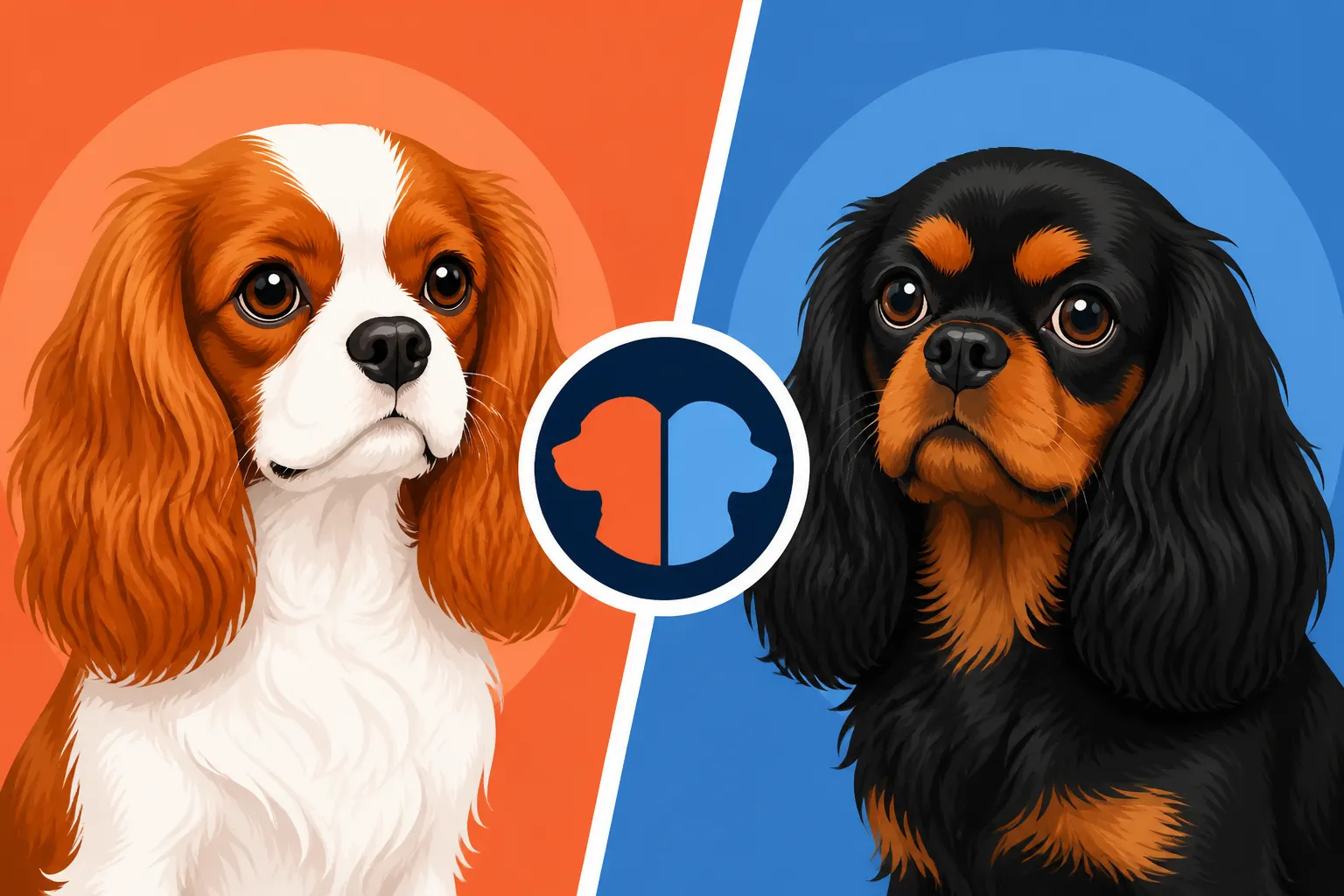
Both breeds come in four familiar color patterns, which is one reason people mistake them for one another. Cavaliers may be Blenheim, tricolor, ruby, or black and tan. English Toy Spaniel colors are commonly called King Charles, Prince Charles, Blenheim, and ruby. Some of the names overlap, while others refer to similar patterns using different breed-specific terminology.
A Blenheim in either breed has chestnut markings on a white ground. In Cavaliers, the chestnut and white pattern is especially familiar, and some dogs have a chestnut spot on the head called a lozenge. Tricolor dogs have black and white markings with tan points. Ruby dogs are predominantly rich red, while black and tan dogs have black coats with tan markings.
Because the patterns can look alike, color is best used alongside head shape and body proportions. A chestnut-and-white dog is not automatically a Cavalier, and a black-and-tan coat does not settle the question either. If you are comparing a puppy, adult coat color may also shift somewhat as the coat develops. The Four Cavalier Colors and What They Are Called explains Cavalier color terminology, while The Blenheim Cavalier and Its Lozenge looks more closely at the Blenheim pattern.
Breed history and temperament
Why the two breeds have similar names and looks
The breeds share a historical connection, which helps explain their resemblance. In Britain, the name King Charles Spaniel refers to the breed known in the United States as the English Toy Spaniel. The Cavalier King Charles Spaniel developed from the same broader tradition of small companion spaniels, but it became a distinct breed with a different head shape and body outline.
The Cavalier’s modern revival was linked to efforts to bring back the longer-muzzled, flatter-headed type seen in older depictions of these spaniels. Over time, the Cavalier and English Toy Spaniel became separate breeds rather than two names for the same dog. Their shared history remains visible in their size, drop ears, silky coats, and companion-dog roles.
That history can make online searches confusing. A reference to “King Charles Spaniel” may mean the English Toy Spaniel, particularly in British contexts, while “Cavalier King Charles Spaniel” identifies the longer-faced breed. If you are looking at pedigrees, rescue records, or breed descriptions, check the full breed name rather than assuming the terms are interchangeable. Why the Cavalier Split From the King Charles Spaniel offers more background on how the breeds came to be distinct.
What their personalities may have in common
Both breeds are companion dogs, and many enjoy close contact with their people. A Cavalier may follow a family member from room to room, settle beside someone on the sofa, or greet visitors with enthusiasm. English Toy Spaniels are also often affectionate and people-oriented, though individual dogs may be more reserved or more independent than the breed stereotype suggests.
Neither breed’s reputation tells you exactly how a particular dog will behave. Early experiences, socialization, health, training, and the dog’s own temperament all matter. A shy English Toy Spaniel may need more time to warm up to new people, while a confident Cavalier may be delighted to meet nearly everyone. Meeting the adult dog or observing a puppy with its litter can provide more useful information than relying on a breed description alone.
Their small size does not mean they have no needs. Both benefit from kind, consistent training, regular grooming, thoughtful exercise, and a predictable routine. If you are weighing whether a Cavalier’s social nature fits your home, Cavalier Temperament and the Sporting Spaniel Beneath It discusses the breed’s companion traits and spaniel instincts. For households considering a Cavalier as a first dog, Whether a Cavalier Is an Easy First Dog explores practical considerations beyond appearance.
Health and everyday care differences
Do not assume one breed is healthier
A familiar mistake is to decide that one breed must be healthier because it looks less extreme or is less commonly discussed. Appearance alone cannot tell you an individual dog’s health, and neither breed should be treated as automatically problem-free. Ask about the dog’s veterinary history, family health, screening, and any symptoms that need follow-up.
Cavaliers are particularly known for mitral valve disease, a progressive heart condition, and they can also be affected by neurological problems such as syringomyelia. These concerns make responsible breeding practices and ongoing veterinary care important topics for anyone considering a Cavalier. Mitral Valve Disease in the Cavalier King Charles Spaniel provides an in-depth overview, and Syringomyelia and Chiari Malformation in Cavaliers explains another condition prospective owners may want to understand.
English Toy Spaniels have their own health considerations, and a short muzzle and prominent eyes can influence the care questions worth asking. The right approach is not to rank the breeds by a simple healthy-versus-unhealthy label. Instead, ask for relevant health records, discuss the individual dog with a veterinarian, and look for a breeder or rescue organization that is open about known health issues. A puppy’s appearance or a reassuring conversation cannot replace appropriate documentation and veterinary assessment.
Grooming, equipment, and home routines
The coats of both breeds need regular attention. Feathering can tangle behind the ears, under the legs, and around the chest, especially if a dog is walked through wet grass or brush. Gentle brushing and checking for mats are more comfortable than waiting until tangles tighten. If you are comparing coat-care tools at Chewy, choose tools suited to the dog’s coat and use them gently; a painful tug can make a dog wary of grooming.
Ears deserve routine checks, too. Drop ears can hold warmth and moisture, so notice changes such as persistent odor, redness, discharge, or repeated head shaking. Avoid pushing cotton swabs into the ear canal. If you are unsure how to clean the ears, ask a veterinary professional to show you what is appropriate for your dog. Cavalier Ear Care Under a Heavy Drop Ear explains the routine in more detail.
A dog’s proportions can also affect how comfortable everyday equipment feels. A compact English Toy Spaniel and a longer-bodied Cavalier may not fit the same harness or bed in the same way, even if their weights seem similar. When browsing beds at Chewy, measure the dog while lying down and compare those measurements with the product’s dimensions. For either breed, comfort and safe fit matter more than a label that says the item is intended for a particular small breed.
How to identify a dog with confidence
Use a simple comparison checklist
When you meet a dog, look at the whole picture rather than focusing on one feature. Start with the skull and muzzle, then compare body proportions, and finally consider coat color. If the dog is moving, notice whether its outline looks longer and more spaniel-like or shorter and more compact. Use these clues together; a single trait can be misleading.
A practical order is:
- Check the muzzle: A longer, more defined muzzle points toward a Cavalier; a very short, broad muzzle and rounded head point toward an English Toy Spaniel.
- Look at the body: A taller, longer outline is more typical of a Cavalier; a compact, square outline is more typical of an English Toy Spaniel.
- Treat coat color as supporting evidence: Similar patterns occur in both breeds, and color names can differ.
- Confirm the recorded breed: Ask for adoption or pedigree records, and clarify whether “King Charles Spaniel” means English Toy Spaniel in the source you are reading.
- Ask about health and care: Request veterinary information and discuss any concerns with a veterinarian rather than trying to infer health from appearance.
If you are choosing a puppy, avoid making a decision based only on a photograph. A close-up can hide body proportions, and lighting may alter how coat markings appear. Ask to see the puppy standing and moving, meet the parents when possible, and review the health information provided by the breeder. How to Judge Whether a Cavalier Breeder Is Serious and Reading a Cavalier Puppy's Health Certificates can help you prepare useful questions.
When appearance is not enough
Some dogs have mixed ancestry, incomplete records, or features that do not closely match either breed’s standard. Rescue dogs may be listed under a likely breed based on appearance, and that description can be an informed estimate rather than a documented pedigree. A dog can still be a wonderful companion without a perfectly certain breed label.
If breed identification matters for registration, breeding, or a formal event, use recognized documentation and the relevant breed organization’s guidance. For everyday ownership, the more useful questions are often practical: What does this dog enjoy? What grooming will it tolerate? Does it have any health concerns? How does it behave around children, other dogs, or visitors? Those answers help you care for the individual dog in front of you.
Whether the dog is a Cavalier or an English Toy Spaniel, its needs deserve attention beyond its looks. Learn its routines, keep up with veterinary care, and make choices based on its build and temperament. A gentle, well-matched home matters far more than getting every breed clue right at first glance.
Disclaimer
This article is for general informational purposes only and does not constitute professional advice. Laws, prices and regulations vary by location and change over time. Consult a qualified professional for guidance on your specific situation.