Whether the Cavalier Can Be Bred Back to Health
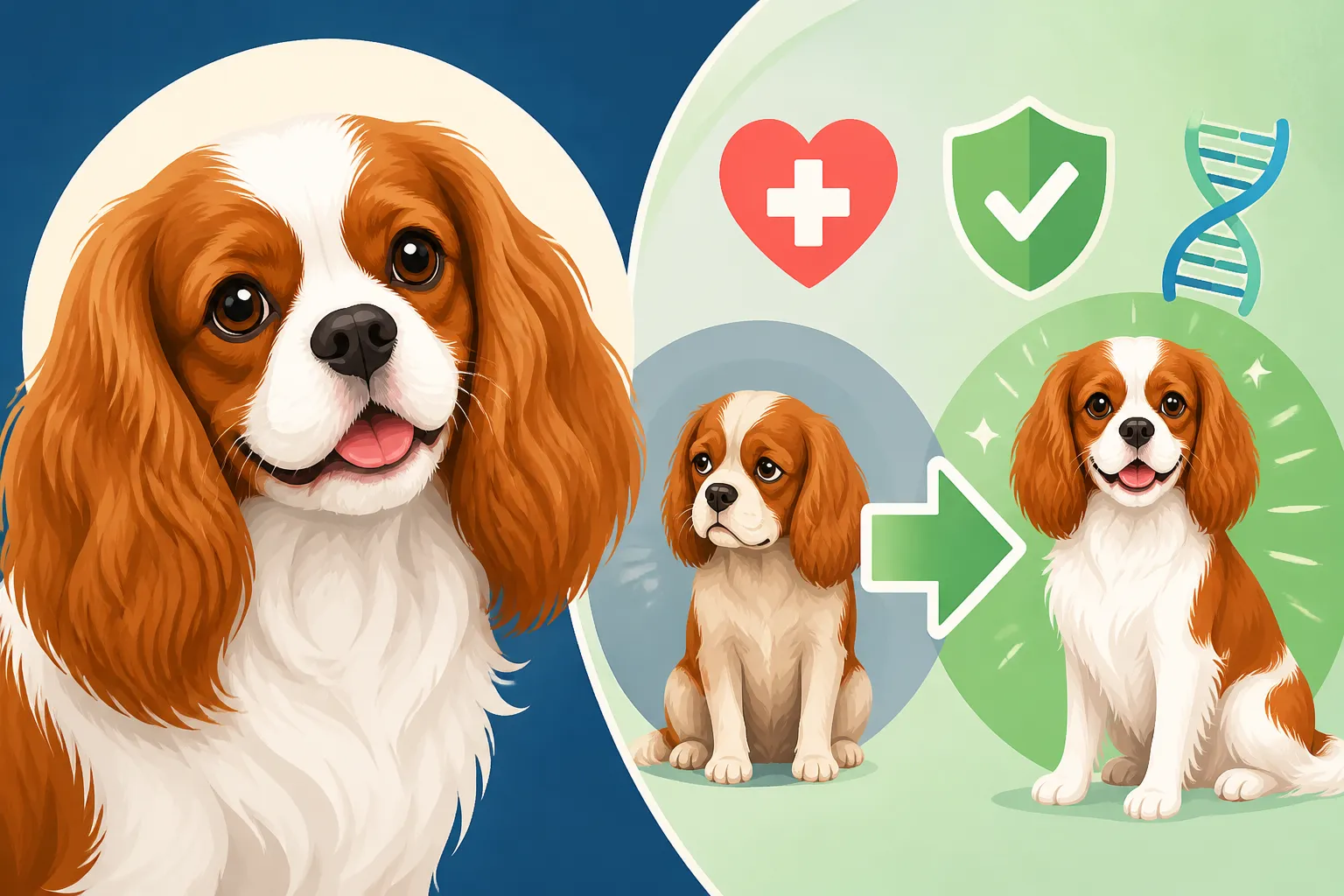
A Cavalier can be bred toward better health, but there is no quick genetic reset or single test that makes a litter risk-free. The hard part is that some major problems, especially mitral valve disease, may emerge later in life, after a dog has already been bred. This guide explains what responsible improvement can involve, what it cannot promise, and how to assess claims about healthier Cavaliers.
What breeding Cavaliers back to health really means
Health improvement is gradual, not a one-generation fix
“Bred back to health” can sound as if breeders can simply choose healthy parents and reliably produce healthy puppies. In reality, health improvement is a long-term population effort. It means identifying inherited risks, making careful breeding decisions, and tracking the health of dogs and their relatives over time—not assuming that a dog with no visible symptoms is free of inherited disease.
A healthy-looking Cavalier can still carry genetic risk or develop a condition later. That matters especially for diseases with a late onset, where a dog may have had puppies before signs appeared. Even when a breeder makes thoughtful choices, puppies inherit a mix of traits from both sides of their family, and the results cannot be guaranteed for every individual.
The aim is therefore to reduce risk across generations while preserving the breed’s genetic health and the qualities that make Cavaliers recognizable. That is different from promising a disease-free puppy. For a wider look at the difficult trade-offs behind this work, see The Health Debate Around Breeding Cavaliers.
Some health problems are easier to screen for than others
Cavaliers face several inherited health concerns, but they do not all behave the same way. Mitral valve disease, or MVD, is a major concern because it can develop as dogs age and is not captured by a simple DNA test that predicts every affected dog. Screening a breeding dog’s heart is useful, but a normal examination at one point in time does not guarantee that the dog will never develop disease.
Syringomyelia and Chiari-like malformation also require care when discussing inherited risk. MRI can show anatomical findings, but a scan is not a crystal ball: findings do not always predict how much pain or disability a dog will experience. Breeders need to interpret results alongside symptoms, family history, and other health information.
Other conditions can be more straightforward to test for genetically. DNA testing can identify known variants associated with conditions such as episodic falling syndrome and dry eye and curly coat syndrome. Those results help guide responsible pairings, but they do not replace heart screening, neurological assessment, or routine veterinary care. The broader overview in The DNA Tests Every Cavalier Should Have explains why genetic results are only one part of the picture.
Breed health includes more than avoiding a diagnosis
A narrow focus on one disease can create unintended problems. If breeders select only a small number of dogs because they appear especially healthy, the gene pool may become less diverse. Reduced diversity can make it harder to manage other inherited risks and may increase the chance that harmful variants become concentrated in certain family lines.
Temperament, structure, fertility, and overall robustness also matter. A breeding program that improves one health measure but produces anxious, fragile, or poorly functioning dogs has not solved the broader problem. Responsible selection has to consider the whole dog and the long-term welfare of the population.
That is why health improvement is not just a matter of finding a perfect sire or dam. It calls for honest records, careful interpretation, cooperation among breeders, and willingness to revise decisions when new information about a family line emerges.
The main barriers to reducing Cavalier health risks
Mitral valve disease can appear after breeding age
MVD is one of the hardest challenges because a dog can seem well when young and still develop a murmur or more advanced disease later. A clear heart check is valuable evidence about the dog at that moment, but it cannot certify lifelong freedom from MVD. The age of the dog and the heart history of its relatives matter when assessing risk.
This is one reason age-based breeding recommendations are discussed in Cavalier breeding. Waiting longer can give more time for signs to become apparent, but waiting does not erase inherited risk, and recommendations can differ between organizations and regions. A responsible breeder should explain the approach they follow and show how it fits with the parents’ ages, examinations, and family histories. Read Why a Cavalier Should Not Be Bred Before Five for more on the reasoning behind waiting.
A breeder’s heart-testing process should be specific, not vague. Ask who performed the examination, when it took place, what the result was, and whether records are available. Learn what a thorough approach involves in The Heart Testing a Cavalier Breeder Must Do and The Cavalier Heart and MRI Papers to Ask For.
Family history is useful, but it can be incomplete
A family history helps reveal patterns that may not be visible in a puppy or its parents. If several close relatives developed heart disease at relatively young ages, that information deserves attention. But family records may be incomplete: relatives might have died without a formal diagnosis, moved away from the breeder, or simply stopped being followed after placement.
This means “the parents are healthy” is not a complete health assessment. Ask about grandparents, siblings, previous litters, and older relatives where information is available. A transparent breeder should be comfortable discussing both reassuring findings and known concerns. No family is guaranteed to be free of disease, and a clear answer should not require pretending otherwise.
It is also worth asking how the breeder follows up with puppy buyers. Long-term updates from owners can reveal health patterns that a breeder could not see at the time of sale. The information is most useful when breeders collect it consistently, rather than relying only on memorable stories or a few selected examples.
Screening has limits and needs proper interpretation
A list of tests is not automatically proof of a sound breeding program. Tests need to be appropriate to the condition, current enough to be meaningful, and interpreted by qualified veterinary professionals. A test result can also be misunderstood: an abnormal finding may not have the same significance in every dog, while a normal result may not rule out a condition that develops later.
For example, DNA testing is highly useful when a known disease-causing variant has been identified. But a clear result for one inherited condition says nothing by itself about MVD or MRI findings. Similarly, a heart examination is not a substitute for a DNA panel. Each tool answers a different question, and combining them gives a more useful picture than relying on one certificate.
If a breeder makes broad claims such as “fully health tested” or “clear of all Cavalier diseases,” ask what those phrases mean in practice. Request the names of the tests, the dates, the results, and the identity of the clinician or laboratory involved. A careful breeder should explain what the results can tell you—and what they cannot.
What responsible breeding and outcrossing can contribute
Select against risk without shrinking the gene pool carelessly
Breeders can use health records and test results to make lower-risk pairings. They can avoid repeating combinations associated with serious inherited problems, take family history into account, and monitor dogs as they age. Over time, this kind of selection may reduce the frequency or impact of some conditions.
But selection needs to balance health goals with genetic diversity. If every breeder uses the same small group of popular dogs, those dogs can contribute an outsized share of genes to later generations. That may look efficient in the short term, but it can narrow the population and spread less obvious inherited risks widely.
Good breeding decisions therefore involve comparing potential parents, not searching for a mythical perfect dog. A dog with a manageable risk in one area may still contribute valuable diversity and sound traits when paired thoughtfully. The goal is to make a responsible choice based on the best available evidence, not to treat any single dog as a complete solution.
Outcrossing may add diversity, but it is not an instant cure
Outcrossing means breeding a Cavalier to a dog from another breed or population to introduce genetic diversity, then making further breeding decisions over subsequent generations. In principle, this can introduce useful variation and may help reduce the concentration of certain inherited risks. It is a long-term strategy, not a shortcut that immediately creates a uniformly healthy Cavalier.
An outcross program needs clear goals, veterinary oversight, careful recordkeeping, and plans for evaluating later generations. Breeders must consider health, temperament, structure, and how traits are inherited across multiple generations. Puppies from an initial cross may not all have the appearance or characteristics expected of a Cavalier, and the health outcomes need to be assessed rather than assumed.
There can also be practical questions about registration, breeding rules, and how dogs from a program are incorporated into the wider population. Those questions need transparent answers before a program is presented as a solution. For context, Outcross Programs Aimed at Cavalier Health discusses why this approach attracts interest and why it requires careful planning.
Genetic diversity must be protected over generations
Breeding for health is not only about removing undesirable traits. It is also about keeping enough healthy variation in the population so breeders retain options in future generations. When a program excludes too many dogs or relies heavily on a small number of popular sires, it can make the breed’s overall gene pool more vulnerable.
A responsible program tracks relatedness and avoids treating one successful litter as proof that a breeding strategy works. It follows dogs over time, gathers health information from owners, and evaluates offspring as they mature. This takes patience. Results may be gradual, and a strategy may need adjustment as more evidence becomes available.
The central question is not simply whether a breeder supports “health breeding.” It is whether their decisions are documented, balanced, and designed to benefit the population beyond one litter. For more on the difficulty of reducing MVD specifically, see Whether Cavalier Heart Disease Can Be Bred Out.
How to assess a breeder’s health claims
Ask for records and clear explanations
Before joining a waiting list or bringing home a puppy, ask the breeder to explain the health testing for both parents. You are not being difficult by asking for documentation. You are trying to understand what is known about the dogs and the limits of that knowledge.
Useful questions include:
- Which examinations and DNA tests were completed for each parent?
- When were the examinations performed, and who performed them?
- Are the results available for me to review?
- What is known about heart, neurological, eye, and other health issues in close relatives?
- How does the breeder gather health updates from previous puppy buyers?
- What does the breeder do if a puppy later develops an inherited condition?
Listen for specific answers rather than polished assurances. “The parents have been tested” is less informative than a clear explanation of the tests, the dates, and the results. A breeder should also be willing to distinguish between a dog that has no current symptoms and a dog whose lifelong risk is known to be low.
A useful starting point for evaluating a breeder’s overall transparency is How to Judge Whether a Cavalier Breeder Is Serious. Health papers matter, but so do the breeder’s willingness to discuss limitations and their commitment to the dogs after they leave.
Recognize claims that sound too certain
Be cautious when someone promises that a puppy will never develop MVD, syringomyelia, or any other inherited condition. Responsible breeding can reduce risk, but it cannot predict every puppy’s future with certainty. A confident guarantee that overlooks late-onset disease or the limits of available testing should prompt more questions.
Also be wary of claims that a single DNA panel, a clear examination, or a “healthy line” proves that all important risks have been removed. Each result has a scope. Ask what condition it addresses and what other screening is done. If a breeder cannot explain how a test relates to a particular disease, the test list may be serving as reassurance rather than meaningful evidence.
The same caution applies to dramatic claims that a particular breeding method has solved the breed’s health problems. Long-term change requires evidence from multiple generations and dogs, including those that were not selected for breeding. Ask how outcomes are tracked and whether less favorable results are reported as openly as successful ones.
Plan for care as well as prevention
Even a carefully bred Cavalier needs ordinary veterinary care, ongoing observation, and a realistic plan for future health needs. Breeding practices can influence risk, but they do not replace examinations or treatment. If you bring home a puppy, arrange veterinary visits and ask your veterinarian what screening is appropriate as the dog grows.
Practical preparation matters, too. Keep health records in one place, note changes in breathing, stamina, movement, or behavior, and share relevant family history with your veterinary team. For routine nonmedical items such as food storage, grooming tools, or a properly sized harness, owners may use retailers such as Chewy; those purchases do not replace professional advice or health screening.
If medication is ever prescribed, follow the veterinarian’s instructions rather than choosing products or supplements based on a retailer listing. Chewy may be one place owners encounter pet-care supplies, but decisions about treatment, diet changes for a heart patient, and supplements belong in a conversation with the veterinarian. As a puppy settles into a home, Chewy can also be a source of ordinary care items, while the breeder’s records and the veterinary relationship remain central to health decisions.
Disclaimer
This article is for general informational purposes only and does not constitute professional advice. Laws, prices and regulations vary by location and change over time. Consult a qualified professional for guidance on your specific situation.